The Storytelling Divide

I was inspired by the extended conversation on Che Webster’s Roleplay Rescue with Anthony, aka ‘Runeslinger’, from Casting Shadows. I’m a regular listener to Che and recommend you check out his podcast here:

https://shows.acast.com/roleplayrescue

I’ll try to summarise the excellent conversation. The hobby has trended over many decades to be described as predominantly a structure to tell stories together. The touch points for this include the White Wolf storyteller games and Monte Cooke’s Cypher system. This narrative experience is seen as the primary goal for the process of play. We play to tell stories. The concern expressed in the podcast conversation is that roleplay game play is actually about other things, particularly the inhabiting of created characters, alternate antagonists and experiencing a believably constructed fantastical alternate world through their eyes. Story will, or course, inevitability emerge through the conversation and process of play, but this is different from the active and ongoing construction of either a predetermined fiction, or the managing of story beats to create a satisfying story. 

Is the older, perhaps more traditional, mode of play a dwindling twilight view of story as by-product, as opposed to the main product of the game? There is a pervasive caveat that much of this is about preference, style and a shifting perspective in styles of play that strengthens and enables a player to inhabit their character and live their life in the shoes of another. You will find a more structured view of the ‘story divide’ in Anthony’s blog:

https://castingshadowsblog.com/2025/05/31/the-accidental-lie-in-rpgs/

One of the great features of the conversation was the return to original sources, a choice selection of games over the years to investigate the language being used to describe what roleplaying, in the context of the roleplaying game book you were holding, was actually all about. Taking inspiration from this I decided to pick up FGU’s Chivalry and Sorcery 2nd edition boxed set from my shelves. The C&S text is a powerful pull for me personally. In the  rollercoaster of life, the text became a source of comfort when things were going through a difficult phase. Reading the game again brought a strong reverberation of the past and some appreciation of the intervening years.

So, heading back to a 1983 publication date, with already a corpus of text on the subject, how does C&S now describe a roleplaying game? Well, considerably different to the 1977 1st edition, as we now meet the ‘Gamemaster Storyteller’. This is chronologically well in advance of anything written in the White Wolf Storyteller games. Did the shift to RPGs being, principally, or even in principle, story telling exercises happen even earlier than supposed? Here are some short elements from the early C&S chapters ‘On Being a Gamemaster’. There is also a subsequent section entitled and On Being a Role Player’, however the balance of the text is weighted much more to the heavier role of Gamemaster.

A Gamemaster needs to be a:

  • Master of Rules –  know the game part, understand the book and house rules and apply them impartially and fairly. You have the final word.
  • Creator of Worlds – and make it fit for effective role play. It is a task that depends upon the imagination, expertise, intelligence, and plain common sense of the GameMaster.
  • Teacher and Advisor – your task is to instruct Players about your view of role playing so that they know how to play in your world. Present the world so the Players know how to deal with it. Instruct on the rules and any house rules and assist players if they have difficulties with a particular rule.
  • Storyteller – here it is… A fantasy role playing game is a akind of enactment of a heroic tale, and the GameMaster is the narrator who tells the story and keeps everything tied together. Players, who have excited imaginations, will add to the general outlines of the ‘story’ through role-playing their characters as the events unfold. The GameMaster will respond to play and modify the general story to match the effects the Players are having on the course of action. In short, you the GameMaster must be prepared to accept the fact that the Players are also ‘storytellers’ who can influence your own plans and ideas. course  
  • Role Player – breathe personalities into your NPCs. Without giving your NPCs a life of their own, then the whole activity is really a farce. Your NPCs gve you a chance to play characters. 
  • Bookkeeper and clean-up man – deal with detail so that everyone knows what is going on, moment by moment.

Put in dramatic terms, the Gamemaster is a combination Playwright / Director / Stage Manager / Producer / Actor. Put another, perhaps more frightening way, the Gamemaster is Fate, God and Everyone Else besides the Player Characters in the fantasy world. GameMastering is a great responsibility, but it is not as difficult a task as it appears if the Gamemaster knows the material, is organised, and has prepared himself beforehand. Indeed, it is an immensely satisfying experience.

Each of these sections are then given greater exposition, with a lot of interesting takes. The text is, of course, rooted in a slightly earlier age, but I think it does a good job of describing a trad GM who has ‘a sense of duty to their players’. After all, if you have 8-10 players, you really need a ‘Caller’ to stop there being so many voices all at once. Ah yes, them warr days.

The storyteller GM is what I recognise in most trad GMs for the past forty years. Apply the rules well, play the game, create a story structure, allow the players to respond and make their own stories, weave them together to create a shared narrative that arises out of collaborative play. If there is a divide, then my old favourite sits on the emergent side, where story is developed as play progresses, with as much emphasis on game and situational resolution for its own sake.

It was nice to go back to the text, though my initial excitement for something more radical wasn’t really there in the detail. I didn’t really think it would be. 

Is the term ‘storyteller’ and ‘storytelling’ misappropriated by modern texts? Do we actually all mean the same thing?Do those terms need to be ‘reclaimed’ for the more mainstream emergent story, the narrative created through character driven play, perhaps guided by adventure design, but diverging as the group create their own pathways? I’m not sure it does. The vast majority of my play experience of forty years has found us telling a story, it just generally formed as a byproduct of our chaotic play. The personal character arcs combined or clashed to give a group outcome. Some of our stories were better shaped than others, but they were all fun, because the play was the thing. 

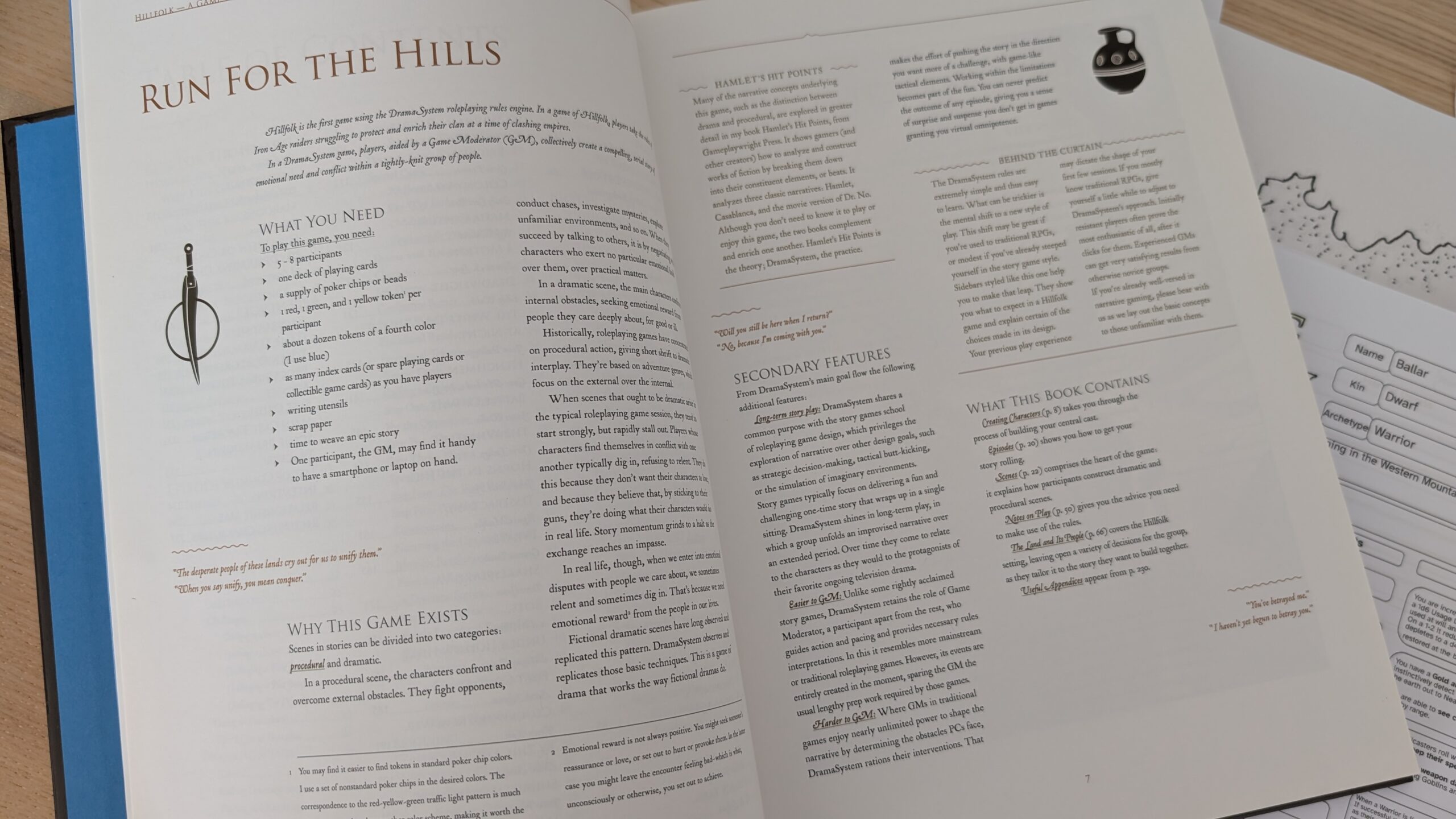
Not that there is anything wrong with a game that is more obviously designed so that a playing group can create a compelling story, sometimes within a set number of sessions, as the main artefact out of the experience. If that is what a ‘Story Game’ is, then even after all this time I have played very few. I have really enjoyed DramaSystem games ‘which privileges the exploration of narrative over other design goals..’. Even here, I have only played Hillfolk as one shots, where the game is actually designed to create an improvised narrative over longer form play.

Perhaps I am wary of the notion of a divide, because I have only played on one side of it, so that the apparent wall seems relatively inconsequential? Is the divide an ephemeral mist of loose taxonomy not actually carried through into actual play experience? Or, perhaps, even now, I need to get out more? Perhaps I need to run for the hills?
Posted in Games | 1 Comment

Classic Traveller – shrouded in nostalgia

The Traveller science fiction RPG was first published on 22nd July 1977, so my continuing forever game is soon to reach the important milestone of a 50th anniversary. I anticipate something of a formal celebration from the current publisher, Mongoose, and broadly across the Traveller playing community. I’m delighted to discover that an old University friend, who I have kept in touch with, and who used to run Traveller for me when it was taking its very early developmental steps in the early 1980s, is planning a celebratory anniversary weekend game for us, using the classic Traveller rules. I’m looking forward to it already! This has prompted me to return to the orignal text to remind me of the few minor differences between the original game and the iterations that I play today: the modern 2d6 system of Mongoose Traveller and Cepheus Engine.

I had one of those heart sinking moments when I realised that I could neither locate my original Starter

set or MegaTraveller books. After a plaintive search into the surface regions of my store cupboard, I had to accept that they have, at least for now, become lost in jumpspace. So, without batting an eyelid, I went onto DrivethruRPG and grabbed a copy of the Traveller Book, both in PDF and physical. This is the 1982 rendition of the game, which is drawn from the 1981 refresh of the original 1977 three little black book release. I think that will prove to be ‘classic enough’, and it will be great to have a physical copy on the table when we play. If I need to get down with 1977, with starship ranges in miles ratjher than kilometers, then electronic copies are available here. If you want to play along for free then there is the Facsimile Edition, which is a tidied up ‘1981 version’ of the three black books. A vast trove of Ancients artefacts are available at Far Future Enterprises. I may yet delve into the treasures, but for now I have what I need.

In the chasms of gaming time, I have allowed myself to forget how different ‘Classic Traveller’ is from the versions I play today. On reading the Traveller Book text, several key aspects immediately struck me, resonating with my resurging memories of the game I played back in the day. Here are my immediate reflections. 

Classic Traveller doesn’t have a standardised task system. Different modifiers and target numbers apply to each skill area. Jack of Trades provides an actual skill level in certain Referee controlled situations. As there is no unified task system, the effect of a character’s skill, or lack thereof, needs to be checked with the skill text. Attributes have different effects, or none at all, for each of the skill areas. I have played with unified systems for so long, I had forgotten that Classic played as it did. 

In the basic game, characters would muster out of their services with very few skills, taken from a much smaller skill list. The ‘Gun Combat’ skill is per weapon, though everyone gets the skill at zero. I remember the hilarity of starting an epic adventure with a character that had Admin-2 and Liaison-1 (and Gun Combat-0). 

Skill training is over a four year block, which provides a temporary level, only to be cemented over a further four year programme. Crikey.

Armour provided a minus modifier for a hit, with each type cross referenced with the weapon list to get the effect. In our early Traveller game we used elements of the seperate boxed Snapshot game for our personal combat. This seemed like a sophisicated upgrade even then. Although mechanically, the game plays out differently, the recognisable core delivers a deadly combat system that encourages other solutions to problems, or a swift return to the quickly generate a new character.

Having skimmed the original core game, I then poured through books 4 to 7, each of which significantly increase the skill totals for characters, and introduces additional skills, all of which are now standard in the later versions of the game. Instinctively we moved our games forward with the incremental releases of these books. We moved with Traveller as it developed. It remains a quetion to someone Refereeing a game of Classic Traveller, to check if they are using Mercenary, High Guard, Scouts and Merchant Prince. 

For me, this return to the original text reinforces the seminal importance of the release of Digest Group Publications’ ‘Universal Task Profile’ in 1985. I remember looking at this new standardised process for resolving tasks and immediately saw the profound benefit it would bring to the way the game plays. All subsequent versions of the 2d6 line of Traveller games use the principles of the UTP, helping to modernise the game, whilst keeping close to the core of the original text.

The UTP as adopted into MegaTraveller

Of course, the core of the beautiful game is all there in Classic Traveller, but I was surprised how different it felt, how early and formative, which of course it had to be. Classic is often touted as the simpler start to the game, and I found nothing in the original text that supported this notion.  Not that the game is complex to play, it just lacks the honed norms of more modern game design. Some will prefer Classic to the modern expressions, it is just a matter of taste. Whether you are playing Classic, MegaTraveller, T4 and 5, Cepheus or Mongoose Traveller, you are always recognisably playing Traveller, such is the strength of the core design and the clever adaptation over the years.

I’m currently enjoying Dom’s Mongoose Traveller Jägermeister Adventure, and will return to play the Drinax adventures in September. My forever game continues, whichever dice modifier or task profile used. The game ages better than a character on the ageing table, it has such good genes. As I commence my eleventh four year term around the sun, I reflect that I’m lucky to have found my forever game.

Posted in Games, Traveller | Leave a comment

LongCon – Tales from the Lone Lands

We had a fantastic weekend at LongCon this year. I just wanted to mark the Tales from the Lone Lands game we played with a few photos.

The core of the game was fully supported by the ‘Tales from the Lone Lands’ adventure book and of course the excellent ‘The One Ring 2nd Edition’ from Free league. As the game’s Loremaster I had all the material I could need to provide an exciting and strongly emblematic set of five sessions over the weekend. We played out the majority of scenarios 2-6 in our time together, paced to ensure a suitable climax that drew a satisfactory conclusion, tieing some of the threads together that had been hinted throughout. It was the quality of the core game and adventure book that persuaded me to offer to GM on this occasion, perhaps backed by my long adoration of Tolkien’s work.

A long preparation

Figures, Lore and Custom Dice Trays

The game also re-ignited my figure painting, picking up a series of excellent figures from Renown Gaming. Alex and Kari painted the heroes and 3D printed some amazing dice trays that really lifted the table presentation! I painted some of the orcs and other foes. Carmel painted a brilliant dragon, and Neil helped by providing a range of other figures that featured prominently in play.

Our session zero was conducted on Role.

An introduction and session zero on Role

I lost two players on the way to the event, which was a great shame, but that left a company of four to tackle the growing shadow in Eriadior.

Play at the table
We paced ourselves instinctively over the five weekend sessions. Focus was strong throughout and the game sessions were fun and engaging with excellent play from the ensemble.

The Heroes

We built a company for a while, to shape the weekend for each of us and play a good game. Although I was tired, I managed the format pretty well, which has encouraged me to offer again another year. It’s good to know that I still have the weekend marathon GMing in me! The weekend and game was made by the excellent play from each of us.

My favourite convention format, and one I will help to continue for years to come.
Posted in Conventions, TOR | Leave a comment

Half Way Around the Sun in 80 Games

We are half way around, already. Time to take a look at the gaming year so far and reflect a little on the games that are getting actual play, and those that I have poured the energy and joy into as a GM.

Here is the breakdown of my 87 games so far:

The larger numbered games reflect campaigns, some of which are ongoing. I’m having such fun with Warhammer Fantasy Roleplay 4th Edition, it’s a real gem. I’m playing in an ongoing campaign, which inspired me to take a look at the game in more detail, and there is a lot of detail. Though there is a lot of depth to the game, it lies beneath a clever and simple d100 test mechanic at the surface, all set in a rich and murky world, full of adventure. I’m now running The Enemy Within campaign, and have hit some convention high notes presenting one shots to people new to the game. I hope there will be much more play of this wonderful game.

My forever game is Traveller, so it is great to see it running high, mostly through campaign play. It just keeps delivering for me, and currently enjoying two very different campaigns, one from the Dungeon Muser and one from Dom. Those numbers will grow, and will include at least one Cepheus Universal game that I am planning for TravCon.
Simon’s Star Trek 2D20 has demonstrated a very good iteration of the Modiphius house system, in an authenticly delivered Trek setting. The tail end of my Trudvang Chronicles campaign account for the Dragonbane numbers, though it is so very good that I may well give it a run out during the latter part of the year. Currently, Dragonbane is acting as my BRP recovery, a return to my gaming youth with a slick modern coating.
The One Ring numbers have been bolstered by five sessions at LongCon, which I’ll write about elsewhere. What a stunning game, and so true to Tolkien’s work. We learned about the game as we played, and it came through very well. I wonder about the core Task Numbers a little and think taking 18 as the base rather than 20 would have been better, though we adjusted to that quite quickly, to no detriment to play. Further experience will hone my craft with that game.
Speaking of which, Fantasy Craft has been such incredible fun to play! I’ve bought into it, getting myself a first printing book and a clutch of PDFs. What is it about noughties games and me? Another of the 3.5 OGL innovative new games, occupying a similar start point as Green Ronin’s True20, a further gem that I would dearly pick up again. Fantasy Craft takes the 3.5 D20 engine and laces it with lots of new ideas. I’ll put something out about it elsewhere, but suffice to say that it provides some old school crunchy fun, with imaginative flair. The split between Vitality (a bit like D&D Hit Points, reflecting luck, energy, minor scrapes and lasting power), with Wounds, real deadly body strikes equal to your Con score, gives you a never quite safe feel to the game. I may have a go at running this game at the momentous Furnace XX convention. We’ll see.
I’m surprised that I gush over the 2009 Fantasy Craft, but not so much Shadow of the Weird Wizard (SOTWW). The game itself is fine and very well put together, as you would expect. Perhaps all F20 games are combat monsters, and SOTWW is certainly a fearsome beast ready, at all times, to slay. I may just have slightly overdosed on F20 combat games, and this very well designed new one, is yet another. I may come back to it with more enthusiasm.
The scattering of others reflect short  series and convention one shots. It’s particularly gratifying to see Fading Suns 4th Edition in there. It’s a terrific game if a little heavy or, perhaps, fiddly. There are a couple of areas that I will either revisit or build out myself, in the hope that I can find another opening for the game. It deserves some more play. My own Black Hack based ‘Heroic Fantasy’ is getting some love. It’s such fun to run, whilst now collating some notes for a future unencumbering expansion to it.
In my social media identifier as ‘First Age’, I speculated about what 2025 might bring. I kind of love that I didn’t see so much of what has now happened in my gaming life in such a short period. There are gems in those predictions that I’d still like to happen, so we will see. Mostly, I expect to be further surprised in the next six months.
A brilliant six months of gaming, clocking in at an average of a session every two days or so. That’s probably my upper limit.
Probably. 
Posted in Games, Review | Leave a comment

LongCon – A Fellowship of Heroes

Next weekend is LongCon, a tabletop RPG convention where you play through a single mini campaign. It’s going to be full on! On Friday I will set-up the temporary curtains in our main room, to shade the players from the bright sunlight, we want them in good shape in service to their masters in far away mountains and towers.

A couple of orcs, ready for the weekend fun

I have also bought a couple of USB chargeable camping lights, that I hope will open out the potential of using the veranda as a gaming area for one of the groups. Another purchase is a rubber safety strip to enable a power cable to go from one wall to the gaming tables area without creating a tripping hazard.

In addition to the practical organising, I’m also running The One Ring, with a series of adventures set in Eriador in the Third Age. I have some more prep to do, but it is shaping up well for the weekend. Every time I return to this game I find that I am hugely impressed with the way it conveys the mood and tone of Tolkien’s stories and setting. In a way, this really is the game that I should be playing, set in a place that has inhabited my mind for 53 years.

Characters and dice for the game

There is, of course, too much material in the excellent ‘Tales from the Lone Lands’. I have already done some pruning, but will leave the exact shape of our story to the weekend itself, allowing the players to breathe and fully inhabit the game. Hopefully, and hope could be in short supply, I’ll be able to give a satisfying arc, with a good sense of a journey to a heroic end.

More generally, I hope that LongCon will continue to thrive. I love the all weekend game format the most, both as a player and GM. What will LongCon 2026 bring?! 

Posted in Conventions, Games, TOR | Leave a comment

Heroic Fantasy Actual Play

It’s really nice to have an opportunity to run some of my Heroic Fantasy for the Thursday Nighters. We chew through a range of games on our shelves to get some interesting variety of games for short form play. The game is very light, based on a Black Hack chasis and then embelished by me with a rich D&D fantasy wrap.

We have:
Adelheid – Dwarf Warrior
Tarakos – Half Orc Barbarian

Aeryndel – Elf Paladin

Character generation takes about 15 minutes once you know what options you wish to select. The rest is just copy and pasting fromt he text onto the sheet. 
Our first session was pretty much straight into the action with a montage of encounters at the Free City of Carse, made up on the fly, trying to find out more about their artefact target: the Eye of J’karaa. With some contacts made we moved straight to the ruined city of Heresgeth, on the border of the haunted remnants of the Helux Dynasty. The terror inducing soul-winds gave all the PCs an Unnerved condition, (initiative and first action roll is hindered). There are a number of conditions in the book, but I made this one up on the fly as a lesser fear effect.
Our initial setting

Getting everyone onto Foundry through Sqyre was comically difficult, and then I had some technical issues with Foundry, one of which was solved by the player swapping out their browser. Clunky and disappointing. Once it was working I really enjoy using the VTT.
Battle across a chasm

My main worry is that my players will find the game too light, without the mechanical grit provided by other games that we enjoy, such as Pathfinder and Warhammer Fantasy. There seems a certain charm to the game in play, with combat moving along at a decent pace, despite the Manes Demons multiple attacks. The Barbarian red mist beserk ability was great fun, causing Tarakos to surge forward, even when all immediate foes were vanquished. 

Here’s a second session with George and Kevin (the Dungeon Muser himself). This further stretched the game’s ad hoc tactical rulings, some of which will form part of a short supplement that I’ll publish sometime.
Heroic Fantasy in full flow on Foundry VTT
I have enjoyed the brevity and directness of the game. I may be the noted clunkmeister, able to run any rules laden brick with an airy lightness of being, but the limited rules in this game hit some good notes without any cognitive effort. It was fun to play in FantasyCraft, a full D&D 3.5 OGL based game, in the afternoon, and Heroic Fantasy in the evening. I loved both, and seem really happy to stradle the complexity/detail/involved to light/focused spectrum that deliniates some. I think I just have a broad appetite. 

I’m making some side notes about the way the game performs as we play, to see if there is anything I want to add to a short expansion document that I have already started. A larger consideration would be to publish the setting, which would be great fun, but something maybe for next year.

Posted in Games, VTT | Leave a comment

New Game Old World

I’ve been reading the reaction to the arrival of the new ‘Old World RPG’ from Cubicle 7. One of the threads has been a criticism that the current Warhammer Fantasy Roleplay 4th Edition (WFRP 4e) is low powered, producing less than heroic common folk that can barely wade through the considerable filth, smeared across the swelling underbelly of the Empire. Although I can see where that criticism is coming from, like many RPGs, you only really need to start characters at a more experienced level to manage this, and the ability to do so is baked into the system. Before long, your character is starting to feel capable, with some talents and significant advances in a range of attributes and skills. Even starting Savage World Novices are a bit on the weak side.

Of course, part of the tone of the game is to be ordinary folk in extraordinary circumstances, set in a grounded and messy world. I think that WFRP 4e does a remarkably good job of delivering that experience, whilst giving extensible head room to lift player characters out of the mire and into a somewhat more heroic tone of play. The unnecessary proliferation of meta-currencies help to give player characters a considerable edge over their fellow citizens. The game isn’t High Fantasy, and therein lies a refreshing change.

Which, neatly, brings me to the other strand of criticism I’m seeing about the current WFRP 4e: it’s overly fiddly rules. Bring me back to my Warhammer 1e or 2e experience is the cry. Although I don’t know the earlier editions, I have enjoyed the new Zweihander Reforged, which delivers a ‘Grim & Perilous’ game with a simpler set of rules. So, I acknowledge this criticism and recognise that, for many, the new Old World game will simplify the rules and get a game going where the current one is just too much. WFRP 4e is also a fluid game, in continuous development and re-expression, with a growing line of extension books that revisit elements of the rules and build out careers and talents into yet more detail. It’s a lot.

The proliferation of Warhammer RPGs creates a rich set of options to explore the worlds of 40K and Old Empire. I’m completely happy to see this, without any understanding of the business efficacy of the strategy. Further, I am looking forward to playing a good number of them. My brief experiences of both Wrath & Glory and Soulbound were excellent. Cubicle 7 produces highly approachable games that know exactly what they are doing and what the table play is about. I hope to play the Old World RPG at some juncture.

However, as a GM and game buyer, I need to pick a game line and devote time to it. Much as I am tempted to ‘have them all’, I don’t think that is particularly sensible. I know that I will get diluted, perhaps to the extent that I take the stunned or paralysed condition, and whirl around uselessly, not really using any of them.

So, for me, and right now, I plan to double down on the existing WFRP 4e game, buy some more tomes and continue to run it. After all, I have a growing reputation as a skilled ‘clunkmeister’, running involved and fussy heavyweigths in an approachable fashion, so that others don’t have to!

PS: I happen to really love WFRP 4e for what it is and think it plays great.

Posted in Games | Leave a comment

The Company Gathers

I am enjoying the preparation for the LongCon all weekender of Tales from the Lone Lands, using Free League’s The One Ring. There are endless things that I have to do, from the basics of absorbng the game rules and the adventure content, through to the fripperies of preparing character stands, hand outs, table displays and painting figures.

I have quite a few of the dice sets…

There isn’t so long to go now, and feel that the readiness of our weekend game is coming along to time. I won’t focus too hard on the mass of stuff to do between now and event weekend. It’s quite a responsibility to run a full weekend for six people, and I want it to be a great and memorable weekend. My own journey has been spared the weight of ‘travel fatigue’ by the glorious help of two of my fellow players, and the ever generous Gowbear (Neil), who have been painting figures of the player characters and some of the servants of the Eye. So, we will have some minis to grace the table for those climactic combats!


Thanks Neil!

I am painting some of my own, but they will end up being quite basic in comparison, but I think worth throwing in to round out the look of the heroic action.

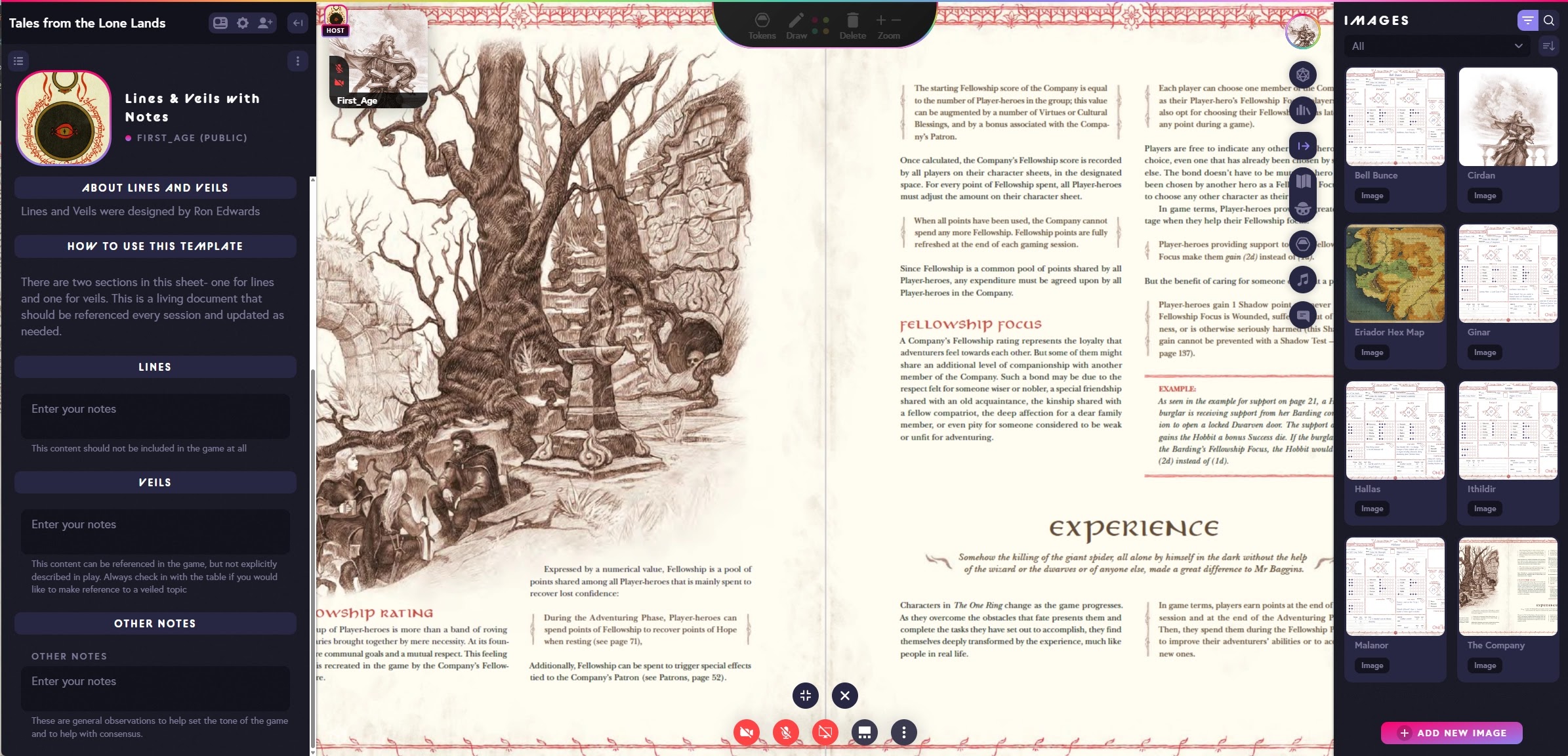
I’ll be using the Role VTT as a hosting platform this Friday, where we will meet each other, virtually, introduce our characters, make connections between them, their patron and places of safety, before opening out the Lines and Veils for the weekend.

Session Zero

All the images and location maps are to be displayed on a monitor, linked up to a laptop. This will save printing, and provide some session mood images. The locations are very much presented for theatre of the mind (with visual prompts) and the combat is abstracted into stances. Some more document and print to come, more reading, and more painting, but the game is nearing ready.

Maybe another update or two before LongCon kicks off.

I hope I do a reasonable job!

Posted in Conventions, Games, TOR | Leave a comment

LongCon Preparation – Tales from the Lone Lands

I am both excited and a touch nervous as I switch to a few weeks of preparation for my ‘Tales from the Lone Lands’ full weekend game at LongCon at the end of June. It will be a heady mix of reading, structure preparation, resource creating, and figure glueing and painting!

The figure painting may just prove beyond me, but I will try to get some rough figures ready for when the Shadow catches up with our company of heroes. I’m using Renown Gaming’s collection of figures and I have an impossible amount to do in the time I have left. They’ll happen either in time for the event or over time for subsequent games.

Here’s a possible resource that I have found for quick creation of base characters. The system generates based on two key choices, and then you can ‘re-roll’ until you get entries that you like. The sheet is also editable and outputs to an editable PDF.

Online Character Generator

I’m treating myself to an updated edition of my trusted guide to Midle Earth by Robert Foster. I love this book so much, and I can’t tell you how many hours I have referenced it whilst reading the texts, playing the game, or frankly just gorgeing on the details from cover to cover. Everytime I do so, I find something new, and a connection that fires my imagination. The book will grace the gaming table for gentle perusing and using lore to inform play. I may be the Loremaster, but I’m being collective with all around the table when it comes to accessing the lore. I mean, if we need to, as there will be adventures out in Eriador that will occupy most of our time! 

Buy this book!
My good friend Dom ran us a superb LongCon game last year, returning us to the Young Kingdoms, with a couple of classic adventure modules on the hunt for the White Wolf, using my own Tripod gaming engine. I’m very glad to return the favour with a game for him this year. Maybe a tradition could be established?! 😊
On which note, I’m delighted that LongCon is back and into its stride this year with five super looking all weekend games. I have recieved timely and super helpful encouragement from many of my gaming circle of mates, not least the incomperable Mr Gowbear. Dom is helping me to organise the event itself, which is a tremendous help. You are nothing, without your company of heroes.
LongCon is on the map. We’ll be doing it again in 2026. Please join us for that immersive all weekend game experience.
More soon as I continue to ready for the event.

Posted in Conventions, Games, TOR | Leave a comment

FantasyCraft – the noughties strike back

I appear to have an unhealthy attraction to ‘designed in the 2000s’ fantasy D20 games. FantasyCraft is my third after Dungeons & Dragons 4th edition and Green Ronin’s inventive True20. It’s not as though I have any meaningful history with the originating source of Dungeons & Dragons 3.0 or 3.5, as I went from University AD&D 1e shenanigans to anything but ‘Levels and Engorged Hit Points’ for more than 30 years. I may have played the 3.5 era once or twice due to test plays via Pete, my perennial D&D friend. Not much of a pedigree.

So, Crafty-Games’ FantasyCraft then. This heroic fantasy take on their super flexible Mastercraft system has so much to recommend it. My nearest touchstone is another 3.5 re-imagining via the True20 RPG, contemporarilary published by Green Ronin. Though both games take some of the core D20 system, they vary significantly in overall design, whilst both being excellent games in their own right. I say this on the basis of a FantasyCraft read through and many years of experience. I can generally and reliably tell when a game has the fun play juices within it, however this needs to be confirmed through actual play. Only then will I really know. Take this blog post as one of those excited ‘First Looks’, sixteen years after the fact.

What we have here is a very full, option festooned, Fantasy D20 game, ready for your own hacking and building. There is a mostly full game here, where you pick various approaches and themes for the game that you want to present. At 395 pages you have a vast and somewhat dense game, that will need absorbing and assimilating, careful considering and detailed preparing before play. This is not a pick up and play game. The delicious variances to the D20 system need a good understanding, even though the surface game can be quickly picked up, keeping the D20 plus a bonus to hit a Difficulty Class mantra.

Starting in the middle, and why wouldn’t you, I see that this exciting system properly embraces and makes a feature out of the D20 level bubble. Hey, says every D20 player for ever, as I go up levels, all the monsters go up levels, so all the numbers are larger but my chances are about the same. You’re in that bubble of managed heroic competence, facing ever more horrendous foes as your shiny ability buffs ascend to stratospheric heights.

In FantasyCraft this is explicitely called out with the threat level system. Foes are rated on a grade of 1-10 in a number of key areas, such as Initiative, Defense, Attack, Health and Skills. Then, to work out their bonus numbers, you slide along a 1-20 ‘Threat level’ that corresponds to the average of the player character level. Quite literally, the NPCs and foes journey with the PCs on their ascension. There’s more here though, as foes have the same base, and classic six, characteristics as PCs which provide bonuses, and physical size, which affects wound totals. They also have templates, such as ‘Ancient’ , ‘Clockwork’, ‘Dire’, or ‘Lich’, which modifies the base foe in a particular direction. Add in extraordinary attack types, gear and treasure and you emerge with a massively flexible system that can build anything from a peasant to a fearsome lich drake.

FantasyCraft provides a rich set of components to build any character or foe that you may wish to create. It’s a feat heavy game, with each tightly described and voluminously listed. Player Characters are rated as ‘Special’, and protagonists can either match them or be rated as ‘Standard’. Special characters get both ‘Vitality’, a level engorging sack of hope, bravery, bruises, and inconsequential scrapes, that keeps them in the fight, and also ‘Wounds’, a largely static and small number that measures real bone crunching, life limiting endurance. Standard characters simple get a Damage Save bonus (or get knocked out). To bring this distinction to visceral life, D20 rolls have both a Threat and Error range. In simple terms this would be a 20 for a threat (critical success) and a 1 for an error (critical failure). These ranges change through a variety of factors. If a foe gets a ‘threat’ then, with the spending of an Action Die metacurrency, they can apply damage straight to your wounds and circumvent your vitality bloat. There is always danger in this game, and that’s how I like it.

Action Dice are available to both players and GM. They can be spent whole to achieve an effect, or be added to a die roll to up your numbers. They continuously explode on their maximum value, potentially giving you very high bonuses. They will also flow back to players as play progresses. It looks a really fun way to give and take edges at crucial moments in the game.

The action economy essentially allows a move and attack, or two attacks from the off. A lot of actions are rated as a ‘half action’, allowing you to do two of them. Rolled initiative, running in descending order. There’s a good range of actions to choose from, before any special actions. Armour absorbs damage and you have defence as the DC to be hit.

A character’s ‘Origin’ is a mix of species and speciality, which gives a range of individually tailored benefits, before even going into the Classes. There are 12 species in the core rulebook including the usual few stalwarts and then some new and varied alternatives. Once you’ve navigated the feats system, I expect it is fairly straightforward to make your own origins.

The Class system provides a familiar range of niche roles in the Basic classes. You can elect to stay in your base class right through the 20 levels, mix and match classes, or indeed move onto Expert (accessible from level 10) and Master tier classes ((accessible from level 15) which narrow the focus to specific archetype expectations.  Other classes are available online on DrivethruRPG.

Spellcasting requires a roll against an ascending DC depending on the spell level. There are a wide range of spells and traditions and plenty of arcane powers to spice up play. As you might expect the explosive spells can be quite powerful and will soon strip away vitality, or make it very hard for ‘standard’ characters to make their damage saves.

The game has room yet for guidance on roleplay, types of fantasy and campaigns, and in Chapter 7 ‘Worlds’, a lot of thought on how to create your game and build a world setting that works for you. Similarly, there is  lots of support for creating your adventures and getting the best out of FantasyCraft. I haven’t remotely covered all the strengths of this game and the depths it can take you.

I appear to have succumbed to the ‘Fixated’ condition and, slack jawed and drooling over the games’ possibilities, feel compelled to get this to the table. It appears to be another large and involved game that I can, inappropriately, bring to a face to face convention. I also note that FantasyCraft is a publisher sanctioned Foundry VTT system. Wave the white flag. I must make it happen.

Although further output for the game is now unlikely, there is plenty available in what they have published to last you a lifetime. I may not have that much time, so probably should get started.

Posted in Games | Leave a comment