Being a Good Tabletop RPG Player

Recently, I put together some guidance on how to be a good tabletop RPG GM, which I discussed on my blog and podcast. This was collated from a range of received wisdom over time and put together in one place as a resource for others.There was no claim to being either comprehensive or original, only having the advantage of being succinct and highly accessible. This guidance was targeted at convention play, but the principles would apply to GMing any RPG session.

I think there is just as much value in exploring good play from the perspective of the player. So, please find below some top tips for being a good tabletop RPG player. This selection is inspired by the excellent guidance delivered by Becky Annison of Black Armada Games.

 Becky’s Blog: https://blackarmada.com/how-to-be-ttrpgs-most-valuable-player/

 Checkout Becky’s series on YouTube:

https://www.youtube.com/watch?v=KMs5q7TAqXk&list=PLxzETbg_EJH32qfJ9ehHKnjdkzqgZ5Zzq

 I thought it well worth ‘reincorporating’ many of Becky’s excellent thoughts, with some of my own thoughts and words, and boost the signal.

As before, let me know what you think? Have I included the main areas that you would? Is my emphasis and tone OK? What would you add or take away from the points below? For extra fun, I invite you to play along with the guidance, and reflect on your own play. How well do you shape up? Is there anything here that you feel are strengths or weaknesses, and how are you going to step up and improve?

I make no pretence to have mastered everything here. As with my own GMing, one of the delights of the hobby is a continuous improvement, with forgivable lapses, in the way we play, and a recognition that insights on best practice continue to evolve over time.

Without further ado, lets dive into 11 examples of good play…

1. Be Ready to Play

Everyone around the table (or online screen) is responsible for making the game session great. Take a moment to check in before the game starts, noting your mood and energy levels. Ideally you will be ready to play. Are you ready to focus on the game for the agreed duration of the session? Able to apply your energy to the game and leave the demands and distractions of the real world behind for a while? It will make the game better not only for you but for everyone else.

We aren’t machines or always in perfect shape to play an RPG. That’s allowed! However, it is always worth having a mindful moment before the session starts to check how well you can apply yourself to your character and the group. If you are going to play then play!

Apply yourself.


2. Know the game

Especially if you are playing in a campaign or extended sequence of sessions, then learn the rules of the game that affect your character and play. This may not be for session one, but take the time to understand how the game works by the end of the first few sessions. If there is anything you are uncertain of, or need help understanding, then reach out. Grab the quick reference sheets and have them to hand in play. Understand how your feats/talents/abilities alter gameplay and the benefits they give you. If there are tactical options, then learn them, so that you can apply them quickly. When it is your turn in a combat scene, be ready with your character’s actions and any rules that underpin them.

Support others who need some help with the rules, including the GM!

Learn the game.


3. Completely commit to the premise of the game

Embrace the premise of the game and play 100% to whatever it is the group is trying to achieve. If you are not sure what the premise of the game is, have a word with your GM and find out. Defeating hidden cultists to save the empire? Get on it! Rescue the Ten Towns from the oppressive evil of the Snow Queen? Wrap up well and sort it out! Traders and freebooters, selling shoes across the sector and undertaking side quests to keep your heap of junk flying? Learn the trade rules, ship mechanics and enjoy the feisty relationships that build amongst the crew.

You’ve hopefully had a session zero, where the premise of the game has been outlined, to give a sense of what the player characters are to do. Build a group consensus on the drives of the game and play strongly to them.

Play to the premise of the game.


4. Embody your character

Immerse yourself in the world view of your character and experience the world through their eyes. RPG play flows continuously on a number of levels, from the inner world of the setting, the unique perspective of the character, to the player, to the game rules and on to the outer world. Though we continue to navigate our own world during a session, great play produces that sense of ‘other’, as you enact your character’s perception, their passions, their cultural drives and personal insights.

The premise of most RPGs includes high stakes encounters that may include character mortal danger. With a character you are invested in, it is easy and understandable to be over cautious, trying to manage risk, optimise every encounter and tactical decision. Play your character, not you managing your character. Don’t be too hesitant and over protective when it comes to your play.

Make a last stand against all the odds, make alliances with the doomed or the dreadful, stand in the place of an endangered fellow character. Follow your character’s heart and not your head, you will have great enjoyment dealing with the consequences of your character’s own actions.

Play your character strongly, but not at the expense of anyone else. If, after a highly destructive or sabotaging piece of play, you hear the words “Ah yes, but that is what my character would do”, then that’s just being a rubbish player. If your character was a lone wolf, probably a moody one, then why are they now in a group? What strengths are they looking to lean on that have been found in the other characters? Why have they recognised that the group is more important than them being alone? Play up uncertainties and insecurities. Build trust and transformation in the character. Delight in it burning down in a satisfying conclusion. If your character is an impetuous and hot headed bravo, that’s great, and getting people into trouble is all part of it, but how are they seeking to hone their nature to the betterment of the group?

Be your character.


5. Elevate others through your play

Your character is rarely alone, generally part of a company, as played by your fellow players, all seeking to achieve common or related goals. Listen to what people say about their characters and reinforce this directly through your character’s voice and actions. Have your character acknowledge and reinforce the strengths and foibles of the other characters. Is someone the ‘hottest pilot in the sector’? – give them the controls and don’t tell them the odds! Is someone a doomed champion of a forgotten god? – speak out their deity’s name as the horde descends, and put your faith in their axe. You will absolutely make the other players’ day.

There is something powerful about one player celebrating the truths of another player character. It deepens the sense of characterisation that you build together.

Lift up others.


6. If another player impresses you with their play then tell them!

Just as you may highlight another character in play, also celebrate another player as they produce imaginative, signature moments at your table. A cunning plan, a memorable speech, a niche rule well applied, generous play supporting other players at a crucial moment, a huge damage roll, the list is endless.

Your appreciation gives the group a boost, tells everyone what you like, and makes your friend feel on top of the world! It’s catching, they are likely to reciprocate. Your openness and generosity adds immeasurably to the enjoyment of the game.

Let players know when you enjoy their play.


7. Bring other characters into your spotlight scenes.

It can be quite difficult if your group is carrying a player who struggles to engage in the game, insufficiently active in the scenes that you are playing out. Encouraging such players through character interaction, may bring them to the fore and build engagement. Be supportive by making direct game suggestions to the player to bring them back into the play. At the same time, someone might just not be able to apply themselves this week, and needs a quieter session. Respect that.

In many ways, much more difficult is the hyper engaged, competitive, lone wolf player who is all about winning and being central to everything that is happening in play. That’s usually poor play. impressive play involves that strong commitment to the session, with highly engaged play, while also drawing others into their action and choosing to hand over to others at critical moments, so that the spotlight moves equitably across the group.

The lone wolf often has compelling backstories that they don’t want any other player to be involved in. Rubbish. If your character has a personal plot, a dark and moody secret, a long lost evil twin? Involve other players in your character’s personal problems! It is so much more fun.

It’s not just the responsibility of the GM to share the spotlight around during a session.

Share the spotlight.


8. Listen and revisit narrative elements through your play

Note the situations and character details provided by GMs and players throughout your game session. Reintroduce these details back into the game session through the words and actions of your character. When you do this you reinforce the fiction that they have introduced, make it even more real, and support other players’ characters so that they can shine.

People love feeling that you have listened, remembered and thought their idea was so good that you brought it back into play. This makes the game world feel richer as well.

Listen to others and incorporate their play in yours.


9. Be mindful of what your other group members bring to the table

We all bring somewhat different needs into a game session and a good player will be both vigilant and respectful of that.

Use CATS, Lines and Veils, and Session Zero to work out what your fellow players are looking for. Collectively, these tools provide a neutral framework to set out a group contract on the content to be included in your game sessions. It won’t be flawless, but provides you with the narrative landmarks to stay vigilant on the content you can introduce. A game is rarely so narrow that you have to include the one thing someone said they really hate.

Play safe.


10. Understand your group dynamics

Be an active collaborator in hitting the right atmosphere at the right time. If you are in a tense and dramatic scene then lean into this, be alarmed, focus on the moments, and respond accordingly. When there are moments of light-hearted fun, possibly breaking out of character, transition to that, and be ready to switch again when the game focus moves back to play.

This may not be instinctive for you, not everyone can pick up on the tonal shifts and react quickly to changes in the mood of the discourse. If you need to, ask another player to help you with this, providing a cue to help when those tonal shifts take place in the group dynamic.

Read the room.


11. Know when you’ve had enough

There is a rich variety to tabletop RPG gaming and styles of play. It is quite understandable that, sometimes, you can find yourself really not enjoying the game.

This realisation that the game is not for you can be for many reasons, and might come to you early in the game or after many sessions of play. This could be due to any number of reasons related to the game or to yourself. Perhaps a thoughtless player, a change in tone of the campaign, a feeling that you have had enough of the game, or a campaign that is significantly over running from its anticipated session count? People’s circumstances and needs change. Perhaps this regular commitment no longer fits?

The convention game you’ve arrived at might just not gel with you at all, despite the game system and the promotional blurb. If there are enough players left to make a viable game, then sometimes it might be necessary to stand up, apologise (British), say the game is not for you, and leave.

As difficult as this is (at least for me!), it is perfectly OK to leave a game if it is not for you. It is better for you to get up and go and prevents you from inadvertently dampening everyone else’s fun (if there is any!). 

Know when to leave.


GMs and players alike will be hoping to get into groups with players who live and breathe these (and other) good practice aspects of play. How did you get on with these? Find some of these instinctive? Others a work in progress? Perhaps check in with a trusted gamer friend and see where you could ‘up your game’! 

We are always able to improve how we play. These 11 principles pick out some key areas, and there are so many more. Play, reflect, and play again. 

Let’s summarise:

  • Apply yourself.
  • Learn the game.
  • Play to the premise of the game.
  • Be your character.
  • Lift up others.
  • Let players know when you enjoy their play.
  • Share the spotlight.
  • Listen to others and incorporate their play in yours.
  • Play safe.
  • Read the room.
  • Know when to leave.
Posted in Games | Leave a comment

Zweihänder Reforged in Foundry VTT

I would like to run some Zweihänder, which invariably means an online session, as that is where I play. Zweihänder has its roots in Warhammer Fantasy Roleplay 2nd edition, often regarded as a clone of that game. Recently a ‘Reforged’ version of the game has been Kickstarted, with copies emerging from printers sometime during 2026. This version of the game simplifies some of the core mechanics and streamlines play, diverging from its roots and making it a little more of its own thing.

There will be a Foundry VTT module for the Reforged version of the game at some point. From the dialogue on the Zweihänder RPG Discord, my confidence is extremely low that this will be any time soon. In fact a request for a date has effectively been met with silence. In a way, this is helpful. This means that I am going to have to find another way to get the game to a place that I feel comfortable running online with friends.

As it happens, Foundry already has a module for the 1st edition of the game. I took a good look at the module to see if I could play a Reforged game using it. It turns out that the answer is a resounding yes, allowing for just a few work arounds for new elements in Reforged that don’t exist in 1st edition. With some data entry work you can get a Reforged game up and running quite quickly. This blog post will outline my approach for anyone else that wishes to get a game going on Foundry.

The ease to set things up is thanks to the developer’s desire for their module to flexibly allow bespoke compendium to change or add to elements of the game. The first one I created was for the simpler skill list in the Reforged version. Once each skill item was added into the compendium, and the settings pointed to it, the character sheet displayed the right skills for the game.

In 1st edition, characters have both ‘Traits’ and ‘Talents’, with Reforged simplifying to just Talents from different sources. Working with the 1st edition character sheet in Foundry persuaded me to keep Ancestral Traits and Reforged Profession core Talents as ‘Traits’, largely because they sit better on the sheet display. The rest are General Talents with their own separate compendium.

With those in place, I thought I’d have a go at Professions and Ancestries to round out the drag and drop for a Reforged character. Professions, of which Zweihänder has a ton, are a breeze to create. Give it a name, drag in the professional trait, drag in the general talents, drag in the skills that can be developed and note the attribute bonuses. The only profession element not covered is the Attribute 5% increase, which I have put in text form in the Notes tab of the Profession template. I started a similar process with Ancestries, though in Reforged they provide some flavour text and a few ancestry talents, gained over a the hero’s lifetime. The 1st edition has an automated lookup of ancestry traits that I couldn’t find (that could just be me), so I simply use my ancestry compendium as something I can drag onto a character sheet, and then manually drag across an ancestry trait from my compendium. Works fine. 


Reforged attributes skills and other values

You can probably, just about, use the existing Trappings, Weapons and Armour compendium, though I have started to create my own as a backup. I suppose the obvious thing to say here is that you often only need to create compendium items that are usefully going to appear in your game! I won’t be bothering populating talent lists for every ancestry, and arguably only those that a player has actually rolled for as part of their advancement. Build these up as you go. In a fit of enthusiasm I have fully populated the talents for humans. I recorded Tragic Flaw and Inner Strength as text in the Background tab.

A character with a Profession, Traits and Talent available


There are some other minor tweaks to sort out. Initiative needs to be set to 2D10 instead of 1D10 in the Zweihänder settings, with the rest identical between the two editions: 2D10 + @stats.secondaryAttributes.initiative.current. Default skills are also updated in the settings to match the ones we have created in our skill compendium.

The module doesn’t support Hindrance on tests, as that isn’t in the 1st edition. You’d need to simply roll another D10 after the fact to see how it impacts the roll. It looks to me that pretty much everything else should work smoothly once you have overlaid the Reforged lists of skills. Talents (and traits if you decide to use them) are largely text prompts, so are great to have on your sheet, but don’t mechanically affect the workings of the sheet.

My thanks to ‘Rex’ for creating a very nice Zweihänder module for Foundry. They continue to update the module, with the last release only yesterday to squash some bugs. The module runs fine on Foundry v13.

I’m planning to run some Reforged games in Foundry this year. There is nothing to stop you doing the same should you wish. Depending on the plan for the official Reforged module, I’d strongly advocate for a series of simple Zweihänder Reforged compendium, made available to Foundry GMs that can be dropped into the existing module. It would make the game start-up super quick, and save all the GMs having to hand crank the data. In theory, just adding Hindrance die mechanics to the current module, you are pretty much there for Reforged right now.

I’ve yet to run the game in Foundry, so look forward to seeing how everything fits together later in the year. I’ll be back with a summary at that time. 

Posted in Games, VTT | Leave a comment

Geo-politics and my data

I don’t know about you, but I’m increasingly finding it difficult to read the news. A late 2025 resolution to only look at the news once per week has slipped a bit this week, particularly with Trump speaking offensive lies at Davos right now, but the intent is holding up fairly well, allowing for feed leakages. In part, it is the powerlessness, the passivity I feel when reading. The sense that there is nothing I can do.

This got me thinking about my dependence on American tech, which is understandably high. With an Android phone, heavy use of Google office, data on Google Drive, Gmail, blog on Blogger, Google Maps, PayPal, my Foundry services are on Sqyre.app, ah the list goes on. Technically very good and reliable services, but here I am trying to allow some feeling through. I’m angry, and dismayed. So, I’ve given myself a small, an inconsequential, amount of power. It’s time to disentangle as much as I feel I can. Some things will go, others will have to stay.

It’s a maze, where I’ll take some wrong turns, and the centre will not be where I think it is. Still, I shall enjoy my wander through the high hedgerows of home NAS and European alternatives. I’ve switched browser to Zen. I run most of my computing on Linux, with some mobile Android. Now it is the turn of my data.

I hold about 360GB of data in Google Drive. The majority of that is made up of gaming hobby digital products accreted over many years. Digital battlemaps take up a substantial amount of storage on their own. This process of organising and culling has made me realise that the data I value most, my photos and videos, and some creative writing project files, are the only ones that I would value having on Cloud as an additional backup. This is less about ease of access when away from home, but more having a supplementary copy stored and managed by someone else to provide me with an extra secure copy. That someone else now has to be ‘not American’.

A home NAS to store my data is almost inevitable, but I want to start steadily. I’ve bought a couple of 1TB USB HDDs to store the data, one a copy of the other. I will need to work out an rsync script to keep them aligned. One should be stored away from the home and I will see how frequently they really need to be kept in parity. The download of 360GB over my Plusnet Fibre to the cabinet connection is a painful travesty. Despite guaranteed 50 mb/s speeds, I’m only managing 2-4 mb/s however I connect to my router. Although customer services were available, pleasant and tried to be helpful, it seems clear that when we are talking large blobs of data, the service just grinds to a halt. I’m dragging folders over gradually right now, but have the option of visiting a friend who has a super highway available.

This process will allow me to delete a sizable chunk of the data on Google Drive. I will drop to a very basic tier to support Google photo, Gmail, and their office docs. I’m looking at Proton as an alternative (just reading Trump sticking it to the Swiss in his Davos address), providing me with some cloud storage and an alternative to Gmail. I already have an email domain with Hostinger, so an email transfer is much easier, with much of the effort being in extricating my accounts on various websites. Part of the cull will be to remove most of my email subscriptions. I have already blitzed through Gmail removing unneeded big attachments. My heart says to go Norwegian with JottaCloud, storing my data securely up a Scandinavian mountain. The Linux client side may deter me, but I still like the idea of it.

Transferring all my Google Photos to an offline copy is also on the hopper.

This will take some time. I’m alive to the notion that this is an illusory galvinisation of action, a call to arms, that will remain unseen and benefit no-one, least of all myself. And yet, I’d rather stand up and do something. While I’m at it, can we remove Palantir from our NHS please? Cheers!


Posted in Linux, tech | Leave a comment

Like Zen Man

Another year and another browser. I have recently switched to the Zen browser as my main window into web services. Initially on my Windows 11 PC, it now sits with my Fedora Linux laptop and Gondolin housed PC. The browser is based on Mozilla Firefox, with a clean and beautiful UI that enables focused browsing, side loading tabs grouped into configurable ‘Spaces’, and split page view for two pages at once. I’ve really taken to it.


Zen Browser on my Laptop

At the weekend I test the quality of Roll20 WebRTC, and if that goes well, then it will be a full switch over for all devices.

This was another small step in my journey to step away from my complete dependence on American owned tech. I expect that it will be a long and slightly bumpy ride. I am conscious that I type this on Blogger and had to enable Google cookies to allow me to load up the image above from my local drive. It’s a nuanced world, with an uncertain future after the present American administration is replaced. My concern has reached sufficient heights that I am considering leaving Google Drive as my main cloud storage, despite its quality and UK housed servers, for Proton.

Let’s see how I get on. I am reaching out to friends to check on their own preferences and solutions. 

Posted in Linux, tech | Leave a comment

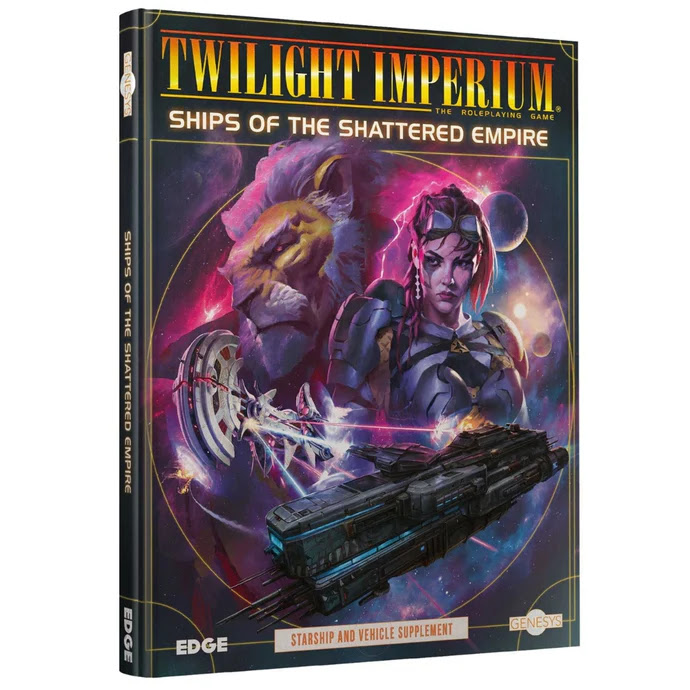
Ships of the Shattered Empire

207 pages including an extensive index.

There is a free PDF Download code in the book inside cover.

Embers of the Imperium is an unbridled space opera for the Genesys RPG, telling bold galactic dramas

in the Twilight Imperium setting. It takes me back to the convolution of FGU’s Space Opera RPG of the 1980s, which I both ran and enjoyed. Genesys, by contrast, is a simple to play and coherent modern game system, which propels you into the action with smooth mechanics and lots of flair.

Ships of the Shattered Empire is a supplement to the ‘Embers of the Imperium’ space opera setting that provides expanded starship and character rules, guidance on running starship battles at all scales, with a separate mass combat system, and one that the actions of the player characters can influence. All of this is packed into 35 pages, with the remainder outlining key starships for 11 factions and civilian vehicle profiles. Altogether, this supplement delivers a very useful expansion both to integrating player characters into starship action and copious examples of the ships that ply the starlanes.

Although the rules section is entirely optional, I can see any GM wanting to incorporate the ideas contained in this section.  There is a loose interplay between abstracted range zones and more detailed momentum based forced movement of ships with restrictions on relative facing for silhouette 5+ vessels. This will affect bringing specific weapon arcs to bear against enemy vessels. Extra rules are provided for in theme space opera ramming and boarding, with some suggestions for the cat and mouse of system wide strategic ranges for distant missile and torpedo fire. Point blank ‘engaged’ fatooming is discretionary possible.

Rule extensions are rounded out with fighter minion groups and some useful notes on PCs as starship crew,  honed dice result spends for starship combat and some new starship and vehicle talents. Some of these talents come to life when embroiled in mass battles which are covered next. The system presents an abstract way of resolving very large conflicts of an kind using the Narrative Dice System and therefore has very broad utility for any Genesys game and setting. Applying factors as to both forces size and quality, you build your pool and the opposing difficulty. This base pool is then modified for other narrative elements by applying Boost and Setback dice. Examples for these are included to spark your own encounters.

Of course a mass battle is not just a dry ‘slugging it out’ affair. The PCs step in and directly affect the outcome with direct actions to shape and guide the conflict. I mean, they are the heroes after all!

And then the starships…

There is a stripped back utility to the Genesis vehicle stat blocks. They tell you everything that you really need to know to bring the example to the table for play. Each war mech or starship in this supplement has their own familiar stat block, grey shaded illustration, and flavour text to bring it to life for play. The silhouette range traverses size 2 to 9 for plenty of scale options.

Further, the ships are found in chapters that provide more factional details about their armies and fleets, with embedded call-outs for lore on pacts, naming conventions, technologies, and adventure seeds. Interspersed, there are some full colour illustrations that will probably see some expression in my VTT when I get this game to the table. 

This is an excellent supplement that further develops starships and fleet actions for the Embers of the Imperiium setting. Its existence has been heavily cloaked by Edge Studios, ardently attempting to restrict hype or, possibly, any sales. Some outlets have smuggled copies, and more galactic noise may become apparent from 9th January, or not. I stumbled into its existence by mistake on the edge of the Klatu system during an energy storm.

In addition to all the expected starship information, you have a nice set of mass combat rules that have broad utility for any game that you might run. Anyway, I’d write more, but I have to board my Serpens Investigator, (which doesn’t exist and you won’t find any records of it – except in this supplement) as we have a priority mission out in the fringes of the Xxcha Kingdom.

Posted in Games | Leave a comment

Crooning Invective

I’m starting to annoy myself with the system flipping to support a possible Hellfrost ‘West Marches’ style game. I’ve run through a host of obvious (though not SWADE!) and ‘out there’ possibilities. Far from scraping the barrel, I have returned to Helmgast’s lovely Hjältarnas Tid, which translates to ‘Age of Heroes’. I bought the PDFs of the game in their native Swedish, and then mangled them through a dodgy Google translate process, and came out with a BRP perfected KSR classic.

Here’s my cheeky translated cover.

It’s a simple d100 system that went on to power Troubleshooters (know that one?). There are great opposed rolls, a few stand out dice tricks, a handy dice-flipping meta-currency, and this malleable attribute called ‘Guard’ which reflects your ability not to be hit that acts as a quick recharging spatter sponge.

Anyway, witness my madness. Huge shiny mega games shout crooning invectives from my shelves, as I fixate on a few PDFs of a game that isn’t even in my native language.

I think, with the arrival of Dragonbane, there is unlikely to be any more published Hjältarnas Tid. The game covers the same silky smooth BRP fantasy vibes that have now been so comprehensively dominated by Dragonbane.

And really it should be Dragonbane. All the time, for ever, and for everything. I flail against the pull of that game’s simple power.

I’m off for a lie down.

Posted in Dragonbane, Games | Leave a comment

A little bit of CSS goes a long way

I run my games in Foundry VTT and have a habit of getting games that don’t have a system on there. I see this as a real limiter to getting some actual play in, unless I run the game at a convention. This is patently not true, but I am now so inculcated into the VTT way, and enjoy the build and presentation of games through Foundry, that I would veer to games that have good systems on there. 

These days I use the Custom System Builder (badly) to create systems for play. The module provides a framework to create a functioning sheet without the need for JavaScript. It certainly benefits from scripting, and some of the functions that provide character sheet dice rolls to the chat can get a little involved, but I find I can get by and create something that works. 

I’ve recently stepped up just a little and have introduced some Cascading Style Sheet (CSS), which is a language used for specifying the presentation and styling of a document. The use of CSS into the character sheet layouts has given me a bit of a lift. They don’t look quite so rubbish anymore (even if they remain fairly basic recorders and dice rollers).

So, that’s probably me cue to try and get Talislanta into some play…

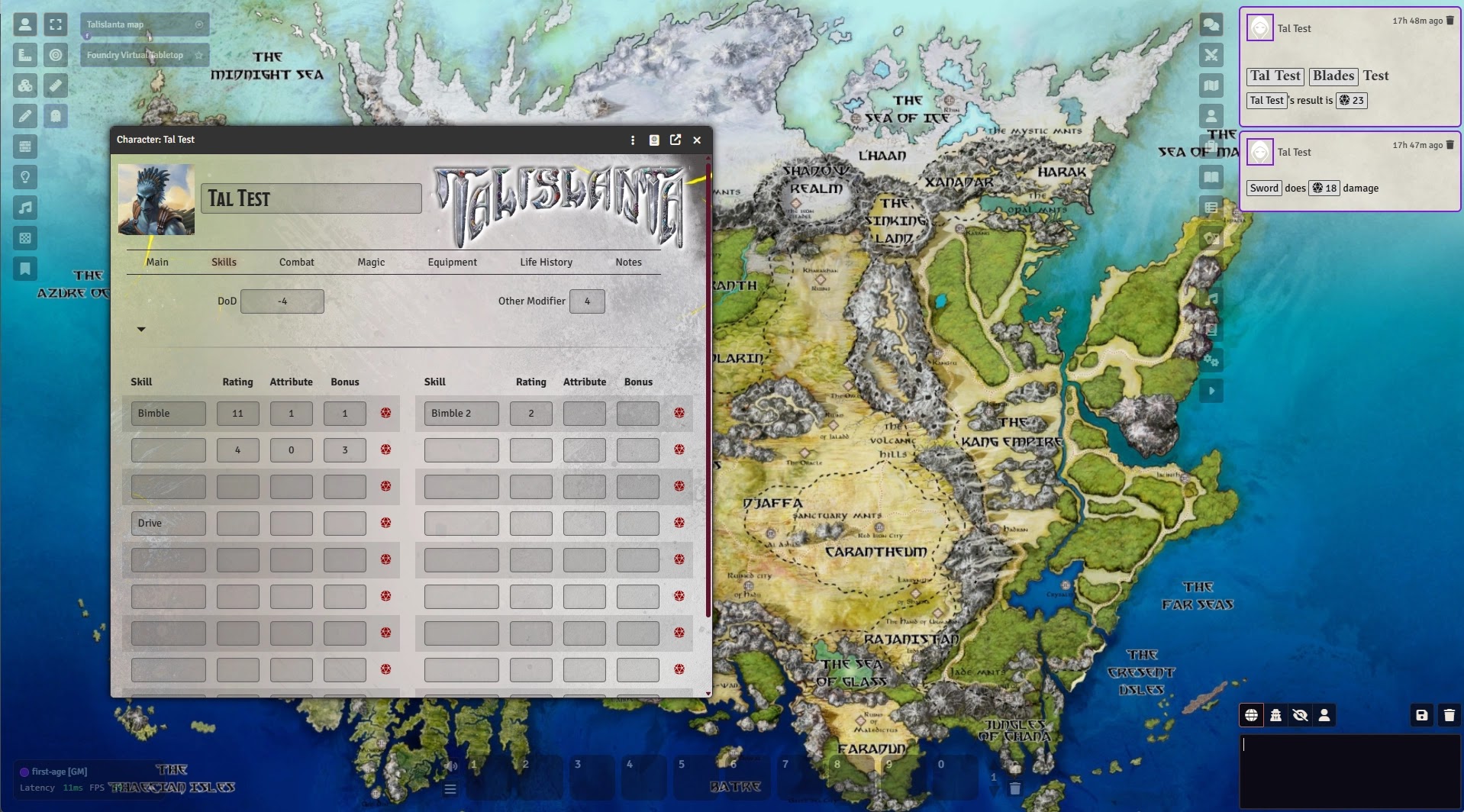
A draft Talislanta character sheet 

Introducing a background image onto a sheet and being able to fine tune some positioning gives a much more satisfying look.

A different look for Tainted Grail

The recent arrival of Studio Agate’s Tainted Grail: Song of a Dying World has raised flutters of excitement, and hope to get something to actual play. An Arthurian inspired heroic saga, with player initiated setup of the basis of the campaign, each with their own ascension arc, and powered by the ‘Story Arc’ system, an updated version of the Shadows of Esteren game. I have too many games to play with any substance, yet this feels like one that may pierce the veil and become real.

Neither Shadows of Esteren or Tainted Grail have a system on Foundry. Buoyed by my recent simple steps in CSS, I have replicated the work to quickly create another sheet, giving a different look, but now able to quickly change the look to one of four backgrounds. More ‘work’ to be done to get the sheet functioning correctly. Both Talislanta and Story Arc have simple skill based systems, adding numeric assets to a die roll for a result. Overall, not too difficult to at least get character sheets to provide test results and spaces to record resources and other details.
With 2025 all but over, it’s a fun time to consider what gaming will happen in 2026. Both of these games feel like strong candidates. Of course, I have made enthusiastic promises to myself before, but that is a topic for my forthcoming 2025 wrap up.
Good gaming, even before some actual play.
Posted in Games, VTT | Leave a comment

Cepheus Universal House Rules

Cepheus Universal is Zozer Games’ excellent 2d6 science fiction roleplaying game, based on Cepheus and developed from there. As such, there is a lot to the game that will be familiar to anyone who has played any of the 2d6 versions of Traveller over the years, right through to the Mongoose editions. Universal is a one book, very complete SF game, which introduces a number of innovations to the Cepheus family. A couple of favourites would be speculative trading which is very fast, and the design of large ‘capital’ starships, using a quick component based design.
This is a short document that outlines the options I use and the tweaks I have made to Cepheus Universal to run the game at my table. Suffice to say that none of the below are strictly necessary, the game is great as it is, but they make some minor tonal shifts that I like. Most all other steps and rules apply, this document only notes some choices and changes.
For most task based rolls I use the standard 2d6 + Skill + Characteristic to get an 8+. In some key areas Universal drops the characteristic bonus. Mostly, I put it back in, though I’m mindful of the probability ranges and effects of some of these rolls, with starship gunnery and speculative trading being two examples.
I come and go with some of these house rules, and they are subject to change and flux. Nevertheless, I thought I’d post them for reference to any GM out there that’s running Cepheus Universal.

Characters

I use design based creation p.26.
p.28. I use the following more generous Characteristic String –  E: 11, 10, 9, 8, 7, 6
Select a Homeworld Skill
A character’s homeworld provides one skill at level 1. Either choose any one skill and justify it in your character biography, or select one based on the character’s homeworld trade codes.
Ice-Capped – Survival
Poor – Survival
Non-Agricultural –  Mechancal
Agricultural – Agriculture
Rich – Carousing
Industrial – Ground Vehicle
Vacuum – Zero-G
Non-Industrial – Mechanical
Asteroid Belt – Zero-G
Desert – Survival
Water World – Watercraft
p.29. Divide up EIGHT skill levels between the skills offered by your character’s chosen career. No skill level may start at more than 3. All other Career Skills begin at level 0.
p.30. Add the following Career:
Performer
[Art]
Other Skills
Athletics
Carousing
Bribery
Liaison
Recon
Steward
Vehicle
Rank
1 Extra
2 Walk on
3 Craftsman
4 Artist
5 Celebrity
6 National Treasure
p.32. Each Career provides a +1 to two Characteristics
Academic:  INT, EDU
Agent:  INT, DEX
Belter:  END, DEX
Citizen:  EDU, SOC
Explorer:  END, EDU
Fixer: INT, SOC
Marine:  STR, EDU
Mercenary:  STR, DEX
Merchant:  INT, SOC
Performer: DEX or INT, SOC
Rogue:  DEX, INT
Spacer:  DEX, EDU
Primitive:  STR, END
Scavanger:  DEX, INT
Technician:  DEX, EDU
Scientist: EDU, INT
p.46 Add the following Skills
Art (Cascade Skill): The various specialties of this skill cover different types of
Artistic endeavours. When this skill is received, the character must immediately
select one of the following: Fine Art, Performance Art, Writing, or Media.
Athletics: Significantly trained in physical development. Physical characteristic tests become standard 8+ checks using Athletics and one of the Characteristics
Rename Vacc Suit as Zero-G
Make sure to apply p. 46:
“It is common to give all player characters level-0 in Vacc Suit, Ground Vehicle and the combat skills of Gun Combat and Melee Combat…”
p.49 Use Abstract Experience

Game System

p.58 Perception Roll. This is ‘Unskilled OK’ so doesn’t attract an unskilled penalty.

Space Combat

p.237 4. Advantage Phase
An effect of 6 on the advantage roll provides a further -2 DM to an enemy attack
p.239 7. Damage Phase
An effect of 6 on the attack roll provides a +2 bonus to the damage roll for adventure class ships
p.239 Ship Damage Table
p.240 Component Damage Table
Swap CU 6 and 7, so Armour becomes 7. Armour Damage is to reduce by 1 point (Hull)

Spacecraft Design

p.249 1 Hull Point every 25t of Hull (this effectively doubles Hull Points). This expansion of Hull Points and the slight curtailment of Hull damage above, gives me a slightly more robust set of ships that will survive a bit longer before kaboom. 

Running the Game

p386. Use Option 4. Destiny Dice. The pool of 6 dice are a shared group resource that can be called on for critical rolls by table concensus.
Posted in Cepheus, Games, Traveller | Leave a comment

Dragonbane House Rules

Here are my Dragonbane House Rules.  These were drawn from helpful discussion on the Dragonbane Discord. This probably means it is time for me to run some more Dragonbbane!

1. Heroic Abilities

This was included to broaden the range of abilities for starter characters.

Characters start with one extra Heroic Ability.

2. Passions

This was included to add a ‘heart and soul’ resource of personal motivation for player characters. 

A passion is something that the character feels very strongly about. For example, a passion could be love of family or a particular person, a deity that they honour, a goal that they are trying to meet, or perhaps an allegiance to a guild or particular city.

A character starts with two passions, and can have a maximum determined by the character’s Charisma. Passions can be gained or lost at any time that makes narrative sense in the story you are creating.

CHARISMA   MAX PASSIONS

1–5  3

6–8  4

9–12  5

13–15  6

16–18  7

A passion can be invoked for a Willpower cost before a roll to grant a boon. The player should narrate what the player character is thinking and why the passion grants a boon to the roll.

PASSION (Name)

⇰ Requirement: —
⇰ Willpower Points: 2

Your passion drives you forward when those of lesser conviction might falter.

A passion that can apply motivation to the current scene can be invoked, for 2 willpower point cost to gain a boon on your next roll. If you are Disheartened then you must make a Willpower check as a free action to invoke a passion.

You cannot invoke a particular passion again until you perform a shift rest.

If the skill roll, benefiting from an invoked passion, fails, or an opposing roll is lost, the character gains the Disheartened condition. If already Disheartened, then choose another condition.

A passion may be recovered at a stretch rest instead of healing a condition. If a momento is related to the passion, then it may be used to recover a passion instead of a condition.

3. Advancement

This was included to slow the advancement of player character skills when playing in a longer form campaign.

Skills

In addition to those skills marked due to Dragon or Demon rolls, ONE other skill can be selected for improvement after every session.

Heroic Abilities

A Heroic Ability is gained once a skill reaches 18.

A further Heroic Ability is gained at the end of a significant campaign or adventure. As a guide, expect this to happen roughly every 10 sessions. For adventure milestones, alternate a free player pick with a more restricted option of choosing between Focused & Robust.

Attributes

Once per game Season if young, or per year if Adult, pick one attribute to try to increase. A particular attribute can only be increased twice.

4. Skill Mastery

This was included to provide experienced heroes in long campaigns with further benefits to skills once they have reached 18.

Once a skill reaches 18 it can still be advanced, but in a different way. If an 18 skill gains an advancement it does not increment one higher, instead a d6 is rolled to see if it can score higher than the current critical range for the skill. This will be ‘1’ to start with. If the d6 roll is higher then the critical range increases by one, up to a maximum of five.

5. Aim

This was included to give a combat action option for ranged attacks.

Spend your action to aim. On your next turn roll a ranged attack with a boon. Or, at a cost of two Willpower points, both aim and fire in your turn. This action cannot be used with the Twin Shot Heroic Ability.

Posted in Dragonbane, Games | Leave a comment

Running the Big Ones

I’m enjoying running Warhammer Fantasy Roleplay 4th Edition and the Enemy Within campaign. Depending on how we go, this could be a longish investment of gaming time, in a high quality and very fun campaign. This got me thinking as to which other ‘big ‘uns’ I’d like to have a go at? In addition to Enemy Within, I’d like to get out another one to run next year.

Here’s the early shortish list:

  • Mercy of the Icons (Coriolis) – I had a stalled attempt at this (for which I am routinely taunted if I bring it up!), but still want to see it through the twists and turns. The group who wants to commit to this will be out there somewhere.
  • Throne of Thorns (Symbaroum) – It needs to be done at some point, though the dark corruption of the game has at least some resonances with the Warhammer I’m currently running. Outside chance that I might get to play this.
  • Dearg (Shadows of Esteren) – A delightful rustic campaign set in a community that means something to you personally. A slightly less well known one, but beautifully done. 
  • Acheron Cascade (Infinity 2D20) –  A full run of this Infinity mini campaign. I always enjoy running games in this setting, and this would provide a chance to let the crunchy game breathe a little.
  • Children of Prophecy (Tribes in the Dark) – return to the original Tribe 8 metaplot, but through the lens of the new/forthcoming Tribes in the Dark. I have the Backers Preview of the rulebook and it is a great rendition.
  • Twilight Imperium: War for the Throne (Genesys) – Inventive, action filled, space opera, powered by a game system that I really enjoy but almost never get to play.
  • Eternal Night of Lockwood (Zweihander Reforged) – Saving a community engulfed by darkness. A bit close to Warhammer for now, but it is worthy of mention. 

I will doubtless add to the list as more come through to me or I stumble over some more ‘good ‘uns’. The Black Sun for Dragonbane Trudvang, and any Legend in the Mist Dales based games are both definite shortlisters. With Age of Arthur emerging out of draft, I can foresee some play, if not a long campaign. Countless short-offs might include Barbarians of Lemuria, Traveller 5, Heavy Gear, Heroic Fantasy 2nd Edition and Tripod.

Those that have Foundry modules will be simpler and quicker to run, with much of the legwork done for me. They would also look lush if done to the standard of Cubicle 7 or Free League offerings.

Thinking cap on, then head towards prep…

Posted in Uncategorized | Leave a comment