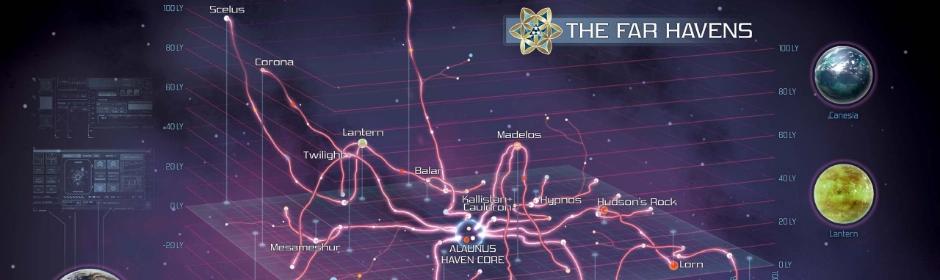
It was back in July of last year that I spoke enthusiastically on my podcast about the Omni RPG system, a multi-genre implementation of the Talislanta mechanics, pitched as the glittering fools gold of a perfect gaming system (for me).
I suggested that the way in should really be to run the newish Talislanta Epic Edition as, even back to its 1987 first edition, the underlying system formed the bedrock that Omni (and Jerry Grayson’s terrific Omega games drew upon. This is exactly what I have just done more than a year later, returning from Grogmeet, a lovely tabletop RPG meetup centred on patreons of the Grognard Files podcast. Good company and great games as usual. Now overdue, I decided to run that Talislanta game, an opportunity to take the most recent Epic Edition off the shelf for some actual play.
The proposed content included relaying the lore of the game as it arose to give a feel for the setting. We played through the introductory adventure in the 1st edition rules, updated for the actual world distances involved and some notes on the post ‘sub-men rising’ epoch. Talislanta is a Vancian baroque sword and sorcery, with a whiff of science, leaning into Moorcock rather than Tolkien. Indeed its famous strap-line is “No Elves!”. Although this is so, I had already anticipated my players reaction when looking at the archetypes and species pictures on display, and look confused that they all looked, well, like elves…
It was fun to spend time with the menagerie of elf lookalikes, describing cultures, twin suns, recent huge conflicts, Thrall tattoos, Sindaran two brains, strange fauna, ancient diabolists, and the arid wastelands that they travelled in. For all the variety and volume of setting lore, the complexity is low and pitched for fun play. I think my players enjoyed being there for a few hours.
With there now being six editions of Talislanta, arising from the first emergence in 1987, five of them can be found in electronic form for free at Talislanta.com. The game system is very easy to play and rules light, though I have found the wording of some versions of the game quite opaque. In the end I stitch together a game from a collective of sources. This was the origin of my Omni Ur-text, which with some additional development is now forming into something a little more comprehensive.
In level and hit point bucket games there is a semi written contract that, as the player party head up their power levels, everything else also rises in level, presenting new and more impressive adversaries, higher difficulty numbers, but with similar success ranges. Talislanta is not a power level progression game, except that every skill has a level and used as a resisting factor against opposition ability levels. So, I found myself balancing the ability levels of the characters with the ability levels of encountered opponents. The core game can be boiled down to rolling a 1d20, add your skill rating as a bonus, and take off the opposing skill or ‘degree of difficulty’ as a penalty, and look at the result on the action table
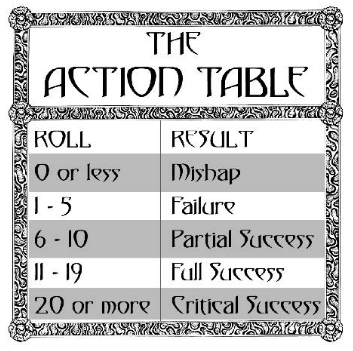
That’s the game. The table is skewed towards at least a partial success, though it is noteworthy that a difference of 5 or more between two opposing skills/abilities is quite significant in play. One side will be rolling a d20 at +5, and on their turn the other side would be rolling a d20 at -5. As the level disparity increases, this can lead to swingy unbalanced rolls on the action table. The range of abilities I had on my side of the screen were well placed to provide a varied and competitive range of results for the players. Something to keep an eye on if you ever GM this system.
When it comes to the rules, the colourful Epic Edition is a little loosely written, and felt frustratingly hand wavey at times. I think this is actually part of the style of this version, presenting the core game rules in a remarkably short number of pages, built around some principles on the Degree of Difficulty range of -10, very hard, to +10, very easy, and everything being derived from there. In practice I found I had to collate some key rules from a range of the historical system corpus, providing some clarity regardless of the brevity of the game. Largely, I ran Epic ‘RAW’, only applying a quick house rule here and there.
In the end, all the versions share common text, and regardless of how you get to there, the game is extremely light on its feet.
One character played a Cymrillian Swordmage, adept both with blade and spell. Magic is very simply applied in this version, dumping the full range of tradition spells on the character from the get go. The level of the spell acts as the Degree of Difficulty for the caster, who rolls on their Wizardry skill on the action table. The mage player had a lot of text to wade through, but managed the information well and picked some apposite castings during the session.
The action table was presented on the player facing side of their A5 standees. The players quickly got the hang of the game and had pretty much learned the result range during the first hour of play. I found that I sometimes had to be quick in declaring a degree of difficulty, as they were straight in with the roll plus their skill rating.
The game flowed well and I left the session enthused by the system and the setting. As you may know, the Talislanta system, or generic Omni, and further developed Khephera Publishing Omega system, has long been a favourite of mine. Traditional core, simple resolution, open ended development to take characters to very high power levels, at least in theory. The Omni system loaded on Talents, and I’m not sure that they are needed.
With the Talislanta editions, Morrigan Press Atlantis , Omni and Khephera Publishing’s Omega, there is an array of interpretations of the core system. In general, the Omega system is the most coherently expressed and cleverly developed of the system versions, and serves as the prime text for any game that I may consider. In practice, I have a range of the games open to see how they vary on common inherited rules.
Scott Agnew has recently posted that a second edition is coming for Omni, which I am fascinated to see. Indeed I hope I can be of some use in supporting and play testing. I’m going to keep working on my connecting blend of extended house rules, but only if I can get an actual game going using my hybrid
I’ve decided to get my Omni hack to a playable state for a game or three next year. Mostly what I have is glue and some new ideas amongst the rich corpus of published Omni games. I’m sufficiently enthused to push on to get it to a small book, but Omni isn’t on an open licence, so this is only ever going to be a ‘non profit’ fan effort.
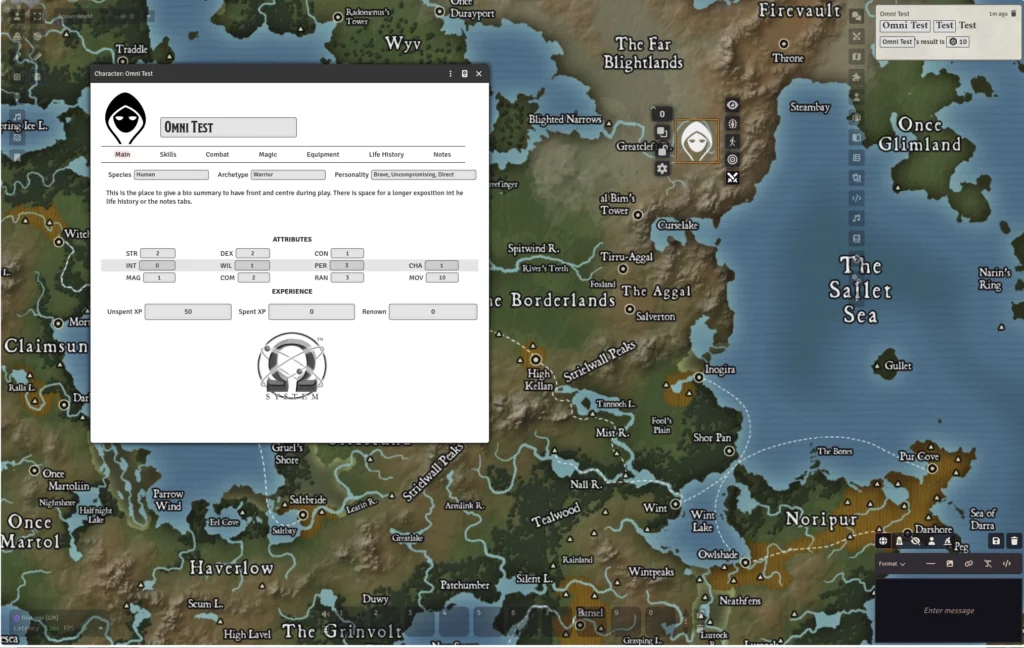
I have the beginnings of a workable foundry character sheet, including elements form my own blend, with some of my own concepts included. So far I have documented:
Core rules
- Action rolls
- Skill List
- Aid mechanic
- A meta currency to affect skill checks
- Structure for Species/Ancestry templates
- Structure for Calling templates – and one example ready
- Training and character development
- Clarifications for combat (especially ‘Defence’)
- Rest and recovery mechanics
Still To do ( a lot!)
- Populate 5 species templates
- Populate 9 of 10 Profession templates
- Equipment listings
- Add Talents (actually probably not!)
- Magic (probably going with Modes and Traditions as found in earlier Talislanta. Omni and Atlantis)
- Complete Foundry templates for characters and antagonists
- Consider science fiction skills and tech
This is a fun creative exercise, creating a game, not from whole cloth, but from a patchwork of interpretations. Really though, I need to set myself a target of either an online game or a convention one shot. Either way, a target ‘good enough to play’ needs to be set! Contingency is too close and Airecon is already planned. It feels too experimental for Longcon (though tempting), leaving an October 2027 Owlbear foray. I think that’s too late, so an online Foundry VTT beckons. And we’ll go for an April game.
Fancy it?
Grogmeet 2027 will be on 26-28 November, in Preston once again. Perhaps I will also run my Omni based game there too?
There’s grogmeet in April 2027.
If you are short of play testers I’d be happy to be involved
That’s a perfect target, and will see if I can get something prepared for this event.