Ongoing Adventures and the 4eRenaissance

 I am starting to get the hang of 4th Edition Dungeons & Dragons, and where it sits in amongst the other D&Ds and across the fantasy spectrum. It creates and manages the most engaging and intense combat encounters, where entering the fight is a major risk and an investment of game time. Our sessions involve straight roleplay with interaction and decision making and background development and some set piece combats. Arguably, much like all the D&Ds. The precision of ‘the Grid’, with the cool powers expressed in square zones, is represented easily by VTTs, where 4e shines.

It’s stirring heroics, with capable heroes who all have signature powers that allow them to shine with equal relevance but in thematic ways.

Where we left off – Iron Circle defeated

In our most recent encounter, the group of player characters, ‘Sturm und Drang’, were ambushed by the Iron Circle, a deadly faction that is seeking to dominate the northern lands. The aftermath is above, with a Rage Drake dominating the terror, and became more powerful once ‘bloodied’ (lost half hit points). Powers and Action Points were sent freely as it was clear this one could go one of two ways. I nearly put paid to our Dragonborn Warlord, who was into Death Saves, and the NPC Ranger, Helena,  was on 3 hit points and only surviving thanks to Dual Shot and dispatching the Minion Brigands in two rounds of fast shooting.

There is, of course, a lot of roleplaying going on in the tactical play. I don’t particularly disassociate the two, and as such, might be a clue as to why I enjoy 4e so much. A following scene revealed something about our half-eleven Hexblade’s family and past. The bulk of our session was the set piece above, but it remains a blend of character, story and intense combat action. It’s a mix I like.

A fascinating podcast, featuring Rob Heinsoo, affirms that the original intent in 4E was not to have all classes have a similar structure (AEDU) and that it was a lack of design time that brought us the symmetry of similar structures for all classes. The Essentials classes were a closer representation of their original 4e design intentions, with greater variety in the way that they operate. It’s a very good interview, with 4E getting a few minutes worth in amongst the 13th Age. Well worth a listen.

https://www.dicegeeks.com/13th-age-how-playing-ttrpgs-changed-rob-heinsoo/

Personally, I’m glad they ran out of time. Sometimes the constraints of deadline can, in fact, create design beauty, even if it wasn’t entirely intended.

As an expression of my current delight, and to banner wave my 4e enjoyment, I went to Twitter, of all places, and posted this:

Yeah, I know, but I thought it would be fun. It has garnered a little attention and created some buzz. We even have our own hashtag now: #4eRenaissance or #4eR. I’m not sure if we will turn it into a movement, but might be a more recognised tendency. 😆 I’d go More4 but Channel 4 beat me to it.

I had wondered about surging the #4eRenaissance with a series of YouTube streaming adventures, showcasing the game and, probably, the Role VTT.
This would make a good 10 episode stream run

I’ve since noted that there are one or two recent 4E streams, and I’d need to ensure that the roleplaying comes through within the combat encounters, but that’s kind of how we play. Finding a group who would be happy to play 10 sessions of D&D4e in a streamed show is presently unlikely. More-so, do I have the time to do it? I think I know the answer to that one.  

Posted in D&D4e, Games, VTT | Leave a comment

Reflections On Running TTRPG Conventions Online

 As our sensors acknowledge that North Star has successfully jumped for another online year, my thoughts have turned to my experiences of running an online tabletop RPG convention. I thought I’d share some of those thoughts here.

Creating virtual spaces for gamers to enjoy the hobby is incredibly rewarding. The events generate such fun and warmth that you feel like the efforts are worthwhile. All the more true at a time when we haven’t been able to game face to face for such a long time. And they have been difficult times for so many of us, so that an escape into the ether, via the collective inventiveness of the GMs and the imaginative power of players, is a great tonic and recharge, a moment of community and play.

Safe to say that I’m still learning how best to organise such events. Mostly, I think we get it about right, but here are some reflections on how to make them better:

  • Dropouts
    The free and online nature of the events inevitably means that individuals feel more able to ‘come and go’ throughout the weekend. We haven’t paid money for travel, or a hotel room, and we are still in our home situe with the other valid distractions to our time. Losing 20-25% of people who have signed up is about the norm, and we have become used to it. Participating for just part of the weekend is also something of a norm, though the event is there for those that feel like the full weekend experience.

    We thought about charging something for the event, with it being refunded if you participate and honour the slots that you sign up for, however many that is. Probably not a good idea. The events are viable, and once you get used to the dropout numbers it’s fine.

  • Communication 
    We run events in a loosely federated manner, with communication hub points spread across the Gaming Tavern Forum, Facebook, the Tavern Discord, and Mailchimp powered direct email messages. It’s  a lot of work to keep the wheels on, especially as we try to fit the people into the schedule with our pre-selection and randomiser. I’m pretty much convinced that the Seven Hills team have got it right with a dedicated Discord Server for the core of the convention communication. This immediately keeps everything together in a place and the cross messaging between attendees can happen without much intervention from the organisers.

    The hybrid model of keeping communication in Discord but reaching out via Mail Chimp and signposting in other forum feels like a more ‘together’ experience. I’ll feel more contactable during the convention too, for any help required. I’ve been skirting around ‘convention software’ as this comes with a cost and for the size of what we are doing it almost certainly isn’t worth it. Discord is free and effective.

  • Organisation
    The Google Form for sign up, and the use of Google Sheets for scheduling works OK at the scale we are at. The magic of the Elaine/Dom randomiser gives people a fair shout at preferred choices. Backing this up with the more insular Discord communications should keep the aforementioned wheels in motion as we head up to actual play.

    Keeping GMs to offering a maximum of two games, continues to feel like the right call. Rewarding those GMs with a first round selection of games is also a tried and tested reward for their heroic efforts. I’d keep the maximum that a game can be booked before the general player round as half capacity (possibly round down).

    Generous and flexible slot sizes over the weekend opens up possibilities for long games, whilst having set break points so that the schedule can work in the next games consistently all seems to work well.

    Formal post-con feedback via a Google Form is something I might do for next time – (see below about ‘next time…’)

  • Safety
    We have a conduct policy and we make this clear in our communication, requiring that attendees confirm their acceptance of it on the sign up form for the convention. We encourage at least some form of #tags in game descriptions to give players an idea about the tone and content of the games. For a convention with federated control, that places responsibility down to the GM for successful and safe games I wonder if we should go further, mandating the use of safety tools for every game. I would expect these to include ‘X-card’ or some other interrupt system, an ‘Open Door Policy’ so that players should feel free to walk away if they start to feel uncomfortable, and a discussion on ‘Lines and Veils’ to explicitly back up the #tags.

    There are a number of people combinations that don’t work. It might be worth us keeping a list of them, though I’m all for redemption and not assuming.

  • Games
    Not much to add here, as we have good GMs who offer fun game experiences. Devolving the responsibility to GMs for the successful running of their event on whatever platform they care to choose feels about right.

    It’s great to see international attendance. This is a huuge plus and one of the fantastic dimensions to online gaming. My regular D&D4e game has similarly benefited with a player from the Seattle area.

The convention team do an excellent job, so these thoughts are just immediate ‘post-con’ reflections. The transition to online has been fairly smooth and we have delivered some fun virtual space over this difficult pandemic. Question is: will there be more of them? I’m moderately confident that Furnace could be in person in October, and then we are on for a return to face to face gaming at The Garrison. I wonder if there will be space and energy for some additional online gaming weekends in the future? Possibly, and I have my thinking cap on…

Posted in Conventions, Games, VTT | Leave a comment

Some Like It Temperate

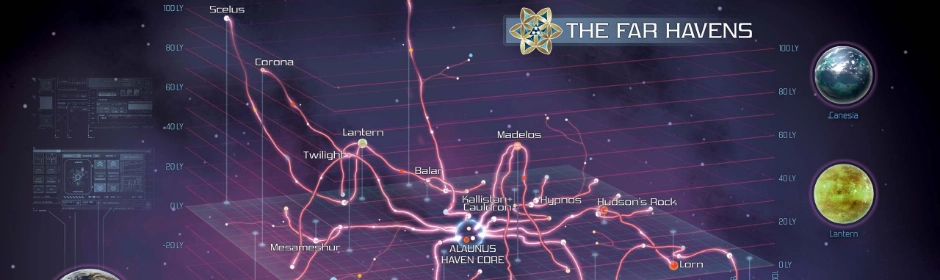
As enthralled as I am by the Fantasy D20 thing, I have gaming space for other things, and North Star has got me back into space via Traveller, a foundational RPG that I reminisced about last year on the Podcast. I’m running a session of Mongoose 2nd Edition Traveller out in the Far Frontiers Sector, a number of Jumps away from the Imperium and Consulate. It’s good to be back, but I have found that I have over prepared around the edges of the game, launching in to asset creation, maps and tokens. Running the game within Foundry VTT, with built in Jitsi video conferencing is a stretch of newness, with a chance that the tech will overwhelm me.

The crew of the Frontier Horizon courier

Still, it is getting me to look at new things, and adds some complexity into running a game that I haven’t run for a very very long time. It’s been a long gap, a rift almost, in time. Traveller itself is, of course, the same simple system it always has been, so not much trouble there. The plot of the tale, well, I’m keeping that under wraps, as it is still to be run, and given all the effort i might just see if I can run it a number of times to payback for the sunk investment. A warm up before firig up the fusion drive of a full campaign out here? Well, maybe. I shall Podcast soon about the the F20 enthrallment that locks me to various D&D offshoot games.

A Gas Giant System at the heart of the scenario

It’s been fun to do some arty stuff and get my creative juices back to the stars. There have alwasy been great tools out there to support the Traveller Universe Designer, and as I return I find that they are readily available, and browser online. One game I have been playing is quick creation of star systems found in the area of space that I am interested in…

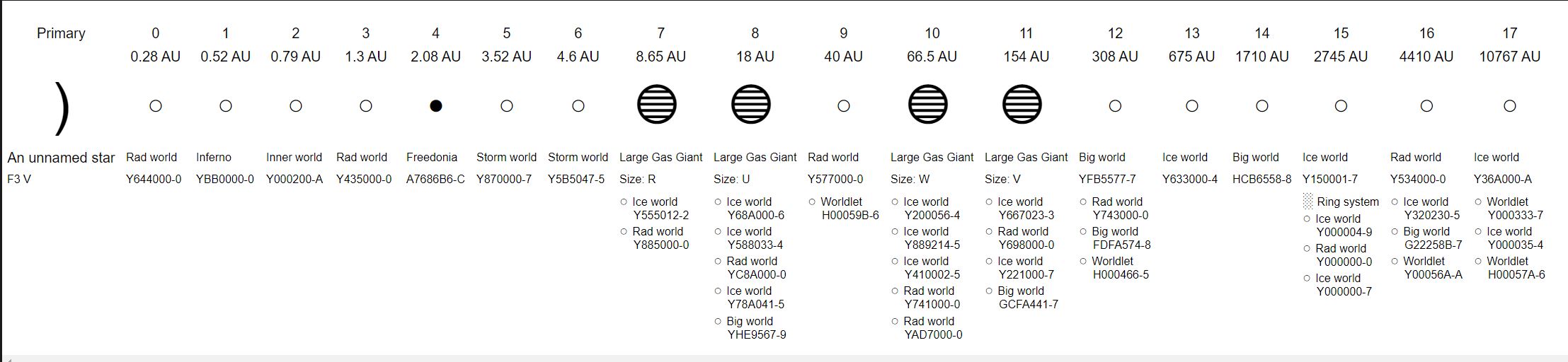
Centring on Freedonia – travellermap.com

The Traveller Map site has somehow managed to be come even more phenomenal since the last tiem I was there.  In particular, being able to zoom in to any system, and then generate the full star system on the fly has proved much fun. Back to my Book 6 – Scouts days of generating star systems, but this time by click and bodge.

Getting the temperature right for a temperate world has involved me moving planets from orbits and getting them just right. Oh the power, Ancient like. Here’s a manipulated Freedonia Garden World in amongst a reseeded star system. Note the average temperature column.

A balmy 18 degrees C

To achieve this I had to move the whole orbit closer to the hot F3 V yellow white star. As seeded to me, the main world was further out and running at an average temperature of -102C. That will never do. There may be a ‘Star Trek’ option, where you can just say ‘make this a class m planet’ and it forces the orbit as best as possible to get you a place where you might wish to go camping.

After some fiddling I have a revised orbit sequence.

Freedonia put in its place…
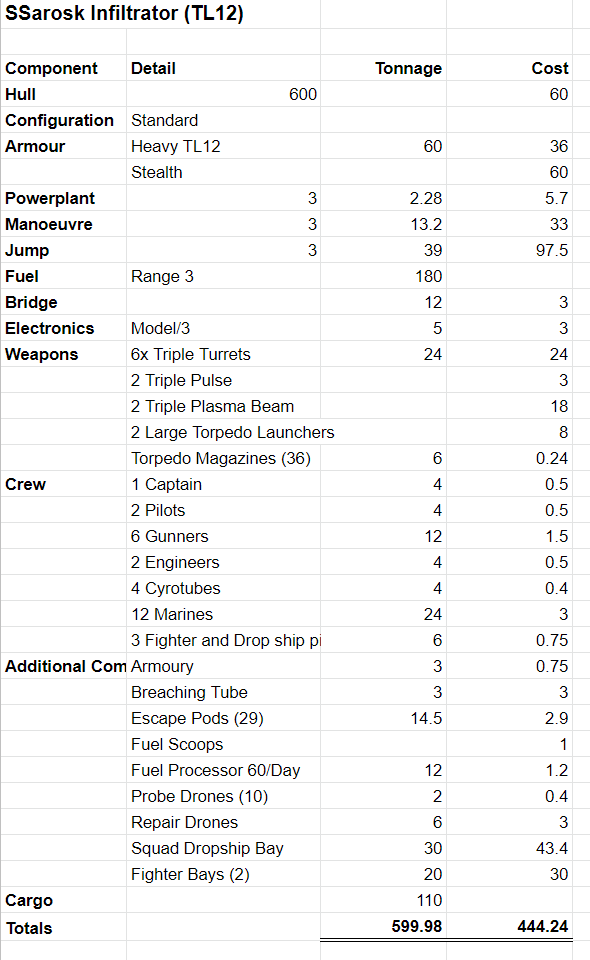
In addition to star system creation I have, for unnecessary verisimilitude, created a jump point calculator for mainworlds and their stellar size contexts and a starship creation sheet, using simple Google Sheets. I really didn’t need to do this, unless I am going to run an extended game. Perhaps that will happen?
Actual scenario then? Oh yeah, that… Wavemaker.cards has got me generating timelines, ideas, mindmaps and some text to weave a story together that should tell a decent tale in the allotted time. I have some fine tuning of it to do yet, but with such a lot invested, I hope the players actually enjoy it!
Fun times again, out in Charted Space.

Posted in Conventions, Games, Traveller, VTT | Leave a comment

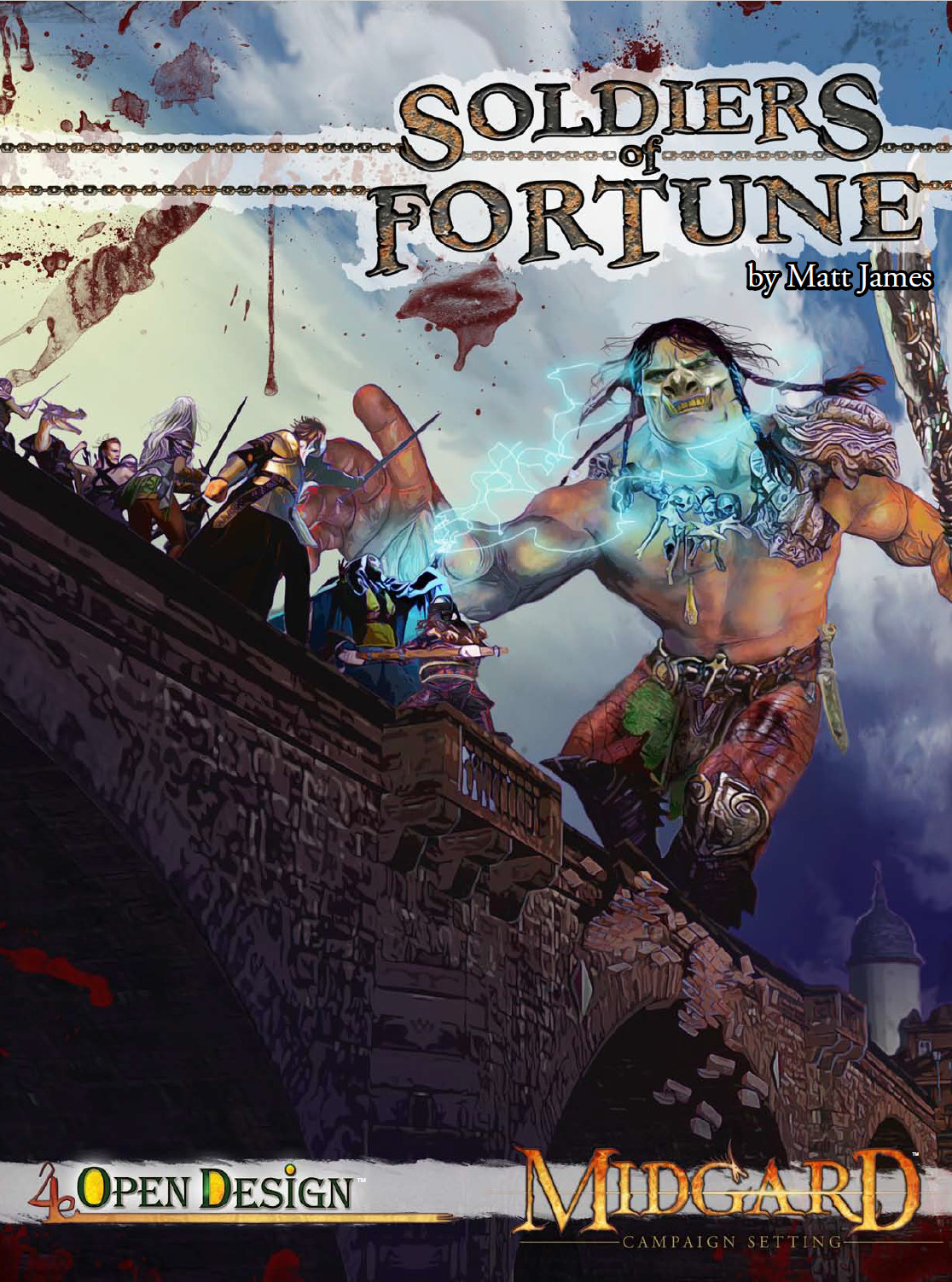
Soldiers of Fortune

In my continuing excavation of lost treasures, perfectly preserved in digital publishing archives, I have hit a rich seam of 3rd party DnD 4e, including Kobold Press Midgard. The first that I dived into was Soldiers of Fortune, which is very good, and provides a huge amount of game-able material for all things war, mass battles and conflict.

What do we get?

  • 82 pages with covers book back and white interiors. Well laid out, bookmarked PDF
  • The author, Matt James, a retired soldier, due to wounds in combat (2005), writes: “Everyone has a
    purpose in life, and I feel mine was to serve in the military so that another would not have to.”
  • Straight in to plot hooks on reasons to go to war, with the hooks scaled to 4e Tiers. No messing, you are headlong into content that provides backing for the campaigns that you might create.
  • A short section on multi-systems – taking other wargames and blending them in with 4e to provide a varied and specialised use of systems to achieve the overall battle effect that you want
  • Plot hooks to tie in the wars to come with the PCs and a short treatise on what a soldier of fortune actually is.
  • Some text on warfare and Midgard.
  • Run the full military campaign using overlapping 4e Skill Challenges. This is gold.
  • “The Midgard Stratagems, penned by a famous and heroic knight named Yaran the Even-Handed . Little is known about Sir Yaran other than legend, and scholars can neither confirm nor deny his actual existence. All that is known is that he is both revered and cherished as a monumental figure in modern day military lore and doctrine.” Sun-Tzu Midgard style.
  • Some fully statted legendary generals, to lift and drop straight into your game.
  • A full Mercenary Theme – with powers right up to 30.
  • Soldier of Fortune, Veteran of War, Spellscourge Mercenary, Sacrosanct Legionnaire Paragon Paths
  • Spoils of War – giving a cache of items for your characters.
  • Battle standards and rituals
  • A Midgard 7th level adventure, â€œThe Battle of Sanguine-Crag Pass”, provides a sequence of skirmish, skill challenge, and build up to the main event. I haven’;t looked in detail but it could be a useful structure that draws on the previous in the book.
  • A huge final splurge of monsters, minions and templates. Again, not looked in detail and how they work with 4e core, but i reckon there is lots that is usable there.

I think the book will work if you are not 4e or Midgard centred. But as I am both, it will do very nicely. the 4 Open Design series of books have a lot going for them and I have more to tuck into. It might be an old buried niche, but it is treasure nevertheless.

Posted in D&D4e | Leave a comment

Into the Feywild

 We are heading towards a third of 2021 gone already, as time inexorably marches on with a quick step. On a retrospective at the gaming things that have made me smile, I find that I have been smiling a lot.

2008 and more DnD4e

I’ll post some more about other smile inducers, but for now, continuing my ’13 years too late’ approach to all things RPGs, I have dug out Wulfgang Baur’s excellent Wrath of the River King and managed to find some of the maps at VTT resolution through Google. This also continues my D&D 4th Edition ride, with what appears to be an excellent Feywild adventure that deserves some extended actual play.

At 96 pages, with a great mix of combat and roleplay encounters, this could find its way into its own Feywild mini campaign, or incorporated with some managed seams into my current Nentir Vale campaign, as they have a possible date with the elves of Harken Forest.  The fey of this adventure are deliciously capricious, with the barrier between the two worlds separating very different folk with opposing agendas.

Whichever route to the table it proves to be, I’m confident it will get some play.

Posted in D&D4e | Leave a comment

A light brush with physics

 Or… back to some Traveller.

Back in the day, the Traveller starter set, my introduction to the game, had the most useful starship system travel formulae in the main book, but these have been removed by Mongoose from their versions. There is a good argument that you don’t really need to bother as long as you are within a close enough extrapolation, and that is doubtless true. Nevertheless, to give in to some slightly overwrought verisimilitude, I have dug out the formulae, including both the ‘accelerate to the midpoint and then decelerate to stop at destination’, where acceleration and distance are known but time/duration is required, and ‘pedal to the metal for a set distance (usually the jump point)’, again looking for time/duration.

I picked up both over here.

These are now plugged into a little Google Sheet to give me the numbers to pointlessly exacting detail. Whilst at it I have a jump point calculator forming, based on the simple ‘100 diametres’ rule, but keeping a weather eye on the orbits and the overbearing effect of the star. Oh yes, the stars! Back to looking at star types and relative Sol sizes, what fun. Oh, oh, and gas giant types and some rule that I never knew about that requires a certain manouevre  thrust for skimming different sizes of giant. When did that happen? Is that a T5 thing? Did I miss it before?

Next, a simple sheet that takes the higher of the star 100 diametres and the homeworld 100 diametres (plus stellar orbit), to get an overall safe jump distance for the system for a tyarget world. This assumes the rule that the star’s 100 diametres always counts, and needs to be compared to the relative position of the homeworld that the players are arriving or leaving. Playing with the LT, lower than, function to return the higher of two values.

The nostalgia! It hasn’t been that long I suppose, but hopping down these thought rabbit holes brings back such fond memories of the classic Traveller solo universe building fun I used to have, way back in the 80s. Mostly, I am enjoying drawing gas giant moon systems and finding cool images to use in the game. A side order of Foundry VTT assimilation provides some visual flair and technical enablement that fits the Traveller vibe.

Needless Maths

Character, plot and situation need to stay at the heart of course, most of the above being window dressing, of the delightfully ‘console flashing lights’ variety. I’m enjoyng the lights. The Wavemaker application has provided some nice plot tools. The timeline builder has given me a neat visual way of mapping out the events that have led up to the convention scenario start point, and I’ll follow-up with a mindmap to plot out the interconnections. There won’t be that many, it’s a simple enough tale.

The physics will be invisible to the players, and now replicable with ease thanks to the Google Sheet. The things you do for a forgotten princess.

Posted in Traveller | Leave a comment

Wavemaker for campaign and scenario writing

 Thanks to my good friend Dom, I have just discovered Wavemaker a great, clean and powerful book writing application. It’s completely free and shows off the Progressive Web Application (PWA) framework really well.

In additon to the core writng view that lets you set up child and sibling sections that can be moved around your sequential tree of writing you get a load of other tools that are perfect for the GM wanting to think through and create a particular scenario or an over-arching campaign.

  • Home – a place to write your words with a clean interface and logically move them about
  • Datbase Cards – a place to note and group (#tagging) elements that you can then use elsewhere. Images and text
  • Snowflake – build up your ideas by branching them out into sub cards and then folding them back in to a linear structure. Use the structure content in the Writer.
  • Planning Board – as you create chapter  and scene structure in your writing, you can attach notes in a planning board to this. The Planning Board view looks at the notes across the diffreent chapters, with cards for characters, locations scenes etc. It’s highly visual and provides lots of ideas in pone place in a structured way
  • Grid Planner – a quick to use Kanban board to plan and progress your creativity.
  • Mind Maps – spider out your thoughts and see what sort of connected web of plot and connections you make.
  • Timeline Tool – create a timeline for your plot and then export it back inot Writer so that it can be seen in the Writer tree (aceroony)
  • Challenege Mode – Push yourself. Set yourself a challenge to complete a set number of words in a set time. The work only saves when you complete. Nose to the screen. Everything else can F off. 
  • Export options
  • Google Drive synchronisation

Multi platform, browser based (especially some) and fantastic for me as a Chromebook user. My work can be shared across devices to my Windows10 PC ‘work’station.

I’m going to be using this for my D&D 4e planning and some one shot planning for conventions.

Posted in Writing | Leave a comment

Dungeons & Delvers – Core Rules


A contemporary dungeon crawler fueled by old school rules, flavor, and aesthetics, lovingly re-imagined and revised.

Yes, what I really needed right now was another D&D variant…

The most recent version of Dungeons & Delvers has emerged out of Kickstarter after a rather long wait. Mostly this was due to the time it took to work through the book and apply so many of their own art pieces. I backed it a long time ago. Needless to say were the Kickstarter to commence today I wouldn’t look at it , only because I’m currently running with three D20 games at the moment.

So, what do we get with this D&D, with this variant? I’m going to bullet point it out for you:

  • 515 page, full letter sized hardback with no index. Digest sized two books also available.
  • Full colour, but not glossy pages
  • Ability Scores are just bonuses in the usual range – array or 4d6 and discard lowest on a table with other variants.
  • Choose Race. Some weird ones in there including Cambions, Cthon statues, Ishim angels, Kobold gnome like people and some standard fare. Bonuses, languages, resistances further refine the character.
  • Choose Class. 12 of the usual ones.
  • Wound and Vitality Points. Vitality is defined by class and level and reflects near misses, bruises and minor scratches points you have more of and return quicker. In combat they are your first buffer before having to dip into your Wound points. They are more serious, you have more of them and they return slower.
  • Low bonuses – warrior classes get roughly +1 to hit per 4 levels and +1 damage per 3 levels. and multi-attacks
  • Willpower points to spend on powering spells with a random drain cost and more spend for more effect.
  • Skill list is a bit of a blend of a few of the D20 ones and 20 in all. Skills have ‘Perks’ which specialise your skill with lots of additional effects and use cases.
  • Skill point per level to buy a skill or a perk
  • A short crafting system
  • Armour provides a bonus to standard 10+DEX AC. Armour also provides some Damage Resistance (absorbtion)
  • Critical Hit tables for different damage types
  • Lots of other useful tables and lists
  • Roughly 150 monsters. Morale is a thing.
  • Magic Items and equipment

It looks to be a highly playable version of D&D, with lower, manageable, bonuses with lots of tweaks and carefully applied variations. And no, I don’t really know why you’d play it over 2, 3, 3.5, 3.75,  or 5e. Or indeed any other version that you fancy. Though it does look nice and cute and a lot of fun.

Posted in Games | Leave a comment

D20 Cognitive Overload

 I sometimes make a rod for my own back; some may even say it is of Deadly Casting. At present I am running three different D20 Fantasy games: True20, D&D 4e and Pathfinder 2e. Each of these games are terrific and deliver a different experience at the table. True20 particularly stands out as different, just as it did back in 2006, delivering a high fantasy experience with an ever present sense of vulnerability, having discarded the Hit Point bloat trope of classic D20 games. I am mindful of the similar style and feel of 4e and PF2e. They are both super-heroic player character high fantasy games with a super tanker load of options and widgets built around fairly sleek tactical play. I love them all.

At the same time I am really enjoying playing out D&D 5e adventures in gloomdark Barovia. Dom is running an excellent game in a well developed setting. Our group approach is fairly gung-ho and out to resolve the place by toppling the evil vampiric count in the centre of it all. I think this game has pushed my capacity to juggle multiple iterations of D20 beyond my limit. D&D Beyond, if you like. Concurrently I am juggling variations in sub-systems such as Initiative, Criticals, Saving Throws, Action Economies, Attacks of Opportunity, Spell Management, Healing, Aiding Another, and the list goes on. They are all close, designed variations of similar themes, but they are all different, and I do sometimes get muddled. My groups are all fantastic gamers and make everything fun and rewarding. They also carry some of the game rule load, so that I can manage the games I run, or manage my player character in the case of the Barovian Strahd.

Of the games I am playing, I have to admit that 4e may well be my favourite. I’d like to go deeper with it, and the campaign that we have commenced could have long term legs, affording an opportunity to delve into the Points of Light back catalogue whilst pushing the game rules to see where it takes us. Both Pathfinder 2e and True 20 games have something about them too, with Pathfinder being 27 sessions in, I can tell you that it delivers a sustainable and fun rules chassis for heroic fantasy long term play. It’s tremendous. True 20 has given me a D20 edgier expression that I have been adapting for the long term as my Truer20!

This is almost all good, but there are casualties. The most recent one seems to be my capacity to play my 5e character effectively. I think I may be letting the group down a bit by my sub-optimal rules play.  I can turn on some elvish charm when the moment requires and I have a sense of my position in the group team and role interplay, but I think the weight of all my other gaming has pushed me into only a light understanding of the character’s sorcerer abilities, which at critical times have undermined group success.  I could fumble excuses about Roll20 sheet design, folding away powers that I missed, but there is no excuse. I should know what my character can do and push these to the limit, not least because the setting is bleak and unforgiving. A heavy and challenging real life work load probably compounds my congested cognitive faculties.

In our 5e game, I sense that most of the opposition we face are considerably more powerful than us and I have felt for some time that we are always a session or two away from a TPK. Our last session was very close to, and perhaps should have been a TPK. Mid-way through, myself and another player simply accepted the inevitability of it and decided to go down fighting. It was a calm moment in a difficult session. However, we would be more effective if we harmonised our abilities as a team to get at the opposition, as is essential with all these D20 team games. I will have to step up a little bit more to play my part in that. It’s not a ‘rock up and just enjoy the play’ kind of game. It has setting depth and just enough rule depth for me to have to get my overstuffed brain around it.

At North Star I plan to run a session of Traveller, which will take me right of the D20 mold and will be a nice refreshing change.

Enjoying the gaming so very much, but I think I have reached my processing limits. It may be time to dial back on one of the games to let me be more excellent at the others?

Posted in D&D4e, Games, Pathfinder, True20 | Leave a comment

Jumped back In to Traveller

Some playing about with my new Foundry VTT has propelled me into Jumpspace and back to Charted Space, through uncharted technology. North Star will open soon enough. I had been holding off thinking too much about it as I thought Seven Hills Convention would be in April. But no, it has jumped into early June instead, which puts me of a mind to get my route set out for mine and Dom’s science fiction convention in May.

The Foundry community are great. The TwoDsix system delivers a very good Cepheus/Traveller implementation to get you up and running. I’m bringing back a slightly revised roster from my 2014 TravCon game for another outing.

TwoDSix System on Foundry VTT

The System is setup to allow you to add in your own items, so I have been adding a few skills and equipment honed for the MGT2e rules.

Really, I’d like Mongoose Publishing to provide supported content for Foundry, allowing TwoDsix to further embellish the system with a compendium of content. As it is I can crack on without, but the easy drag and drop of correct entries would be terrific.

Still, all fun and good gaming.

Posted in Conventions, Games, Traveller, VTT | Leave a comment