Distro Play

A spare, and now somewhat ageing, Matebook laptop has afforded me an occasional Linux Distro hop. Although the Matebook is showing its years in a few areas, it continues to look fabulous, and sports a tremendous 3000 x 2000 resolution 13″ touch screen panel with thin bezels.

I thought I’d take a look at the Cosmic Desktop via Pop!_OS.

Cosmic Desktop

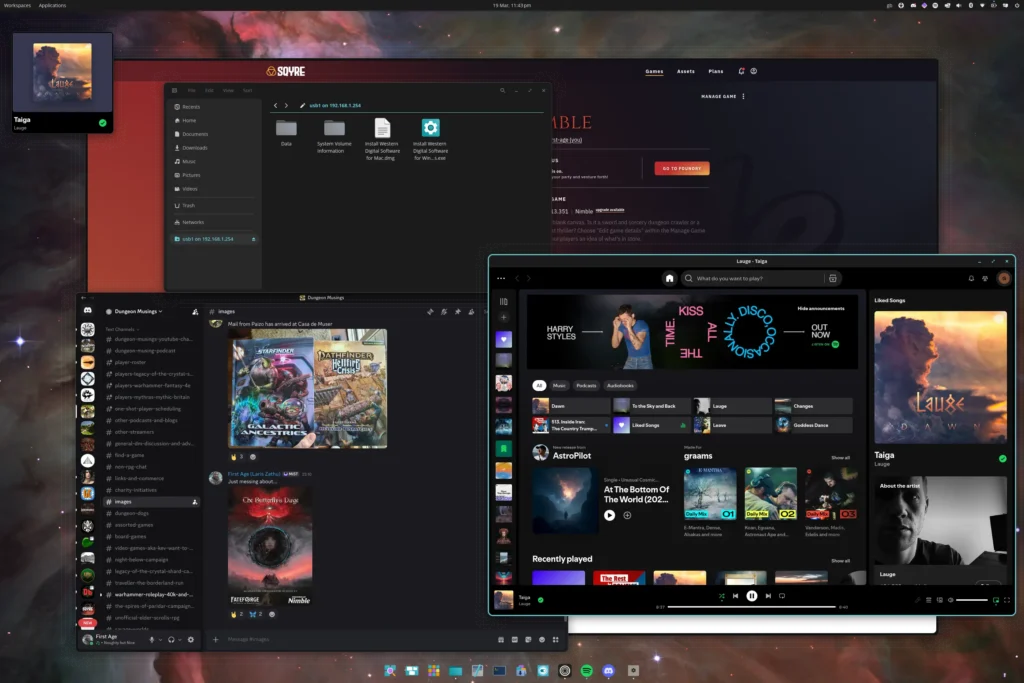
There is so much to like about this environment. It feels modern and responsive, with rich tiling and theming options. The few Cosmic apps are well implemented. Cosmic Files allowed simple samba loading of my network drive (once the config file had been edited to allow for the poor capabilities of my Plusnet router).

I’ve grown accustomed to the fairly vanilla Gnome desktop, with just a few tweaks and Dash to Dock. I felt immediately at home with Cosmic. The distro is packaged to handle my aged NVIDIA card flawlessly, delivering a smooth and high quality display. The Cosmic store seems to use Flathub almost exclusively, which keeps things simple, while managing any application updates in a straightforward manner. Proton, Zen browser and most of the other apps I routinely use are all there, so I am just cracking on doing what I do.

There are other distros that accommodate Cosmic, which I may check out, but for now I’m enjoying playing from where I am.

A fun dalliance.

Posted in Linux, tech | Leave a comment

Airecon Harrogate 2026

Another Airecon analogue gaming weekend in Harrogate, and what a fine time we have had! I run the RPG track as part of a lovely tabletop community convention, well organised, with a strong and positive ethos. It’s great to play a part in supporting this perfectly sized gaming weekend. Below are some personal reflections, in anticipation of feedback from my GMs and possibly some attendees via the community forum.

It was a very good weekend, with RPGs continuing to grow a little year on year, providing another gaming expression to the amazing board, card and other games. This year we moved to the grand Hilton Majestic Hotel with the Reading and Drawing rooms opened for 21 tables in each of the 8 sessions available. Being a short walk from the main convention halls probably had its pros and cons, but we were very happy with the space provided, amidst the grandeur of the column and chandelier great rooms, with carpets, drapes, and high ceilings that managed the sound so well. It was a delight to work the desk, helping people to find their booked tables and get into games. The buzz and laughter emanated through the walls to my corridor desk all weekend.

Our space was sponsored by Chaosium, who are significantly contributing to tabletop convention roleplay events across the UK (and doubtless beyond). Thank you to them for helping us put our RPG event together in such a fantastic location!

With some spaces in our programme, particularly on the lighter Sunday afternoon, we offered 781 player spaces, with 543 tickets sold. This tells me that, for now, we have the right number of tables, and should focus on filling the capacity we have, before expanding the space that we might need in future years. RPGs are very much a full part of the Airecon experience and they are there to stay.

Remi!!

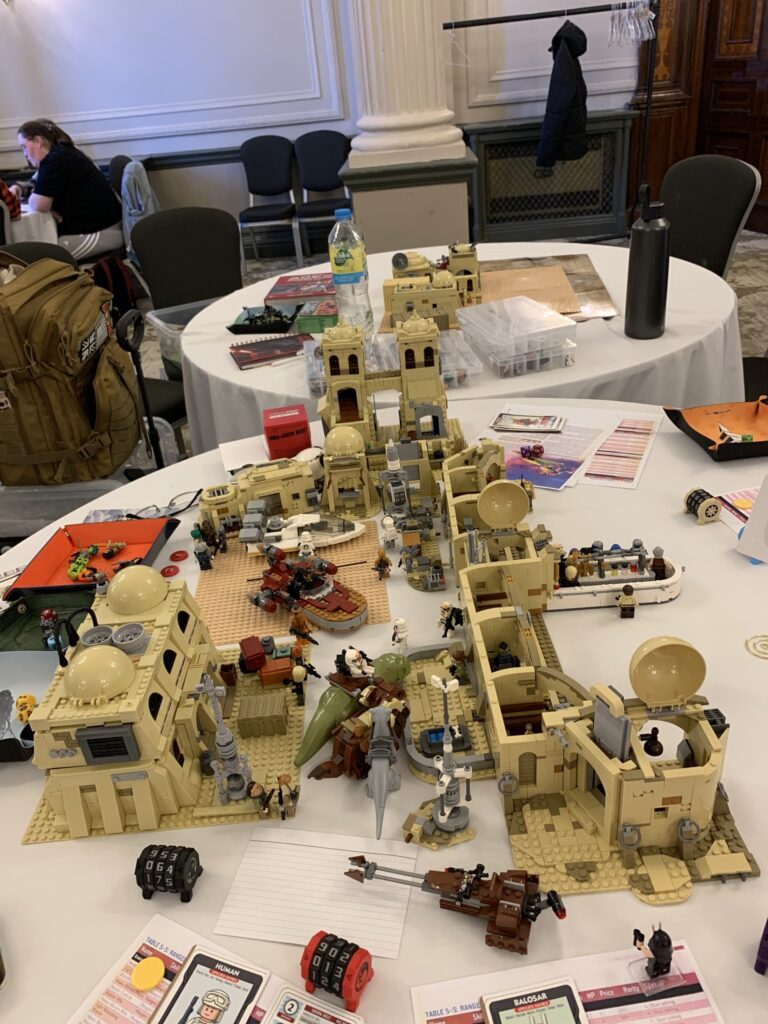
Airecon’s RPG Gamemasters (GMs) are a terrific group, many of whom return every year to ply their craft. They bring a wide range of different RPGs with varying playstyles, thrilling situations for the players to resolve, or indeed murders to solve, and all delivered with a lot of heart and significant preparation. I think Remi might have stolen the show with his huge Lego diorama for his Star Wars games, though as I toured the tables I saw gorgeous character sheets, figures and maps, props, and even a touch of fancy dress, all of which, though not essential, adds to the experience. However, the real preparation is more important and invisible. The mastery of the game, the design of situations that engage, and characters that can be expressed through play at the table. Creators of memorable gaming experiences all.

Not everything works out smoothly on the day. Some games might not fill or be viable, some players do not show up, and just occasionally a GM might not be able to make the session they had pledged to run. We have a principle that GMs are ready to run, even if we know there are no, or few, ticket sales for their game. This enables me to juggle late minute player sign ups, or re-allocate players from one cancelled game to another. It was so nice to see players prefer to be slotted into another game, other than the one they had booked, instead of going for a refund. People had arrived to play! GMs with no sign-ups are also able to join games to make up numbers and get games going if required. GMs like to play too.

Our friend, David.

We were especially concerned about one GM who didn’t show up at all, and wasn’t responding to messages. It is with profound sadness that we were told that one of our number, David Gallico, passed away on Thursday night. Many of you know David, a lovely and kind hearted man, who shared our passion for RPGs and was always keen to offer a rich variety of games at conventions. David will be greatly missed, and I shall think of him, and his game of DCC that he ran for me. Time is so precious, and I am so glad to have shared the moments I had with David.

As an organiser, I also like to run games. I thought it particularly important to do so this tmie around, to personally experience the new play space. My planning of table numbering was designed to soften any impact of loud noise, though the rooms handled the volume extremely well. My three games of Free League’s ‘Dragonbane’ went well, with some riotous and welcoming play from a cast of wonderful players. My last game on Sunday afternoon was much shorter than I had planned, a full hour and 45 minutes less than the same game the previous evening. Sometimes the players take routes and decisions that short cut potential complications. I’ll be running three games again next year.

I have made a few notes on a very few changes that will fine tune the organisation of RPGs for next year. Most especially, I think some form of ‘#children friendly’ tag (or some such) will help parents choose games that GMs have prepared with children and younger adults in mind. I was very lucky to have a ten year old and mum play in my first game, and it was a considerable delight to see my other three adult players adapt their play to make the younger one welcome and included. The youngster seemed to have a wonderful time and remained fully engaged throughout more than three hours of play.

To conclude, I just want to say a big thank you to all the GMs. The event is nothing without you. You’re commitment to bring great play experiences to the table is clearly evident from the preparation, your skill and approach to managing the sessions, and perhaps most of all the electric buzz of players engaging in your games with all the cries of surprise and laughter flowing from the room.

We’ll be ready for next year.

Posted in Conventions, Games | 2 Comments

A Nimble Cybergoth

I will admit to an ongoing dalliance with Fantasy D20 level and hit point designed games, despite my instinctive preference for lower fantasy skill based systems with static(ish) wound thresholds, so in the Warhammer and Dragonbane mode. It seems clear that I will put up with the ascending competence bubble for the visceral delights of levelling up. There’s also something of a joy to the engorged high fantasy tone, with menagerie populations and thoroughly unlikely super hero powers, popping off amongst the ale, simple farmsteads, and lost towers of the ghoulish Deathdealer King.

As you may know, I returned to these games after a long time away, mostly summoned by the prospect of my daughter becoming a Critter and starting to play D&D. This was a magnetic draw, initially fuelled by Green Ronin’s Dragon Age, and then unleashing the contrarian in me that took me to the adjacent Pathfinder 2nd Edition, which I played and very much enjoyed, and onto a huge spend fest on D&D 4th Edition. 4e over Covid with a great group and an epic campaign will live long in the memory.

Much as I enjoy the big blocks of F20 rules and ability lists, and copious monster options, there was always a desire to have it all without the bloated weight of the text walls, perhaps because I am a slow reader. So, I produced Heroic Fantasy, a Black Hack based game that delivers a similar experience but in a slim fast play volume. Some people out there really enjoying playing it, as do I. The earth was tilled and primed for the next crop of temptations.

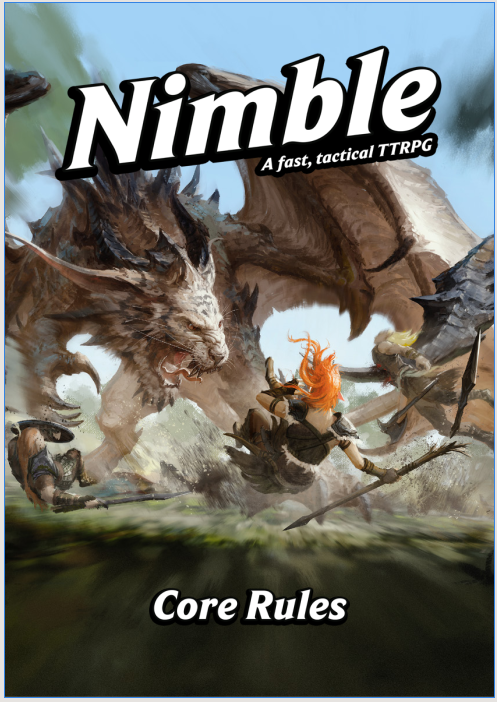
My good friend Dom, who understands my gaming journey, introduced me to his most recent kickstarter backing: Nimble RPG. This is exactly the sort of D&D adjacent game I have been looking for. He knew it. Stripping back a lot of the 5e guff, you have a fast play ‘rules tight’ heroic fantasy game with 1-20 levels of ascending power, highly focused and very simple to play. That it also takes design inspiration from Pathfinder 2, D&D 4e, Savage Worlds and even out to ‘Into the Odd’, only added to my delight. Sixty page rulebook? That’ll do.

Nimble is perfect for someone like me, having quietly purchased a shed load of F20 adventures and campaigns, flowing from Bundles and indiscrete, over enthusiastic, DrivethruRPG shopping grabs. Nimble can take any of this rich input and, with conversion ‘on the fly’ produce a game of Nimble in a trice. I may know that the mouldering digital pile is unlikely to see much, if any play, but with Nimble I can now pretend that I have a ready vehicle to turn the steaming feat load into some actual gaming.

Even now, I look at the gothic nonsense of Elderbrains’ ‘Crown of the Oathbreaker’ campaign and think that I could, at last, get it to the table. Back to Greyhawk for some more of my Bandit Kingdom sandbox? Nimble. That nice looking Pathfinder adventure path? Nimble. That dodgy third party campaign module with inadvisable line art? Nimble. A simple one off for a convention? Well, that’s easy.

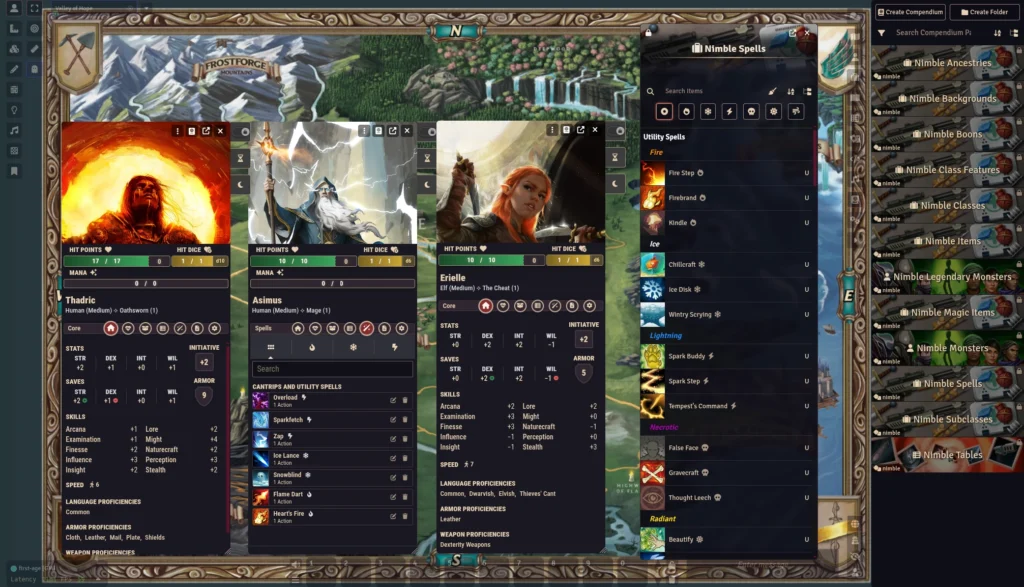
That it inhales some tactical vapours from Savage Worlds and 4e really works for me, instinctively taking me over to Foundry VTT, where I discovered that it had a beautiful and free Nimble system module full of ready to use compendium.

A few PCs I created with eight clicks each, and the compendium of data

Attractively, the Nimble community has a busy Discord, supporting websites, great VTT support, a regular zine, and, perhaps most important of all, a phenomenally talented and approachable creator. The third party licence is open and generous, doubtless foretelling a mushroom of community content.

The Kickstarter has just a few days to go. My digital pledge has been ‘Cybergothed’ (Dom’s online handle name) to a matching physical box tier, swept up as I am by the excitement of play. Virtual Grogmeet in April will be its first outing for me, and expect many more to follow.

Although unlikely to supercede Dragonbane in my affection, I still have a place for Nimble. It might nudge my own Heroic Fantasy game out of the way, at least for a while. I’m looking forward both to playing in Dom’s forthcoming game, and to inflicting this ‘5e but not’ on others, including possibly yourself!

Posted in Games, Heroic Fantasy, Uncategorized, VTT | Leave a comment

Get the balance right

Don’t tend this way
Don’t tend that way
Straight down the middle until next Thursday
First to the left Back to the right
Twist and turn until you got it right

Depeche Mode

To the thumping synths of a 1980s dance floor, welcome to this newly located blog! Here you will find a signal continuation from the Far Havens sector, briefly interrupted by an ongoing desire to move away from USA corporate owned tech. Legacy messages are found at https://farhavens.blogspot.com, though I have undertaken a full import of the old content to WordPress using a plugin.

Perhaps a fitting first post on this new ‘deGoogled’ blog site is a consideration of my engagement in social media, and where the healthy boundaries are? This will be different for everyone; have you got the balance right? I really don’t believe I have. Recognising this, I’ve already taken some steps, having walled off some places, particularly Facebook, languishing instead at quite a few Discord servers, along with some occasional Instagram, a forum or two, and a little BlueSky and Mastodon (dice.camp). So, a strongly curated series of places that allows some conversation about my gaming hobby, some tech, miscellanea, and often with people that I know and trust. Despite this, I have brought back into focus some old thinking about the amount of social media time that is really healthy for me, and the terms by which I choose to engage. You really don’t want to spend your retirement doom scrolling.

I think it would be beneficial to wind down the overall time I engage in online blather, and perhaps find the best moments in the day to click, view and participate. With the multiplicity of opportunities dangling on a typical desktop dock, it can be difficult to stay clear of the time sink icons. Still, I think a focus on just a few choice places is right, necessarily including the discussion associated with the conventions that I help to organise.

It has proven difficult to stick to my goal to only look at the news and politics on a Saturday morning. There seems to be a highly clickable despicable every single damned day. Need to double down on that goal. I think that this ‘clamour reclamation’ will be extremely positive for me, allowing some more space for family and closer friends, my own thoughts, creative endeavours, music, series, and ‘quiet reading’.

This blog has always been a strong place for me to express my enthusiasm and delight. I guess the amount of dialogue is low, except for the good folk of the Tavern, and so I get to speak forth with some good view numbers yet without extenuated conversation. So, I shall continue to write in this new place, and enjoy articulating thoughts in a positive manner. I’d be happy to engage more on the posts here and in other sites.

It amuses me that I could post this and, without some form of social media posting, no-one would see it! I sense this post is actually for me, so in some ways that would be fine.

Hope you have a good balance, and that your online dialogue adds positively to the time tapestry of your life.  

Posted in tech | 2 Comments

The Union is in a state

On the morning after the bloated and falsehood strewn State of the Union address by President Trump, I thought I’d reflect on the progress I have made to disentangle my digital dependence on USA tech companies.

I use the Affinity Suite for a lot of my image and text presentation for creative projects. This Windows and Mac application suite has now been straightforwardly enabled on Linux, either through using an AppImage, or a GUI based Wine implementation. Although I can still hope for a native port to Linux, it is more than good enough for me to ditch the Windows PC that I held on to for just this purpose, and switch it to Linux. Microsoft has left my building. My Mrs uses Windows for work and home, but that’s fine, this is my struggle.

A satisfying morning adding repos and apps and making my local network USB HDD available to a fresh Fedora Workstation 43. I’ll add Affinity Suite as a standard these days. I think the main OS changes, away from USA corporations, that are possible for me right now are complete. Default browser is Zen (Firefox based), search engine is currently DuckDuckGo. I have the Brave browser if I need something Chromium based.

There is more that I can do, at a leisurely pace. The majority of my data is now stored locally on a pair of cheap USB HDDs, one live on the router and accessible throughout home, the other a maintained back-up. The backup is kept in sync by a monthly rsync process, sending changes that have occurred on the main HDD to the backup. I was stunned by the simplicity and power of ‘rsync’ on the command line. The process isn’t ideal, but for the nature of my data, this cadence is more than good enough. A proper NAS is likely this year, and I’ll report back on the one I go for and how I find it. Probably UGREEN, but we’ll see. In the mean time I plan to further reduce my Google Drive data, though I am already within the 100GB threshold I had set myself.

I have a full local archive of my Google photos, using their takeout service. It came to more than 40GB, reflecting many years of accumulation. I really should have first gone through the cloud based files and deleted the huge weight of pointless ones!

I need to decide if I am going to commit to Proton for an additional email address and cloud space. It would be part funded by the reduction in  Google subscription. I also host websites for conventions on Hostinger, and have a domain there with email access. The cost of hosting is covered as charge to the conventions. I think the web presence is useful for the small charge.

I’m evaluating European alternatives to Google Maps. I think that will be a full switch, over the coming months. 

Some elements will remain. Sunk cost on the Google phone and HarmonyOS based tablet will keep me for their lifetime. I’ve already noted alternatives for when the time comes. I really should do something about my bank!

And of course there is this blog. It will probably have to move. It makes sense to migrate the blog by using a WordPress instance on Hostinger. That feels like a significant effort, but it is a further next step.

Progress then. I feel less entangled, less personally dependent. I was disappointed by the speech given in my name by our Prime Minister at Munich. I have rehearsed the one that I would have given. It is a time of rupture, and despite beneficial and enduring cooperation, we have to recognise that a return to a rules based order with a properly cogent and powerful ally is not a given. For now, I’ll do these small things, in one aspect of my life, to give a sense of positive action.

More to come.

Posted in Linux, Politics, tech | Leave a comment

Star System Explorer

An excellent resource for any science fiction RPG enthusiast is the free Star System Explorer (https://star-system-generator.vercel.app).  Particularly responsive in any chromium based browser, this application calculates star system dynamics and planetary physical details, providing a graphical display of the orbits around the star. It has been modeled on known physics, to give a consistent projection of a system composition.

Even more amazing is that it pulls data using the Travellermap API, enabling you to import Traveller subsectors, where every system is mapped out using the application’s logic. There is space for you to edit your copy of this with other world details useful for your campaign. All the world system mathematics heavy lifting seems to be carried for you, leaving you with just the juicy narrative aspects to add.

Subsector G, Hyperion, of the Vanguard Reaches

One of the systems in the subsector

The system’s mainworld


Early days, but I think this tool may quickly become essential. You can save your maps and reload them should you need to. I’ll be using it at Travcon, perhaps with a screen display for a bit of a Sci Fi feel.

Amazing.
 

Posted in Cepheus, Games, Traveller | Leave a comment

Diving Deeper into T5

If for no more than an indulgence of time in my favourite RPG, I am enjoying the exploration of Marc Miller’s Traveller 5, an edition that is seen by many as more toolkit than a ready to play game. I am in no way through all the sub-systems, many of which lie tantalisingly out of immediate cognitive capacity, but the part familiar retelling of many aspects of Traveller play have bathed me in a warm summer’s glow of long memories.

As much as the theoretical appeals, I’m really interested in seeing if this heavyweight can deliver a game that I’d like to run. The early indications are good. Character generation and core tasks are both familiar while intriguingly recast in a somewhat different expression. Familiar character operations, including trade, seem fine and playable. Worlds and star systems are created with good detail and can be generated in a moment using tools from the Traveller Map site that uses T5 as its source. I won’t really know how T5 plays until I take the plunge, with willing or unwitting volunteers, to test the game in action.

I’m an old lag, with good systemic instincts. Although wrapped in good detail, I have wondered if the T5 personal and starship combat sections would actually translate well to exciting play. The starship system covers smaller ‘Adventure Class Ships’ (ACS) with size up to 2400 tons. This is fair enough. as ships over a certain scale start to push the relevance of individual characters to the side. A T5 starship, even a more approachably sized one, has a significant amount of detail in the familiar types of sections. Most noticeably, a ship will have a number of compartments identified, numerically increasing with scale, that effectively provide hit locations to note what has been damaged inflicted. However, the container section on the combat cards don’t match the suggested dice range. Also a D6-D6 ‘Flux’ distribution brings its own probability curve effects that are not acknowledged in the game. Put a component at location zero and that is going to get hit much more frequently. There is little guidance on where you place components on the combat chart.

Starship combat tasks are particularly driven by the technology, with difficulty dice ascending with range and Task Numbers combining Tech Level, possibly twice, unless an individual gunner is outstanding. I decided to take these observations to the T5 experts at the T5 thread on the Traveller Discord. These folk have been very helpful, and form a cadre who love this version and actually play it! The consensus of actual play is to narrate outcomes rather than slavishly following the rule sequence. This also applies to some of the ship design elements. I can see the wisdom of this, though I want my systems to drive these narratives.

Dog with a bone, I know that I am going to struggle with representing starships in T5. The level of detail, the lack of an automated ‘maker’, and the probably laboriously work to create bespoke combat cards with randomised compartments is pushing me away. I know, I hear you, my completist need for an approachable yet system driven level of detail is quite vexing. How often will this stuff come up in play? Just narrate it. Bah, not for me, and after nearly 900 pages of dense rules, I’m looking for something that I can use quickly enough to encourage me to run the game.


 Image from Starship Geomorphs 2.0 by Robert Pearce, Pearce Design Studios LLC

So, what to do? I’m at a crossroads. I could just ditch all of T5 and return to a set that I already like. Both Mongoose Traveller and Cepheus Universal are perfectly good renditions of the Traveller game. I could instead draw large twitching chunks of T5 across and embed those ideas in Mongoose or Cepheus Universal. I think a lot of people do that. Maybe I’m just in too deep to do a runner? I think I’m going to try and stick with the T5 core and draw in workable ideas on vehicles, starships (especially) and personal combat from Cepheus Universal and make them T5 adjacent. It’ll be a bodge, but I already think a fairly seamless one. I note that current writers have produced simplifications to starship descriptions. Starships are fine in T5 and strongly detailed. This depth can be used as flavour without taking the system wholesale.

So, here is a blend of Cepheus Universal and T5, with a dramatic task profile:

To hit a target with starship weapons
Difficult(?) 3D < Dex or Int + Gunner +K

Mods
1 Range Band Over Weapon Optimum -2
2 Range Band Over Weapon Optimum -4
Individual Turret 0
3-Turret Group +2
6-Turret Group +3
Attacker’s ship one Tech Level higher/lower +1/-1
Attacker’s ship three Tech Levels higher/lower +2/-2
Attacker’s ship five or more Tech Levels higher/lower +3/-3
Capital ship forced to fight at Short range -2

Defensive fire against missiles
Difficult 3D < Dex or Int + Gunner +K

1d6+Flux missiles destroyed on a success.

Mods as above and
Torpedo -2

I can  create any starship from small craft to Dreadnought using Cepheus Universal in 15 minutes.

I think this says something about me. I’m all for narration and vivid descriptions, but after nearly 900 pages of dense rules, I feel you need to have the game strongly support the narration mechanically. Rules light games may lean into narration more, but even then, with a smaller page count, the game can work and base our descriptions actually on something that the rules have given you.

I’m not done yet. With this decision out of the way, I can now delve yet deeper into the recesses of this intriguing version of Traveller. 

Posted in Games, Traveller | Leave a comment

Traveller 5 – The Ultimate Edition

I have been working my way through Traveller 5 (T5) to see if I can get this game to the table. It is said that only nuclear scientists, engineers and Biblical Studies and Philosophy graduates are able to do so.

The three big black books (BBBs) are notoriously dense, abbreviated, and complex to navigate. Including indexes they clock in at 888 pages, styled as procedural manuals to launch missile systems. And yet, there is an intriguing and playable game in amongst the tables and ‘condensed to the point of confusion’ summary sheets. Many people give up. I have wavered, but have doggedly pushed through.


The game system is a major divergence to the Classic -> Mongoose/Cepheus line of 2D6 games. The Task system is redolent of the previous errata strewn T4, now evolved and honed as the ultimate expression of the game, at least down this evolutionary path. As task difficulty ascends so does the dice pool you have to roll. The dice result must be equal or less than the ‘Task Number’ (TN) for a success. The TN is formulated in a variety of ways, but most frequently the addition of a characteristic, skill and knowledge. ‘Knowledges’ are akin to skill specialisations. So, characteristics, which are generated in the same way as the 2D SF Traveller editions, are much more directly influential to task checks.

If your combined skill and knowledge is lower than the base difficulty dice number, you have to apply the ‘This is Hard!’ rule and engorge your dice pool by one extra die. How I am ever going to get a group of players to see past the wording of this rule without faintly embarrassed guffaws of laughter I really don’t know.

I happen to like a lot of game in my RPG. When looking to embrace a heavyweight, I create my own quick reference sheets, less to replicate what the game obfuscates in its depths, but rather to pick out the core sense of the game for a playable summary. In reality, I think that the base text of the game needs a more sympathetic rendering to draw out the system in a more approachable way. A mammoth task and way beyond me, so a simple document will have to suffice.

Acknowledging the apparent complexity, I don’t think the game looks particularly difficult to run. Once you have your mind around the task checks you really are off and running. At times the game provides relieving simplification. Wounds are factored similarly to the 2D6 line but with a post battle severity and diagnosis check to provide more uncertainty and detail to the restoration. NPCs, on the other hand have a simple ’10+ points of damage and they are out of action’ rule with any damage less than this ignored. For all the mechanical changes, and some of the technological detail, the game feels very much like Traveller.

Having said that, I have found my first eye widening major divergence from other editions of the game. Such surprise came not from the task system, or many of the sub systems in T5. These are different, and apply lots of interesting changes to to the Mongoose version, but none of them change the logic of the Traveller universe as I understood it. I’m deep in Book 2 Starships and have discovered that most of the turret based weapons, such as the classic Beam Lasers and Fusion Guns have ranges only out to about 500KM. In all other versions I have encountered they have ranges of hundreds of thousands of kilometers. Starship combat works at very short range with these weapons or, as I was told on the Traveller Discord, they are mostly used as defensive systems to shoot down missiles, which now have greater prominence as primary offensive systems with long space ranges. Fire missiles or get in close to rip a ship apart. You can still stand off with the biggies, such as Particle Accelerators or Meson Cannon. 

My simple Foundry VTT T5 character sheet in action

To show willing, and perhaps to push me over the precipice into a sunk time fallacy of actual play, I have put together one of my basic Foundry VTT character sheets. Lacking automation, it works well enough to record character details and roll dice. This propels me to a final step. What am I actually going to do with the game?

A shout out to Rob Eaglestone, whose Xboat and Imperiallines low cost zines have illustrated many aspects of the T5 game. I have bought them all and have yet to digest. They look terrific. Amongst these zines is an introduction to the Galaxiad setting, further out in the future of the official timeline. Instinctively, I think running a game out there is too much of a Hop Drive away from my comfort zone, perhaps until it is detailed a little more. I like the look of where it is going.

Converting any 2D6 Traveller material looks possible on the fly. Characteristics and skill names are largely the same, and their numbers are not very different from Mongoose 2e. High level examples of starships and weapons need very little cross over, though I’d need to think about detailed hit location compartments should a starship ever have the misfortune to get into a battle.

Could I face my old favourite Hard Times? Right now, I think I need something a little less implosional. The Fifth Frontier War is a prior destructive sploosh in the fragile fallacy of the Imperial pond. Could it be a classic trading and adventuring sandbox, out in the Vanguard Reaches? Yeah, maybe that. A sort of frontier scifi, themed like a rustic fantasy. Picking a simple hook and cluster setting and then dropping a free trader crew in the midst usually does the trick.

Maybe. 

Posted in Games, Traveller, VTT | Leave a comment

Being a Good Tabletop RPG Player

Recently, I put together some guidance on how to be a good tabletop RPG GM, which I discussed on my blog and podcast. This was collated from a range of received wisdom over time and put together in one place as a resource for others.There was no claim to being either comprehensive or original, only having the advantage of being succinct and highly accessible. This guidance was targeted at convention play, but the principles would apply to GMing any RPG session.

I think there is just as much value in exploring good play from the perspective of the player. So, please find below some top tips for being a good tabletop RPG player. This selection is inspired by the excellent guidance delivered by Becky Annison of Black Armada Games.

 Becky’s Blog: https://blackarmada.com/how-to-be-ttrpgs-most-valuable-player/

 Checkout Becky’s series on YouTube:

https://www.youtube.com/watch?v=KMs5q7TAqXk&list=PLxzETbg_EJH32qfJ9ehHKnjdkzqgZ5Zzq

 I thought it well worth ‘reincorporating’ many of Becky’s excellent thoughts, with some of my own thoughts and words, and boost the signal.

As before, let me know what you think? Have I included the main areas that you would? Is my emphasis and tone OK? What would you add or take away from the points below? For extra fun, I invite you to play along with the guidance, and reflect on your own play. How well do you shape up? Is there anything here that you feel are strengths or weaknesses, and how are you going to step up and improve?

I make no pretence to have mastered everything here. As with my own GMing, one of the delights of the hobby is a continuous improvement, with forgivable lapses, in the way we play, and a recognition that insights on best practice continue to evolve over time.

Without further ado, lets dive into 11 examples of good play…

1. Be Ready to Play

Everyone around the table (or online screen) is responsible for making the game session great. Take a moment to check in before the game starts, noting your mood and energy levels. Ideally you will be ready to play. Are you ready to focus on the game for the agreed duration of the session? Able to apply your energy to the game and leave the demands and distractions of the real world behind for a while? It will make the game better not only for you but for everyone else.

We aren’t machines or always in perfect shape to play an RPG. That’s allowed! However, it is always worth having a mindful moment before the session starts to check how well you can apply yourself to your character and the group. If you are going to play then play!

Apply yourself.


2. Know the game

Especially if you are playing in a campaign or extended sequence of sessions, then learn the rules of the game that affect your character and play. This may not be for session one, but take the time to understand how the game works by the end of the first few sessions. If there is anything you are uncertain of, or need help understanding, then reach out. Grab the quick reference sheets and have them to hand in play. Understand how your feats/talents/abilities alter gameplay and the benefits they give you. If there are tactical options, then learn them, so that you can apply them quickly. When it is your turn in a combat scene, be ready with your character’s actions and any rules that underpin them.

Support others who need some help with the rules, including the GM!

Learn the game.


3. Completely commit to the premise of the game

Embrace the premise of the game and play 100% to whatever it is the group is trying to achieve. If you are not sure what the premise of the game is, have a word with your GM and find out. Defeating hidden cultists to save the empire? Get on it! Rescue the Ten Towns from the oppressive evil of the Snow Queen? Wrap up well and sort it out! Traders and freebooters, selling shoes across the sector and undertaking side quests to keep your heap of junk flying? Learn the trade rules, ship mechanics and enjoy the feisty relationships that build amongst the crew.

You’ve hopefully had a session zero, where the premise of the game has been outlined, to give a sense of what the player characters are to do. Build a group consensus on the drives of the game and play strongly to them.

Play to the premise of the game.


4. Embody your character

Immerse yourself in the world view of your character and experience the world through their eyes. RPG play flows continuously on a number of levels, from the inner world of the setting, the unique perspective of the character, to the player, to the game rules and on to the outer world. Though we continue to navigate our own world during a session, great play produces that sense of ‘other’, as you enact your character’s perception, their passions, their cultural drives and personal insights.

The premise of most RPGs includes high stakes encounters that may include character mortal danger. With a character you are invested in, it is easy and understandable to be over cautious, trying to manage risk, optimise every encounter and tactical decision. Play your character, not you managing your character. Don’t be too hesitant and over protective when it comes to your play.

Make a last stand against all the odds, make alliances with the doomed or the dreadful, stand in the place of an endangered fellow character. Follow your character’s heart and not your head, you will have great enjoyment dealing with the consequences of your character’s own actions.

Play your character strongly, but not at the expense of anyone else. If, after a highly destructive or sabotaging piece of play, you hear the words “Ah yes, but that is what my character would do”, then that’s just being a rubbish player. If your character was a lone wolf, probably a moody one, then why are they now in a group? What strengths are they looking to lean on that have been found in the other characters? Why have they recognised that the group is more important than them being alone? Play up uncertainties and insecurities. Build trust and transformation in the character. Delight in it burning down in a satisfying conclusion. If your character is an impetuous and hot headed bravo, that’s great, and getting people into trouble is all part of it, but how are they seeking to hone their nature to the betterment of the group?

Be your character.


5. Elevate others through your play

Your character is rarely alone, generally part of a company, as played by your fellow players, all seeking to achieve common or related goals. Listen to what people say about their characters and reinforce this directly through your character’s voice and actions. Have your character acknowledge and reinforce the strengths and foibles of the other characters. Is someone the ‘hottest pilot in the sector’? – give them the controls and don’t tell them the odds! Is someone a doomed champion of a forgotten god? – speak out their deity’s name as the horde descends, and put your faith in their axe. You will absolutely make the other players’ day.

There is something powerful about one player celebrating the truths of another player character. It deepens the sense of characterisation that you build together.

Lift up others.


6. If another player impresses you with their play then tell them!

Just as you may highlight another character in play, also celebrate another player as they produce imaginative, signature moments at your table. A cunning plan, a memorable speech, a niche rule well applied, generous play supporting other players at a crucial moment, a huge damage roll, the list is endless.

Your appreciation gives the group a boost, tells everyone what you like, and makes your friend feel on top of the world! It’s catching, they are likely to reciprocate. Your openness and generosity adds immeasurably to the enjoyment of the game.

Let players know when you enjoy their play.


7. Bring other characters into your spotlight scenes.

It can be quite difficult if your group is carrying a player who struggles to engage in the game, insufficiently active in the scenes that you are playing out. Encouraging such players through character interaction, may bring them to the fore and build engagement. Be supportive by making direct game suggestions to the player to bring them back into the play. At the same time, someone might just not be able to apply themselves this week, and needs a quieter session. Respect that.

In many ways, much more difficult is the hyper engaged, competitive, lone wolf player who is all about winning and being central to everything that is happening in play. That’s usually poor play. impressive play involves that strong commitment to the session, with highly engaged play, while also drawing others into their action and choosing to hand over to others at critical moments, so that the spotlight moves equitably across the group.

The lone wolf often has compelling backstories that they don’t want any other player to be involved in. Rubbish. If your character has a personal plot, a dark and moody secret, a long lost evil twin? Involve other players in your character’s personal problems! It is so much more fun.

It’s not just the responsibility of the GM to share the spotlight around during a session.

Share the spotlight.


8. Listen and revisit narrative elements through your play

Note the situations and character details provided by GMs and players throughout your game session. Reintroduce these details back into the game session through the words and actions of your character. When you do this you reinforce the fiction that they have introduced, make it even more real, and support other players’ characters so that they can shine.

People love feeling that you have listened, remembered and thought their idea was so good that you brought it back into play. This makes the game world feel richer as well.

Listen to others and incorporate their play in yours.


9. Be mindful of what your other group members bring to the table

We all bring somewhat different needs into a game session and a good player will be both vigilant and respectful of that.

Use CATS, Lines and Veils, and Session Zero to work out what your fellow players are looking for. Collectively, these tools provide a neutral framework to set out a group contract on the content to be included in your game sessions. It won’t be flawless, but provides you with the narrative landmarks to stay vigilant on the content you can introduce. A game is rarely so narrow that you have to include the one thing someone said they really hate.

Play safe.


10. Understand your group dynamics

Be an active collaborator in hitting the right atmosphere at the right time. If you are in a tense and dramatic scene then lean into this, be alarmed, focus on the moments, and respond accordingly. When there are moments of light-hearted fun, possibly breaking out of character, transition to that, and be ready to switch again when the game focus moves back to play.

This may not be instinctive for you, not everyone can pick up on the tonal shifts and react quickly to changes in the mood of the discourse. If you need to, ask another player to help you with this, providing a cue to help when those tonal shifts take place in the group dynamic.

Read the room.


11. Know when you’ve had enough

There is a rich variety to tabletop RPG gaming and styles of play. It is quite understandable that, sometimes, you can find yourself really not enjoying the game.

This realisation that the game is not for you can be for many reasons, and might come to you early in the game or after many sessions of play. This could be due to any number of reasons related to the game or to yourself. Perhaps a thoughtless player, a change in tone of the campaign, a feeling that you have had enough of the game, or a campaign that is significantly over running from its anticipated session count? People’s circumstances and needs change. Perhaps this regular commitment no longer fits?

The convention game you’ve arrived at might just not gel with you at all, despite the game system and the promotional blurb. If there are enough players left to make a viable game, then sometimes it might be necessary to stand up, apologise (British), say the game is not for you, and leave.

As difficult as this is (at least for me!), it is perfectly OK to leave a game if it is not for you. It is better for you to get up and go and prevents you from inadvertently dampening everyone else’s fun (if there is any!). 

Know when to leave.


GMs and players alike will be hoping to get into groups with players who live and breathe these (and other) good practice aspects of play. How did you get on with these? Find some of these instinctive? Others a work in progress? Perhaps check in with a trusted gamer friend and see where you could ‘up your game’! 

We are always able to improve how we play. These 11 principles pick out some key areas, and there are so many more. Play, reflect, and play again. 

Let’s summarise:

  • Apply yourself.
  • Learn the game.
  • Play to the premise of the game.
  • Be your character.
  • Lift up others.
  • Let players know when you enjoy their play.
  • Share the spotlight.
  • Listen to others and incorporate their play in yours.
  • Play safe.
  • Read the room.
  • Know when to leave.
Posted in Games | Leave a comment

Zweihänder Reforged in Foundry VTT

I would like to run some Zweihänder, which invariably means an online session, as that is where I play. Zweihänder has its roots in Warhammer Fantasy Roleplay 2nd edition, often regarded as a clone of that game. Recently a ‘Reforged’ version of the game has been Kickstarted, with copies emerging from printers sometime during 2026. This version of the game simplifies some of the core mechanics and streamlines play, diverging from its roots and making it a little more of its own thing.

There will be a Foundry VTT module for the Reforged version of the game at some point. From the dialogue on the Zweihänder RPG Discord, my confidence is extremely low that this will be any time soon. In fact a request for a date has effectively been met with silence. In a way, this is helpful. This means that I am going to have to find another way to get the game to a place that I feel comfortable running online with friends.

As it happens, Foundry already has a module for the 1st edition of the game. I took a good look at the module to see if I could play a Reforged game using it. It turns out that the answer is a resounding yes, allowing for just a few work arounds for new elements in Reforged that don’t exist in 1st edition. With some data entry work you can get a Reforged game up and running quite quickly. This blog post will outline my approach for anyone else that wishes to get a game going on Foundry.

The ease to set things up is thanks to the developer’s desire for their module to flexibly allow bespoke compendium to change or add to elements of the game. The first one I created was for the simpler skill list in the Reforged version. Once each skill item was added into the compendium, and the settings pointed to it, the character sheet displayed the right skills for the game.

In 1st edition, characters have both ‘Traits’ and ‘Talents’, with Reforged simplifying to just Talents from different sources. Working with the 1st edition character sheet in Foundry persuaded me to keep Ancestral Traits and Reforged Profession core Talents as ‘Traits’, largely because they sit better on the sheet display. The rest are General Talents with their own separate compendium.

With those in place, I thought I’d have a go at Professions and Ancestries to round out the drag and drop for a Reforged character. Professions, of which Zweihänder has a ton, are a breeze to create. Give it a name, drag in the professional trait, drag in the general talents, drag in the skills that can be developed and note the attribute bonuses. The only profession element not covered is the Attribute 5% increase, which I have put in text form in the Notes tab of the Profession template. I started a similar process with Ancestries, though in Reforged they provide some flavour text and a few ancestry talents, gained over a the hero’s lifetime. The 1st edition has an automated lookup of ancestry traits that I couldn’t find (that could just be me), so I simply use my ancestry compendium as something I can drag onto a character sheet, and then manually drag across an ancestry trait from my compendium. Works fine. 


Reforged attributes skills and other values

You can probably, just about, use the existing Trappings, Weapons and Armour compendium, though I have started to create my own as a backup. I suppose the obvious thing to say here is that you often only need to create compendium items that are usefully going to appear in your game! I won’t be bothering populating talent lists for every ancestry, and arguably only those that a player has actually rolled for as part of their advancement. Build these up as you go. In a fit of enthusiasm I have fully populated the talents for humans. I recorded Tragic Flaw and Inner Strength as text in the Background tab.

A character with a Profession, Traits and Talent available


There are some other minor tweaks to sort out. Initiative needs to be set to 2D10 instead of 1D10 in the Zweihänder settings, with the rest identical between the two editions: 2D10 + @stats.secondaryAttributes.initiative.current. Default skills are also updated in the settings to match the ones we have created in our skill compendium.

The module doesn’t support Hindrance on tests, as that isn’t in the 1st edition. You’d need to simply roll another D10 after the fact to see how it impacts the roll. It looks to me that pretty much everything else should work smoothly once you have overlaid the Reforged lists of skills. Talents (and traits if you decide to use them) are largely text prompts, so are great to have on your sheet, but don’t mechanically affect the workings of the sheet.

My thanks to ‘Rex’ for creating a very nice Zweihänder module for Foundry. They continue to update the module, with the last release only yesterday to squash some bugs. The module runs fine on Foundry v13.

I’m planning to run some Reforged games in Foundry this year. There is nothing to stop you doing the same should you wish. Depending on the plan for the official Reforged module, I’d strongly advocate for a series of simple Zweihänder Reforged compendium, made available to Foundry GMs that can be dropped into the existing module. It would make the game start-up super quick, and save all the GMs having to hand crank the data. In theory, just adding Hindrance die mechanics to the current module, you are pretty much there for Reforged right now.

I’ve yet to run the game in Foundry, so look forward to seeing how everything fits together later in the year. I’ll be back with a summary at that time. 

Posted in Games, VTT, Zweihänder | Leave a comment