Neon City Overdrive at Seven Hills 2024

I’m glad to be able to attend Seven Hills this year, one of a brace of great ttrpg conventions in Sheffield, UK. The convention has a theme to guide GMs who submit games. the theme for 2024 will be ‘Punk’.

I’ll be running some Neon City Overdrive, using ‘Acton Tales!’, my current tingle system. Here’s my game write up…

Amongst the stiffling towers of storm-wracked SOYA-plex (South Yorkshire Authority), your alt-soc team has a job. A mother looking for her missing daughter. People disappear in the ‘Bation all the time, so this is a simple job, which is also bringing in much needed, stable, corporate credits, a regrettable necessity. 

The year is 2124. You exist on the fringes, cyphers, enigmas, finding a way and defying the pervasive corporate control. SOYA-plex is a forgotten cosmopolis, in the middle of the irrelevant ‘England Administration’. More than a century of stubbornly unreversed Break-It™ has divided the once United Kingdom, leaving a disgraced, forgotten, and bankrupt state. On the edge of the prosperous EuroZone, belligerent England, drunk on its ancient past, has been acquired by an avalanche of corporate powers and other competing interests.

As living standards decline for a sizable majority, the corporate powers have ushered in a new age of opportunity and industry. Employment is high, but meaningless, as more complex jobs are automated by AI, or serviced by cheap, dependable, bioroids. Across the Channel, environment protection, wealth and creativity distribution have created more viable and alternative lifestyles. England’s borders are, finally, closed, but that is to keep people in.


Let’s return to Sheffield, one hundred years from now. It could be worse, only half an hour away lies Shudderfield…
Posted in Games | Leave a comment

Peril Planet’s Freeform Universal RPG – Action Tales!

Having got excited about 1981’s best RPG, DragonQuest, to show my eclectic side, I have really got excited about Peril Planet’s Freeform Universal RPG, more generically known as ‘Action Tales! RPG’. In particular the 2e of the game, currently in beta (free download). I have Neon City Overdrive and Star Scoundrels to play with at conventions next year. This is a super light narrative game with characters described by tag phrases including: ‘Trademarks’ (concept), associated ‘Edges’ (skills and abilities) ‘Drives’ (motivators), and ‘Gear’ (gear!).

The game is a D6 dice pool with action dice taken from appropriate Tags (including scenery) and difficulty dice taken from opponents, difficulties and character conditions. Danger dice cancel out same numbered action dice one for one, leaving you with a result of highest remaining action die (if any). This result (1-6) gives you a range from 6 (Yes And) to 1  (No And…).  So a result of 1-3 is some sort of failure and 4-6 some sort of success. There’s an update that includes ‘Pressure’, where uncancelled Danger Dice that are a 6 goes onto a Pressure clock. When that gets to a value of 6, something fateful and unwelcome happens! 

The 2e game has some mechanical grift, with weapons and armour (L/M/H) dishing out and absorbing increasing damage and your result also boosts damage. Scale is also factored in, with Danger Dice also quick calculated depending on the type of adversary, from Mook to Boss. Damage tracks can also be scaled easily in an Ironsworny kind of way. It looks light, narrative and a lot of fun.

There’s more here: https://www.perilplanet.com/

The game reminds me a little of my own Tripod (Traits in Pools of Dice) game, and looks good for some fast inventive play. I hope to have a go at the Cyberpunk Neon City Overdrive, having started to mess about with a location map of my home town… 

Posted in Games | Leave a comment

SPI’s DragonQuest RPG in Play

Simulation Publication Incorporated (SPI) 1980 DragonQuest fantasy RPG was a game that passed me by, back in the day. I started the gaming hobby in 1981, my first year at university, playing AD&D 1e, Runequest 1e and Traveller. Although aware at the time of ‘another one’, as Dragonquest was statted up in Chaosium’s multi system Thieves World box set, I never dipped in or played it. SPI was certainly in my consciousness, as I would spend much too much time perusing their varied and accessibly affordable wargame boxes, eventually buying Outreach, which I extensively played solo.

I’ve noted some patterns in my gaming projects. I often go back to out of print and no longer supported games, and ones that I have passed over, due to the nexus of choices made at the time. So, perhaps no surprise that I started to research Dragonquest, which for me means, get a copy, set up a game and actually play it.

With the availability of a rich online site of digital resources, at the Dragonquest Players Association archives (https://www.dragonquest.org/files/index.html), it was quickly possible to get a copy of the game. Only a small amount of research confirmed that I would be using the 1981 2nd edition white book version, which had simplified the action economy and tidied up a few elements from their 1980 boxed first edition. My reference edition was the 2.19 open version, with some section renumbering to accommodate inserts to round out the game. Second hand copies of the game are at a minimum of £70 for aging soft covers. Instead I went for a spiral bound copy of the 2.19 reformatted text, but with the 2e cover rendered on a card fron page, to give me that authentic feel.
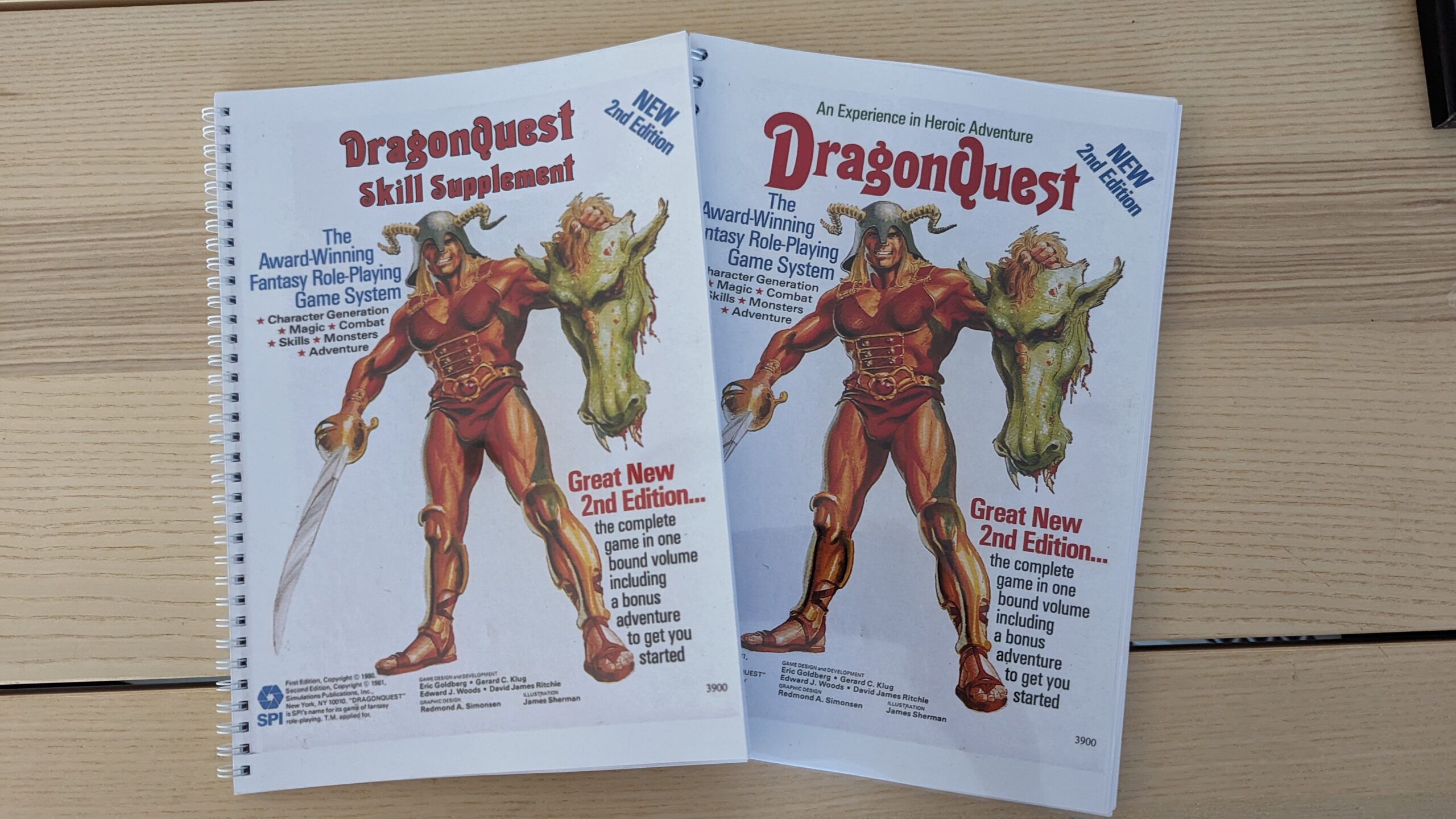
Spiral Bound copies of DragonQuest

The game itself, written and organised in SPI wargame rules style, with enumerated paragraphs for handy cross referencing, is a bit of a gem, full of early hobby play assumptions. It’s a classless system, with d100% resolution, where characters are created and designed around some core characteristics that you point buy from a random dice roll table. These characteristics, missing the familiar intelligence and charisma dimensions, can be rolled using a difficulty factor (multiplier) from 0.5 to 5. This provides a percentage chance that you roll for success. Once SPI folded, due to TSR calling in a loan, and possibly after the final 3rd edition, the design team moved to Avalon Hill’s ‘Victory Games’, and worked on the James Bond 007 RPG, which has the same mechanic as its core.

Heritage and Birthright is rolled for. You are assumed to play a human, but you can roll up to three times on a table to see if you can play a non-human. If you fail three times then you are human. Characters are then built up with choices of Professional Skills, which are like classes, but packages of skills that ascend when the Profession Skill Rank is increased. Weapons are chosen and a decision is made whether to play an Adept who can use magic. The game has a nicely detailed tactical combat system, played out on a hex grid, and copious schools of magic, with a tasty array of magic.

There’s a lot to go at, but I found that the game was actually lacking in useful skills, wheer the design had largely left out anything social based. I made a number of minor adjustments. I renamed the optional ‘Physical Beauty’ characteristic as ‘Presence’, to use in social tests. In the DQPA files is a document of 96 additional professional skills that can be spliced into the game and an expansion of ‘adventurer’ skills that can be picked up individually. This extension    is expected by the game’s third concept of flexible and modular design, that expects homebrew expansion. My final decision was how to ‘pro rate’ characters without having to drop into the experience point economy to buy individual skills. I needed my one shot characters to have some ‘Ranks’ under their belt. So I set up a simple process for acquiring Ranks to get a character going. They would be at about Rank4 and would be classed as early in the ‘adventurer’ tier of play. A quick Google Doc character sheet design gave me something to populate for a face to face game.

Just to say, that every skill has a completely different formula to calculate base chance and then a % increase per Rank, with skill Ranls being in a range of 1-10, but spell casting Ranks on a scale of 1-20. There is no simple integrated skill system, as per the contemporary Runequest. Although a complete pain, I have to say that is part of its 1980s charm.

I ran the game at Grogmeet, with a really great table of players, who were all happy to lean into the idiosyncrasies of the system.
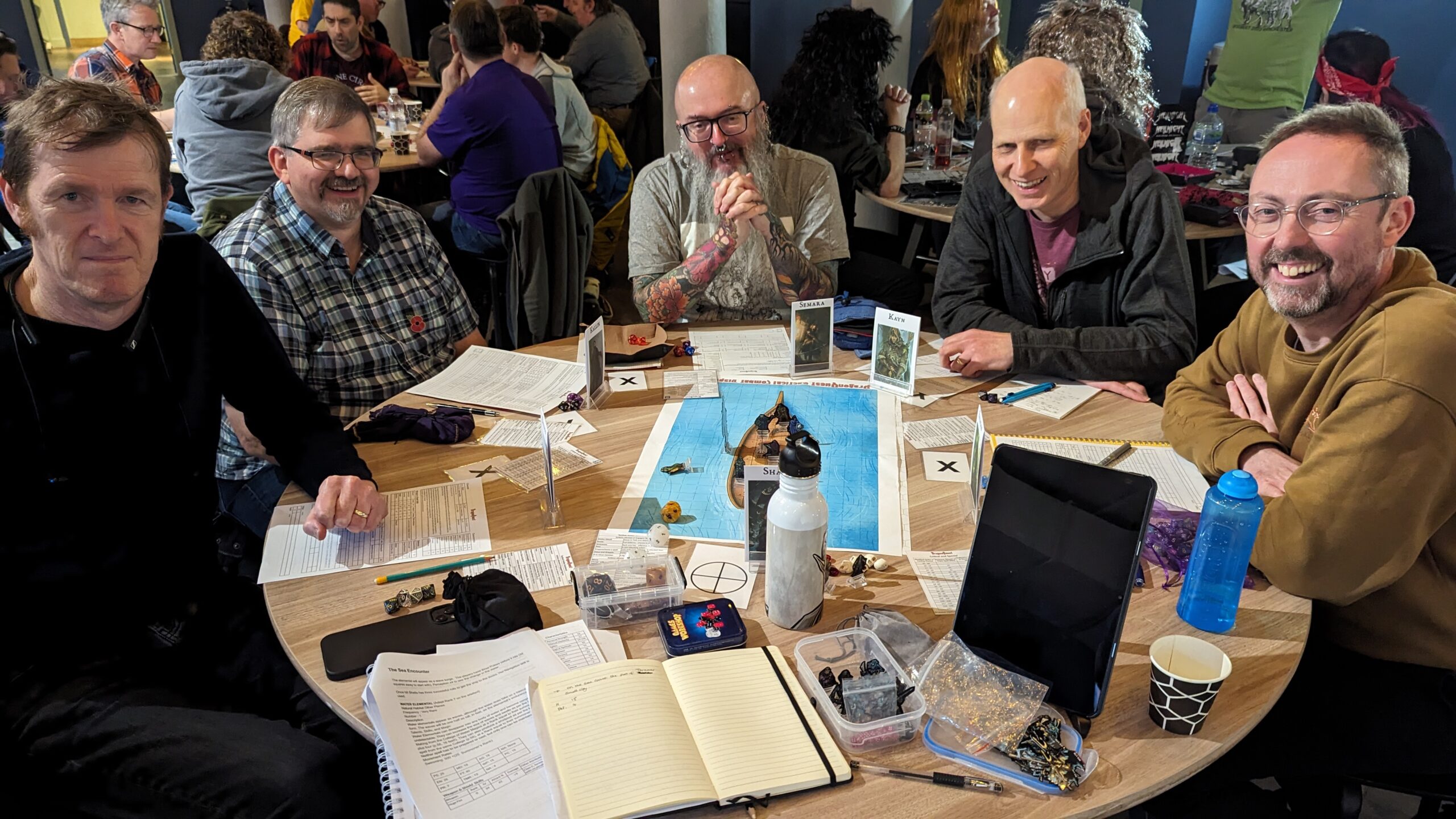
My terrific group at Grogmeet 2023

So, how does it play? The tactical combat is good fun, and even in the few hours we played, the action speeded up. You have to take a defence/evade % off your strike chance to give you your modified chance. This took some on the fly mental arithmetic. I had learned the modifiers, the difference between a passive defence and an active evade and how damage is applied. Basically, if you are going to run this game, learn it, know it. Damage is either a standard hit which armour absorbs and is taken off Fatigue in the first instance, or if 15% of your chance, then it goes straight off Endurance with no armour. Damage is rolled on a d10 with a modifier for weapon type and optional rules for high PS (strength) or skill Rank providing additional damage. You don’t have many endurance points (a range of 10-20ish). So, you hope for a standard hit, that your armour can absorb (yep, damage absorption) and that it is taken off Fatigue (range of 15-25 ish). If you roll 5% of your modified strike chance then it is an endurance hit and a chance that it is also a grievous wound, which has a d100% table of truly awful and probably fatal outcomes. There are three types of weapon: A – piercing, B – slashing, C – crushing. Each type owns a range on the grievous wound table. If your d100% falls within the right range then the gruesome effect applies.

Dragonquest combat is heart pounding and dangerous. I had printed out cards with the calculation of 15% and 5% chances for endurance and grievous wounds. For all the clunk, I find myself wanting to play the combat again, and draw on some of the other options that we didn’t explore in our game. Make sure your party has a Military Scientist Professional (I called the skill ‘Military Tactician’), as they are good at leading, and rolling the group initiative, as they add their Rank to the result.

Any hit, fatigue or endurance affecting that is equal to or greater than the target’s END/3 stuns the target. At that point the target is only able to try each 5 second pulse to un-stun themselves, leaving them vulnerable to attacks. There was a lot of stunning and hacking going on.

I included a mage in the party to give the magic rules a proper airing. Magic damage is slightly different in that it will always take of fatigue first, but armour does not count. The 15% and 5% rule also applies to the casting chance, enabling either a doubling or tripling of one dimension of the effect. Triple damage would be terrifying, especially if the mage managed to succeed with the cast!

In tactical play, a spell requires a pulse of preparation followed by casting, which costs fatigue. There is a house rule for fast casting at a cast chance penalty, but I reckon that would only be employed by much more established and confident mages. If a casting roll is 30% over what was needed (40% in non-tactical situations) then the mage suffers a backlash, rolled on a table. These are nasty, and came into play towards the end of the game.

Our mage was an adept of the College of Ensorcelments and Enchantments and had Rank 4 in some spells, but on reflection not enough. Base casting chances vary with every spell, and then increased through high Magical Aptitude characteristic and +3% per Rank. Targets typically get to roll their innate magic resistance, which is equal to Willpower, plus 20% if the target is not a member of any college of magic. The PC mage’s Bolt of Energy Spell (S2) Rank 2 was going off on a 63% chance to hit (D10-3 damage). At Rank 10, damage would be 1d10+5, about the same as a heavy blade, and with the chance of doubling or tripling. I worry slightly that I was using magic resistance like an evade, rather than a separate roll, which would have made the caster’s chance much lower. The caster also had the Spell of Charming (G1) Rank 4 at 34%. At Rank 10 (half way to mastery) it would clamber up to a 52%. Yikes.

Whilst acknowledging that there is a good chance that one magic backlash would ‘take out’ the caster, the range of colleges and spells available are great, and there is alot going on with meta magics too. Rituals of purification to improve magic resistance and casting chances, investing spells into items, warding, and counterspells are all in the mix. I think longer term play would reward this area of the ame greatly.
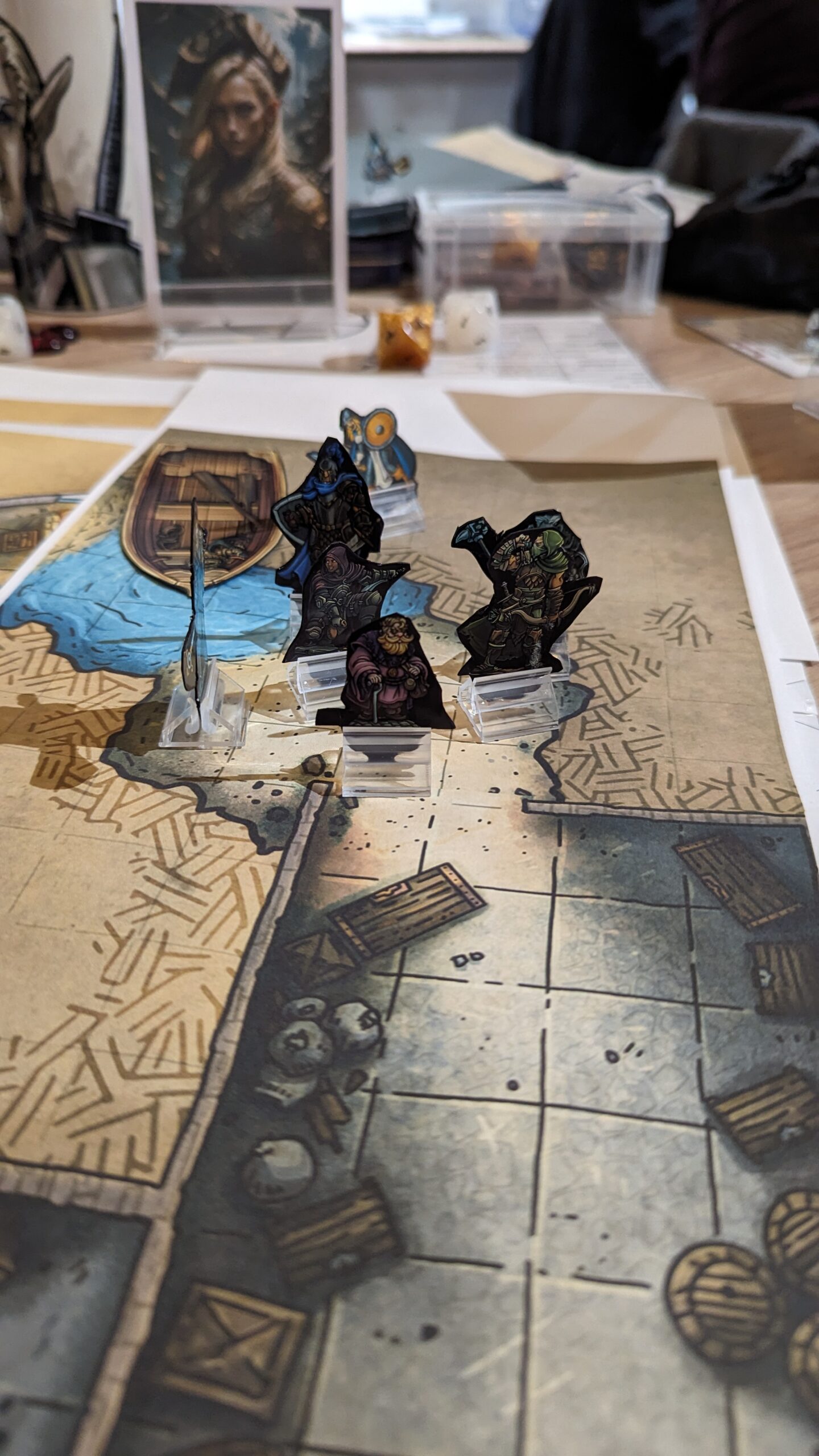
Action mid game

Would I run Dragonquest again? The answer is a qualified “yes”. I like the game for its early 1980 sensibilities and expectations. The mix of flexible characteristic checks, skills and profession groups, weapons and spells, gives you lots to go at to tailor the character you want. The game has tactical detail, which I like, and some depth around a percentage based core. It has danger and something of a sword and sorcery feel. I’d want to consider character starting experience carefully.

Cleaving to the game’s ‘concept three’, the inclusion of your own Professions is a work of minutes, which the game’s expectant broad shoulders will handle with ease. As much as I could go with handling social encounters with ‘just roleplay, persuade your GM, and roll on the Reaction table’, I’ve played too many games that give such encounters some mechanical support. I’d use ‘Presence’ and some persuasion secondary skills. There are some base monsters and a lot of natural animals, so you may need to make up some of your own adversaries, but that is no sweat given all the examples in the book.

If I get stuck, then I know what to do…
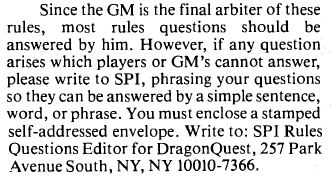
Help is at hand…

Inevitably, it will be the competing weight of other more immediately accessible and ‘in print’ games that might keep me at bay. That’s a hint by the way, to get me to run some online with you…
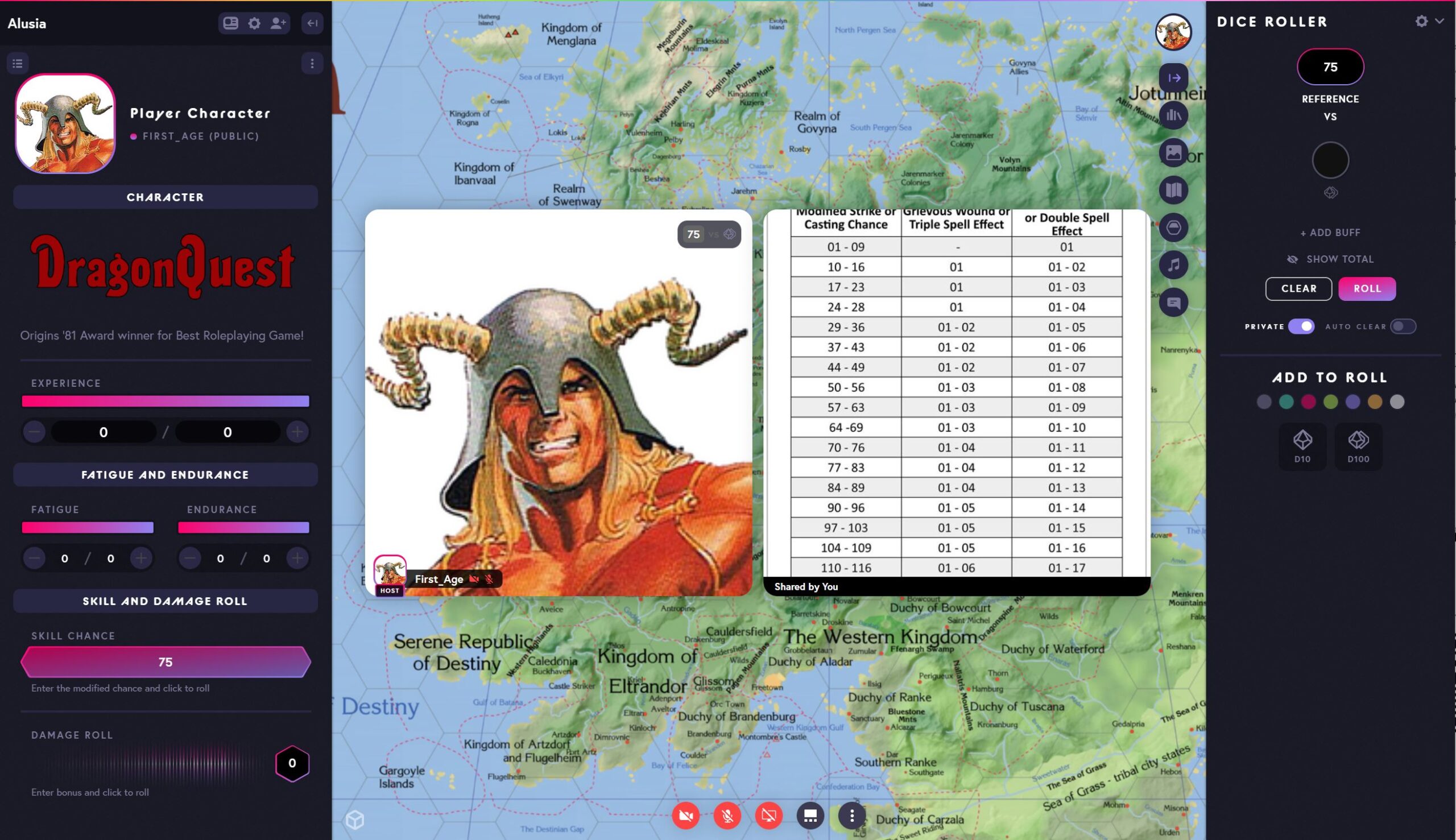
 

DragonQuest ready on the Role VTT

Posted in Uncategorized | Leave a comment

Dragonbane: Trudvang

It seems like an obvious connection, pairing the most up-to-date iteration of Drakar och Demoner, Free League’s Dragonbane, to the rich game world of Riot Mind’s previous system expression, Trudvang Chronicles. I have wanted to explore the Trudvang setting for some time, and had managed to get the base game out for a short convention run. Although fiddly, I was happy enough with it, and could see that, with extended campaign play, players would settle down with the proliferation of skills and somewhat involved action point economy. However, Free League have knocked it out of the park (again) with Dragonbane, an instantly accessible nouveau BRP-alike game laced with their customary design flourishes. It’s too good not to play.

It probably helps that the Foundry VTT Dragonbane system is an elegant and attractive implementation of a smooth game system. This makes online play so attractive. However, to get the system and setting to talk to each other I had to make some basic design decisions of my own. Do you just plonk Dragonbane wholesale on top of Trudvang? How much of the Trudvang setting flavour, expressed in game mechanical terms, do you bring into Dragonbane? After some thought, I have decided to bring the Vitner Weaving magic, and Dimwalker divine powers over to Dragonbane pretty much wholesale, as they are imbued with setting flavour. By far this was the biggest part of the melding process, at least so far. 

Creating Trudvang powers using the Dragonbane system framework

The Foundry Dragonbane system is extremely accommodating to extension in new directions, adding new ‘spells’, secondary skills, professions, and probably just about anything else. My conversion watchword was to stick to the simplicity of the Dragonbane game, watchfull not to bring over copious and unnecessary Trudvang skills and detailed power point spends. So, a blend of Trudvang flavour, with extended Dragonbane simplicity. So far, this seems to look OK.

Dragonbane: Trudvang characters ready to play

In some ways my conversion has been character led. Taking my six iconic Trudvang Chronicles characters, I converted them each across to Dragonbane, picking up the secondary skills and magic powers as I went. I have six Dragonbane characters ready to go.

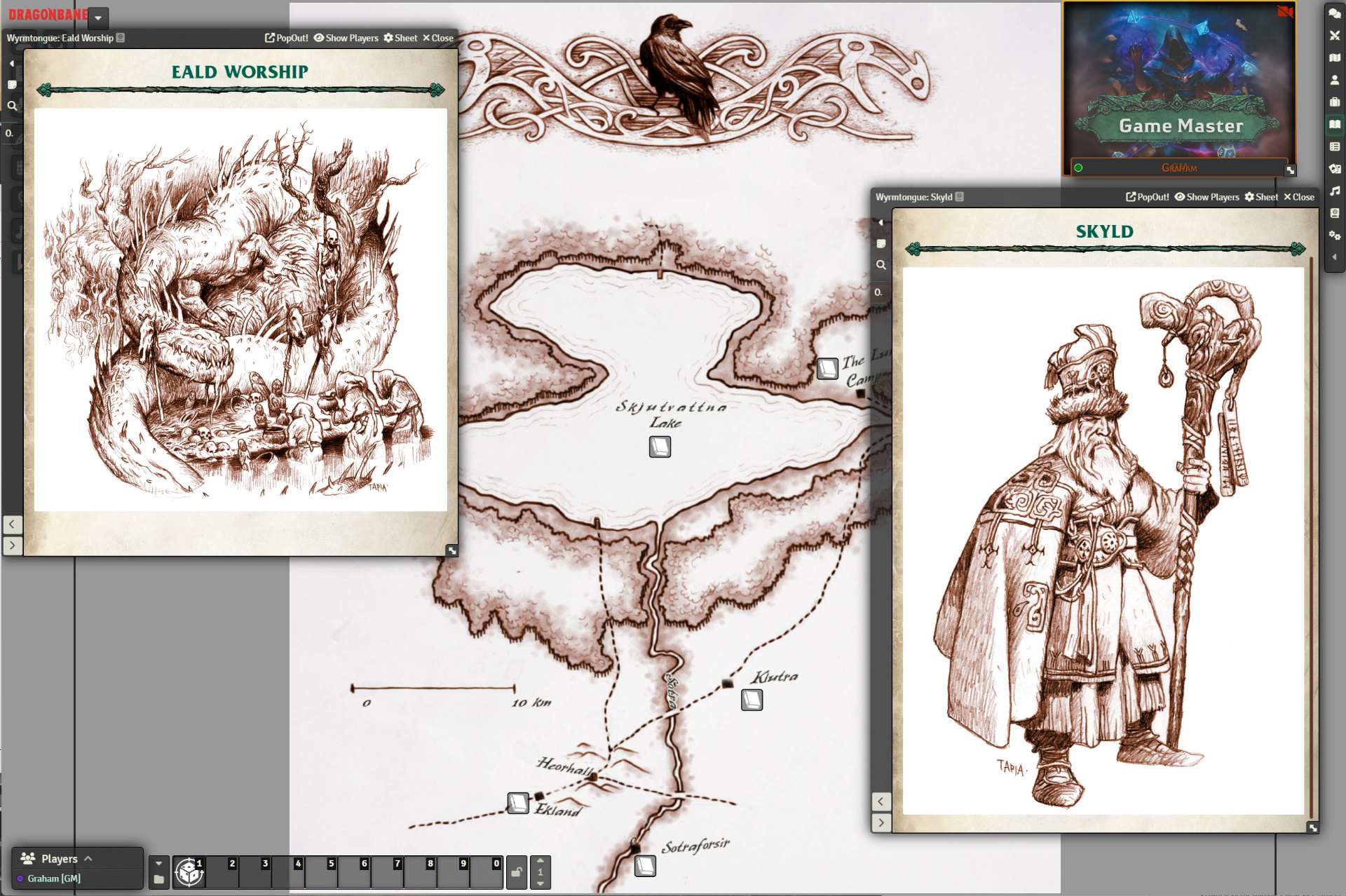
Of course, the watchwords are ‘actual play’, so the next step is to put together a game where all these elements can be tested out. In my digital vault of Trudvang, I have a few nice scenarios, including a few that were prepared for D&D5e. One of these is ‘Wyrmtongue’ a self contained aventure of 1-2 sessions that conveys the setting and tells an epic tale.

Wyrmtongue in preparation

This adventure is now all loaded in and ready to go. I hope to stream this game in the near future. It should prove a useful test bed in preparation for ‘Snowsaga’ a longer epic saga, that will need some structural work to be enjoyable. The adventure as written has a lazy railroad undercurrent, that needs stomping on from a great height by a suitably grumpy Hrim Troll. There’s lots to like about it, but after my Conan 2D20 ‘Shadow of the Sorcerer’ experience, I’m wary of these set piece A-B-C-D-Inevitable End structures. I shall weave some magic around it to bring out the fun, for players then to reconstruct as they wish.  

Trudvang Journaling

One of the real delights in this process has been the underpinning support of Foundry VTT. At present, I am developing accessible Trudvang world lore using Foundry’s powerful Journal system. In particular, being able to drag and drop journal entries onto maps to seamlessly create links between the visual and the written is just wonderful. Another week of this and I will be ready to bring Snowsaga itself into the VTT and make it ready for play.

There will be some tweaking to do once play commences. I’m sure some of the new spells will need some editing as we go, but the combination of sleek system and rich setting is quite intoxicating.

I just need to find some people who would like to explore this with me…  

Posted in Dragonbane, Games | Leave a comment

LongCon – Convention Design

As much as I enjoy one-shot convention ttrpgs, I really enjoy the longer form ‘Longcon’, where games last either a whole day, or full weekend. mini-campaign-alicious.

I’ve composed some thoughts, which are below. Please feel free to comment, to help me shape the organisation of such an event.  

Premise

Longcon is a convention that is designed to provide a shared space for groups to meet and enjoy all day, or all weekend, games in a familiar atmospheric gaming space with nearby local facilities and overnight accommodation if required. The focus will be on ‘long form’ ttrpg play, where we can break the shackles of one shot constraints and get in a mini campaign or deeper game experience. The space will also allow for in-between socialising with the fellow gamer family.

Different with Challenges

Longcon is different. The longer form play delivers some great opportunities, but also some challenges, which the convention organisation needs to address. Here are two of the main challenges:

RISK: “I’m happy to play in most one-shots, because they are just 3-4 hours in length, but I’m wary of committing to a whole day, or whole weekend game. What do I do if a couple of hours in I realise this isn’t working for me?”

CLIQUE: “Some games seem to be organised fully formed, with no opportunity to join. As someone not as well connected, this feels elitist and exclusionary.”    

Ground Rules

Longcon will operate under Garricon safety rules and the code of conduct and Harassment and Inappropriate Conduct Policy. There will also be an expectation of the use of some form of safety tools (see pitches, below).

Game Types

Longcon games will be entered into a shared online place, probably an editable Google Sheet as per some Garricons, so that everyone can see what is being offered. Games on the schedule will either be ‘open’, ‘partially open’ or closed.

  • Open Games – those that are available for the game selection process
  • Partially Open Games – some places will be available for the game selection process
  • Closed – no places available for selection

Game Pitches

GMs running games offering player places, will run an online game pitch during a specified week in the run up to the convention. This session will inform prospective players of the nature of the adventure, an idea of structure, and any other considerations such as likely content, safety tools in operation, how player characters will be generated, all to help inform players as to their interest.

Players can attend as many pitches as they wish. They are designed to help with game selection, so the more the better.

Game Selection

Places in games will be offered on a similar basis to the Garricons. Players will be able to put themselves forward, on a provisional basis for games. If there are enough games then this will allow for multiple ranked preferences.

  • Players will be allocated into games matching their preferences.
  • The initial allocation will be shared on the open view (probably a Google Sheet).
  • Game allocation will then be subject to a confidential moderation process. Let’s be clear, Players and GMs may have difficulties playing with particular people. During the moderation process players may need to move games. This will be managed sensitively by the games coordinator for Longcon.
  • A Final allocation will be confirmed on the Google Sheet

Session Zero

All GMs will run an online session zero for their game. This may include Lines and Veils, introductory information, any preparation for the game, potentially including character generation and forging motivation and connection to the adventure.

It is assumed that the place to discuss the game in the lead-up to the event will be the Garricon Hub Discord, however GMs can also create their own places to discuss the game.

Table Allocation

In discussion with GMs, games will be allocated Garrison venue tables for play. Depending on the size of the event, this may be spread over the usual three gaming areas.

During the convention

The LongCon games coordinator, who will also either be a player or GM, will be available throughout the event to support GMs and players as the games progress.

The process above is designed to mitigate the main issues that a Longcon format can introduce. At the end of the day, process can’t predict the multiplicity of human interaction, but it is there to help.

Posted in Conventions | Leave a comment

DragonQuest Characters


A quick update on DragonQuest Characters. They are mostly done for now. I’ve used a simple pro-rate method to give them starting Ranks in two professions, profession skills and adventurer skills. There’s some more fluff text to add, but they are pretty much good to go.

Download the characters (PDF) here.

I usually make character stands for my convention games. That way you get a nice evocative image and the characters’ names printed out and available for the other players to use. It’s usually a quick Pintrest grab for my own use and plonk them into Affinity Publisher. Some white A4 card and a slightly labouring inkjet printer later and I have them good to go.

I don’t know if I will get takers at Grogmeet, but the process of discovering this game has been great fun and I am sure I will get it to the table somewhere and somehow in the future. These five will also be loaded into Role VT for online play.

Also glad to have my two spiral bound copies of DragonQuest information: The 2.19 open rules and the DragonQuest skills document.

Posted in Games | Leave a comment

Furnace Convention XVIII

Our 18th Furnace(!!) was another fun gathering of 65 gamers or so, all together for a packed weekend of top RPGs. As ever the GMs had offered a great variety of inventive games and worlds for us all to explore. The weekend went really well!

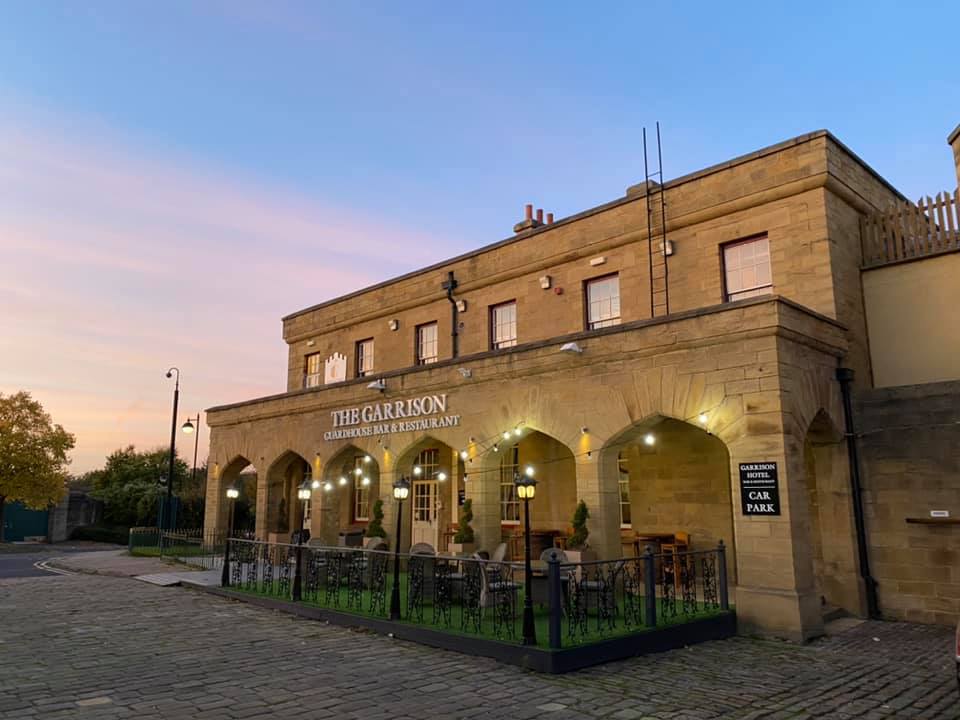
Without wishing to dwell, behind the scenes there has been a change at the Garrison, which has resulted in much poorer communication than we are used to. The experience of this in the run up to the convention, and thinking of our 2024 events, had left me with just a shade of uncertainty about how the weekend would go.

Of course, once there, some of the experienced staff were available to help smooth the way and so all
was well. I spent time in the gaps, bagging up rubbish and gathering glasses and returning to the bar as a help to the hard working staff. I could see how appreciative they were and it is those sorts of things that help cement the great reputation we already have with the venue. I reflected, as the glasses chinked on the tray, that this is exactly what my Dad would have done. He was always looking to help staff with what they were doing, in various restaurants and other hospitality. It is strange how these sorts of things suddenly bring him back to me so vividly.

Our attendees often comment on the smooth organisation and it must be said that, to a degree, the convention now ‘runs on rails’, but only because of Dom and Elaine. Furnace is a fully prescheduled convention, with preferences used as much as possible to fit people to the games that interest them. The process is vulnerable to GM drop out, which happens a little and most years, but our attendees are a lovely bunch and we always get there in the end around the edges of a solid programme. Registration, badges, raffle, comms, and other incidentals are picked up by Dom, while I do site liaison, finance and some focus for greeting, and whatever’s left. (Intro speech here.)

Although the event is a blur of games, we have generous meal breaks and usually some late night bar time. This one was no exception, all adding some convivial socialising in amongst the between, and in game, chat. Thanks to everyone that got me a drink, I don’t think I managed to reciprocate for everyone, so next time!

Patriot Games and All Rolled Up are great additions to our event. Michael and Paul helped us out respectively. I think we all missed Fil this year and are thinking of her and really looking forward to seeing her again next year.

My games seemed to go down well, and I enjoyed the two that I played:

GM – Dragonbane – The Village of the Day Before. My second outing for this adventure and it is a cracker. Suffice to say that there was much mirth with the mayhem, as the game advertises, and the core mystery was solved. I love this deceptive game. Easy to let it pass as a beginners’ game, one that’s too light, or traditional for the more discerning gamer. There are depths to the intuitive design, a quiet power to its simplicity, and consistent delight from those trying it.

During the convention, Free League announced the pre-order for the Bestiary (with cardboard standees) and the hardback rulebook with new adventure. When I got home I dived in and I think the Bestiary confirms that this game is going to see a lot of play.

Player – Sanction – The Red Drop. Paul Baldowski ably ran his fresh and successfully Kickstarted roleplaying game. What riotous fun as we leaned in, perhaps a little too wholeheartedly, to the premise that we were MI5 rejects, too crap to hold down a real position in the intelligence community, and pushed into an underfunded and poorly regarded ‘agency’ for much lower grade tasks. I’m glad to report that we did not disappoint, as we seemed incapable of engaging with a scenario that may have had some depths, if only we had the wherewithal to find them. My character had the personality notes ‘arsehole’, ‘frustrated’ and played what I was given. In the last hour, as our floundering failure became inevitable, I started to jot down names for the comedy TV series that we could commission. The list included:

  • The Spy who Died in the Cold
  • Spy Hard
  • The Least Wanted Men
  • Spy Another Way
  • Monkey Tennis
  • The Spy Who Failed Me
  • Quantum of Failure
  • Blunderball (from Tim Gray)

Good times.

GM – Genesys – Ashes of Power. I was really glad to get Genesys out for a run round in this space opera set in the Twilight Imperium universe. There was some investigation, some blaster blamming, and fun interplay. The Genesys dice roller app provided newbie dice support and the game blazed an amusing trail for a few hours.

Player – 2D20 – Ghosts of Tsushima. Pete Atkinson has built his own custom game from the 2D20 SRD and delivered a fun and action packed mediaeval Japan classic. A really fun game. We are playing a lot of 2D20 at the moment and confess that there was some side enjoyment just seeing how Pete had woven his own take on the toolkit. The game worked well, with extended contests used along with montage to speed significant action into a manageable convention slot. Inspiring adaptation which I hope to play again.

GM – Genesys – Orphaned Star. Another outing for the Keleresspecial operations team and another mystery on a remote planet with a past. Unexpected diversions on the way to the mission site created an in-game time delay that ripped up a core encounter and got me to flex two sentences into an hour’s play. Players seemed to enjoy the space opera and delivered it all in good time for people to get away to various homes near and far.

Genesys hadn’t seen any play for a few years, so I was a bit rusty, but it soon came back. For all the abstraction and symbols on the dice, the game itself is very easy to run and gets you buzzing about the Advantages and Threats generated by the dice. I’ll be running some more, and a possible plan was forming for Seven Hills in April.

My thanks to everyone for a great weekend. Top games from very good GMs, ace company with the customary friendly vibes. Those pre-convention shades were banished very early. Our philosophy is that organisers are attendees too, allowing us to run games and enjoy play. We did just that.

I’ll sort out dates for next year and let everyone know.

Posted in Conventions | Leave a comment

Pro Rating DragonQuest Characters

Perhaps one of my more specialist blog posts! I’m planning some convention DragonQuest, and wanted a method to uplift starter characters to a higher degree of competance, edging into the ‘adventurer level’.

Initially I looked at generating a pool of Experience Points to spend, based on a number of successfully completed adventures at the ‘mercenary level’, and then buying Skill Ranks and Characteristics at the book cost. Whereas this would work, acknowledging the huge leg up starting Mages get with their College of Magic Rank 0 startup, I just felt that this was way too much faff for me. Nervously, I recognise that ’embracing too much faff’ is exactly the mentality for being a DragonQuest GM.

My core rule reference is DragonQuest Version 2.19; Last revised 20th July 2003. This is the DragonQuest Open Source Document (DQOS) based on the 2e rules.

After some chat with the DragonQuest community (yes, there is one) on Facebook, and on the basis of “[2.1] The rules are intended to guide, not restrict, the GM”, I am going to use the following as my ‘quick’ character generation

[4.4] The effects of an optional characteristic must be determined by the GM.

I am using the suggested Physical Beauty, though it is likely to be renamed ‘Presence’ (PR) for broader application. As per [5.5], this will be generated by a random roll of 4D5+3.

I had wonderd about including Charisma and Intelligence characteristics, but instead will use Presence and an application of Willpower, along with some of the extended Profession Skills noted below.

Follow character generation as per the book up to and including [8.4]

Replace [8.5] with: 

Mages

1 x Weapon Skill at R1
4 x Adventurer Skills at R1
1 x Profession Skill at R2 (or two at R1)
1 x College of Magic as per rules.
4 x General or Ritual spells at R4
1 x Specialist Spell at R2
Perception base = 10

FP +2

Everyone else

4 x Weapon skills at R4
3 x Adventurer Skills at R4
2 x Profession Skills at R4
Perception base = 10
FP +2

2 x Characteristics +1

Notes on Skills

Languages

Speak and Read/Write Common plus Kin (if applies) at R8

One other language of choice, Speak and Read Write at R3

Adventurer Skills (These may be added to as the game develops)

DragonQuest have two types of skills. Everyone has Adventurer Skills, and I give everyone Rank 0 in all of them. My adventurer skill list is as per below, with the starting % formula for each:
 

Climbing (3xMD)+(5xRank)
Carousing ((2xPB)+WP)+(5xRank)
Riding (WP+AG)/2 + (8xRank)
Stealth  (3xAG)+(5xRank)

Swimming ((2xAG)+MD)+(5xRank)

These might be added to, if actual play suggests a gap. 

EDIT – I have switched to using the DragonQuest skills document, a huge compendium of 65 skills, as well as other suggested DragonQuest additions, by Christopher Dargan & Others. 

Find it here: http://www.dragonquest.org/files/index-dqrules-skills.html

Profession Skills

The other type of skill is like a profession. These are more costly to gain and improve because they grant a whole series of abilities as you ascend in Rank. You rarely roll specifically on the profession itself, but rather on the sub abilities that they provide. I am to be including the following profession skills from Worldly Endeavour 2.0 house rules:

Acrobat, Administrator *, Architect/Builder *, Armorer, Arms Master, Artist *, Berserker, Bowyer/Fletcher, Cartographer, Chevalier, Climb, Devotee, Gambler *, Homemaker *,  Hunter and Fisherman, Martial Artist, Miner and Prospector. Orator *, Planter *, Sailor,  Scholar *, Teamster *, Tradesman *, Weaponsmith.

EDIT – see above for the link to the skills document I am now using.

The house rules suggest that Ranks in those professions with a * do not count towards Tier progression.

Start with armour and weapons with which you have Rank. Start with 200 Silver modified by status in [8.1] and [8.3].

Were I to be running an ongoing series of adventures with these characters, then I would need to consider the assumptions in the core game. It could be that I just switch back to XP awards and develop from this base. I might also be generous with Training Times and Healing Durations. It’s fine to have characters out of action for weeks of in-game time if you play a seasonal game, or embrace the game’s assumption that you will be running up to six characters simultaneously. I may well do neither.
Gosh, I actually think I have managed to out nerd myself!
Posted in Games | Leave a comment

DragonQuest: The Fifth Book – Worldly Endeavour

Having recently jumped into DragonQuest, I am testing its edges and expanding the game where it expects and encourages. With no practical experience of the game, I’m running on instinct and the GMing Rank 4 ability: Table Sense. To be clear, this isn’t about changing the rules, they will played as written, but looking at the periphary and the gaps that the game itself acknowledges. 

With much of the game now found in freely available PDFs, but hard to find in print, I have stumbled upon the definitive trove of lore at the DragonQuest Players Association.  Tucked away is the unofficial fifth book of DragonQuest, Worldly Endeavour. They are Stephen Clark’s house rules, and well done, largely expanding the few skills in the core game. His website has gone, but the rules live on.

Linked with this is an expansion of professions, including a small number in bold that might appeal to adventurers. Today, they all do, but this is old school focus, so the others, though available to all, are designed to flesh out everyone else in the game world. Hello Aristocrat, Innkeeper and oh so many more, all fleshed out with tiered abilities.

There’s more with Devotional & Deities, to bring the holiness in amongst the colleges of magic, with ‘White Magic’ introduced here.

An extended list of livestock and retainers, with barely a distance between them, and more about birthrights and thoughts on starting character skills. There’s even a half-elf in here.

Perhaps most hilariously is the concluding 6.5, Sex in DQ, a series of “ideas for adding sex to a DQ adventure or campaign for heterosexual interaction between consenting adults.” You have an optional Libido characteristic, Seducer and Lover skills and the Barmaid profession. Oh dear, oh dear. 💋

Despite this, the main expansion of skills and professions look to be very useful, with many of the ideas finding their way into my own game.

I’m daft really.

Posted in Games | Leave a comment

A rumble through SPI’s DragonQuest – play like it’s 1981!

As happens every time a Grogmeet emerges, I scurry off to bury myself in a game from ‘back in the day’.
Today, I have taken a joyful canter through the densely enumerated DragonQuest (2e), to look in some depth at a game that passed me by at the time, but continues with the enthusiasm of a cadre of dedicated players. 

Fantasy roleplaying, as a way to spend one’s leisure time, has come of age in the last five years. Since the days when a small group of devoted die-hards first uncovered an enjoyable fantasy roleplaying game, the idea has attracted an ever-growing body of people whose divergent tastes demand innovative and original new works. Thus, enter DragonQuest.

Three general themes guided the design and development of DragonQuest and make this game different, and an improvement on other roleplaying games 

Thus, enter Dragonquest… I love to read games from back in the day, time capsules of early enthusiasm, confidence, and even heady arrogance. Who would then have thought of the voluminous divergence of today, or that this game would have such a limited published life? When you are in the midst of the text, all those future realities fall away; you are right there with the writers, in your leg warmers and flouncy shirt,  as they put down the all encompassing RPG of the eternal future.

The three themes were:

  • Classless – without the restrictions of a certain other game. The game leans into a more RQish openness with players able to choose pretty much everything from weapons, skills and magic, with inbuilt limitations from the implied setting
  • A kind of verisimilitude by using creatures of our own legend and myth. Probably overstated, but the list is big enough from which extrapolation can build out any classic adversary. 
  • Flexible rules that you can add to without breaking the game. That seems right, not least because the rules are some thing of a patchwork that can be similarly patched without affecting existing similar rules. There is no ‘Charisma’ or ‘persuasion’ style ability, but a big reaction table (Rule 132), with a lot of hand wavium for modifiers to the reaction roll. I’d like to add a Characteristic for that, and the game is comfortable for me to do so.

The game is 40 years old, and it shows its age. There are many softer assumptions that wouldn’t fly today, but I’m not judging the game for being of its time. Here’s one on gender.

[6.1] A player may always choose the gender of his character.

A character must be either male or female. Every race described in this section comprises only those two sexes. A character may only be hermaphroditic or asexual if his player receives special permission from the GM.

Each player should choose the sex of the character. It is recommended each character be the same sex as the player. Roleplaying a character whose entire gestalt is alien to the player is hard enough without a change of sex. If the player wishes a character of the opposite sex, the GM should warn him (or her) of the difficulties, and judge that player’s characterization as closely as anyone else’s.

The Physical Strength of a female character is decreased by two, but her Manual Dexterity and Fatigue are increased by one.

A character’s gender may be changed only through deep magic, or by a deity.

There are other assumptions on play style and session length that probably don’t fit so well today, but make me want to run an all day game at home as if I were a student or retired. Wait…

There’s a very C&S ‘birthright and aspects’ section that plays into future skill checks and reactions which looks quite nice, though I’m not sure if there is much payback for remembering to apply the effects in play. You can be a shape changer, giant or an orc along with the other more usual heritages. 

The game is purely a d10 based percentile resolution system for arracks, spellcasting and skill checks. Skills are a grouping of abilities that feel like ‘professions’ and only focus on ‘adventuring’, though even then with gaps that I think can be plugged with the Characteristic check rules. Healer encompasses a spiritual power as much as practical arts. Damage is a d10 with modifiers, as is a melee parry/reaction evasion. You’re encouraged to use a set of playing cards if you don’t have some d10 to hand.

Melee combat is played out tactically on a hex grid, to pick up ‘facing’ which provide chunky modifiers on to hit rolls. There are a number of small edge cases and procedures that need learning, but it looks highly playable and reasonably straightforward. Armour absorbs and damage can come off fatigue or endurance depending on the attack roll. There’s a deadly grevious wounds table as well to keep your character out of the action for weeks whilst recuperating. That’s OK though, as everyone likes to have up to six characters on the go, though you are advised to only play one at any one time, and interactions between your stable should be kept to a minimum.

Magic is well described with many arcane schools, in which you must become an adept to learn the talents, spells and rituals. This hones your choices and provides an in-game speciialisation. Magic backfire is certainly a thing, you are playing with fire.

Downtime is riven through the game. Either training for new ranks in abilities, or spells, or recuperating from injuries, all the while spending upkeep. Before long you will have blown your money and will need to get back out there, refreshed and slightly upgraded to face more terror and treasures.

Here’s the guidance on experience point rewards:

[160.1] The GM should make one set of Experience Point awards for every five hours of effective play during one session. The players are effectively playing their characters when the characters are attempting to complete a mission (i.e., discounting time spent by players in eating or arguing, or time spent by players on inconsequential activities).

The five hour measure of time is intended as a flexible guideline. If the GM runs an especially long play session, he will probably want to reward the players for their patience and sustained acting of their respective character parts. The totals listed in rule 160.2 are also intended as guides for awards given during an unfinished adventure.

Stop messing about and focus on being in character, you’re on the clock with five hour blocks.

I can’t help liking the game, as much as a curiosity of its time. There are borrowed innovations that set it apart from D&D, whilst the very few design gaps can be plugged with the encouraged additions a GM might wish to make. I’m probably beyond the point of no return to get this one to the table.

Would anyone play?

Posted in Games | Leave a comment