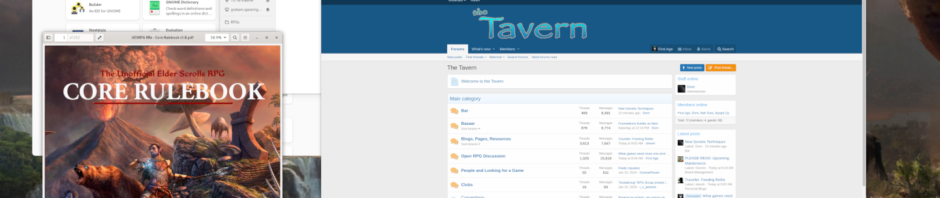
Well, I have gone and done it, and switched operating systems on my main PC, moving from Windows 10 to the Fedora 39 Workstation Linux distribution. There is that moment, when you look at the disk partitions, and hover over the ‘remove’ option. Took a deep breath and away went Windows.
Preparation has involved a number of slow forming things. My cheap second hand laptop has had Fedora since it arrived, allowing me to get re-acquainted to the lovely Gnome desktop environment and some of the apps that are a few clicks away. I go back to 1995, when you had to hack config files to get the monitor to display something, so it is safe to say that the desktop Linux world has moved on. It’s a really smooth experience now, with a library of apps that I wouldn’t be without.
I threw some money at the move, doubling my RAM up to 32 Gbs of DDR4 and 1TB of M2 storage. A small investment into the little tower that my son built for me a few years ago. The system should see me right for years ahead.
The switch felt a good option for me, and now I discover the joys and, no doubt, some of the wrinkles and problems.

Data that was not already Cloud based was shoveled onto a portable disk, for a considered return when the new system was up and running. The Fedora Media Writer makes it very easy for you to create a bootable USB drive with the operating system poised within to launch and install. A quick hack of the BioS to enable the correct boot order and there it was. The only tricky piece came when I moved to create a Virtual Machine using Boxes to run Windows 10 inside the Linux distribution itself. When I got a ‘no KVM’ error, some smart googling was needed to find the BIOS setting on the motherbord that enabled virtul machines, lost in the depths of CPU frequencies. I fancied myself an apprentice sorcerer who was delving into blasphemous and dangerous lore, in which I could so easily lose my soul.

So, I now just need some fonts and some patience as I acclimatise, but it feels really good and will prove to be an enduring productive base.
I have, already, had my first gotcha. I play with a tabletop roleplaying game online streaming group, where the GM has very particular display requirements for his Roll20 VTT sessions. For technically inexplicable reasons, he doesn’t seem to be able to get what he wants with Chrome based browsers so we use Firefox. I ran a test of my new Linux system using Firefox and everything looked great, only to find, when we were all online, that no-one else could see my webcam, though I could see everyone else. I had to scuttle off to a back-up option. I’ll keep trying, but that might just be one that I have to let go. I’m hopeful that a Chromium based browser in Foundry is OK…
More to come.