I was inspired by the extended conversation on Che Webster’s Roleplay Rescue with Anthony, aka ‘Runeslinger’, from Casting Shadows. I’m a regular listener to Che and recommend you check out his podcast here:
https://shows.acast.com/roleplayrescue
I’ll try to summarise the excellent conversation. The hobby has trended over many decades to be described as predominantly a structure to tell stories together. The touch points for this include the White Wolf storyteller games and Monte Cooke’s Cypher system. This narrative experience is seen as the primary goal for the process of play. We play to tell stories. The concern expressed in the podcast conversation is that roleplay game play is actually about other things, particularly the inhabiting of created characters, alternate antagonists and experiencing a believably constructed fantastical alternate world through their eyes. Story will, or course, inevitability emerge through the conversation and process of play, but this is different from the active and ongoing construction of either a predetermined fiction, or the managing of story beats to create a satisfying story.
Is the older, perhaps more traditional, mode of play a dwindling twilight view of story as by-product, as opposed to the main product of the game? There is a pervasive caveat that much of this is about preference, style and a shifting perspective in styles of play that strengthens and enables a player to inhabit their character and live their life in the shoes of another. You will find a more structured view of the ‘story divide’ in Anthony’s blog:
https://castingshadowsblog.com/2025/05/31/the-accidental-lie-in-rpgs/

One of the great features of the conversation was the return to original sources, a choice selection of games over the years to investigate the language being used to describe what roleplaying, in the context of the roleplaying game book you were holding, was actually all about. Taking inspiration from this I decided to pick up FGU’s Chivalry and Sorcery 2nd edition boxed set from my shelves. The C&S text is a powerful pull for me personally. In the rollercoaster of life, the text became a source of comfort when things were going through a difficult phase. Reading the game again brought a strong reverberation of the past and some appreciation of the intervening years.
So, heading back to a 1983 publication date, with already a corpus of text on the subject, how does C&S now describe a roleplaying game? Well, considerably different to the 1977 1st edition, as we now meet the ‘Gamemaster Storyteller’. This is chronologically well in advance of anything written in the White Wolf Storyteller games. Did the shift to RPGs being, principally, or even in principle, story telling exercises happen even earlier than supposed? Here are some short elements from the early C&S chapters ‘On Being a Gamemaster’. There is also a subsequent section entitled and On Being a Role Player’, however the balance of the text is weighted much more to the heavier role of Gamemaster.
A Gamemaster needs to be a:
- Master of Rules – know the game part, understand the book and house rules and apply them impartially and fairly. You have the final word.
- Creator of Worlds – and make it fit for effective role play. It is a task that depends upon the imagination, expertise, intelligence, and plain common sense of the GameMaster.
- Teacher and Advisor – your task is to instruct Players about your view of role playing so that they know how to play in your world. Present the world so the Players know how to deal with it. Instruct on the rules and any house rules and assist players if they have difficulties with a particular rule.
- Storyteller – here it is… A fantasy role playing game is a akind of enactment of a heroic tale, and the GameMaster is the narrator who tells the story and keeps everything tied together. Players, who have excited imaginations, will add to the general outlines of the ‘story’ through role-playing their characters as the events unfold. The GameMaster will respond to play and modify the general story to match the effects the Players are having on the course of action. In short, you the GameMaster must be prepared to accept the fact that the Players are also ‘storytellers’ who can influence your own plans and ideas. course
- Role Player – breathe personalities into your NPCs. Without giving your NPCs a life of their own, then the whole activity is really a farce. Your NPCs gve you a chance to play characters.
- Bookkeeper and clean-up man – deal with detail so that everyone knows what is going on, moment by moment.
Put in dramatic terms, the Gamemaster is a combination Playwright / Director / Stage Manager / Producer / Actor. Put another, perhaps more frightening way, the Gamemaster is Fate, God and Everyone Else besides the Player Characters in the fantasy world. GameMastering is a great responsibility, but it is not as difficult a task as it appears if the Gamemaster knows the material, is organised, and has prepared himself beforehand. Indeed, it is an immensely satisfying experience.
Each of these sections are then given greater exposition, with a lot of interesting takes. The text is, of course, rooted in a slightly earlier age, but I think it does a good job of describing a trad GM who has ‘a sense of duty to their players’. After all, if you have 8-10 players, you really need a ‘Caller’ to stop there being so many voices all at once. Ah yes, them warr days.
The storyteller GM is what I recognise in most trad GMs for the past forty years. Apply the rules well, play the game, create a story structure, allow the players to respond and make their own stories, weave them together to create a shared narrative that arises out of collaborative play. If there is a divide, then my old favourite sits on the emergent side, where story is developed as play progresses, with as much emphasis on game and situational resolution for its own sake.
It was nice to go back to the text, though my initial excitement for something more radical wasn’t really there in the detail. I didn’t really think it would be.
Is the term ‘storyteller’ and ‘storytelling’ misappropriated by modern texts? Do we actually all mean the same thing?Do those terms need to be ‘reclaimed’ for the more mainstream emergent story, the narrative created through character driven play, perhaps guided by adventure design, but diverging as the group create their own pathways? I’m not sure it does. The vast majority of my play experience of forty years has found us telling a story, it just generally formed as a byproduct of our chaotic play. The personal character arcs combined or clashed to give a group outcome. Some of our stories were better shaped than others, but they were all fun, because the play was the thing.
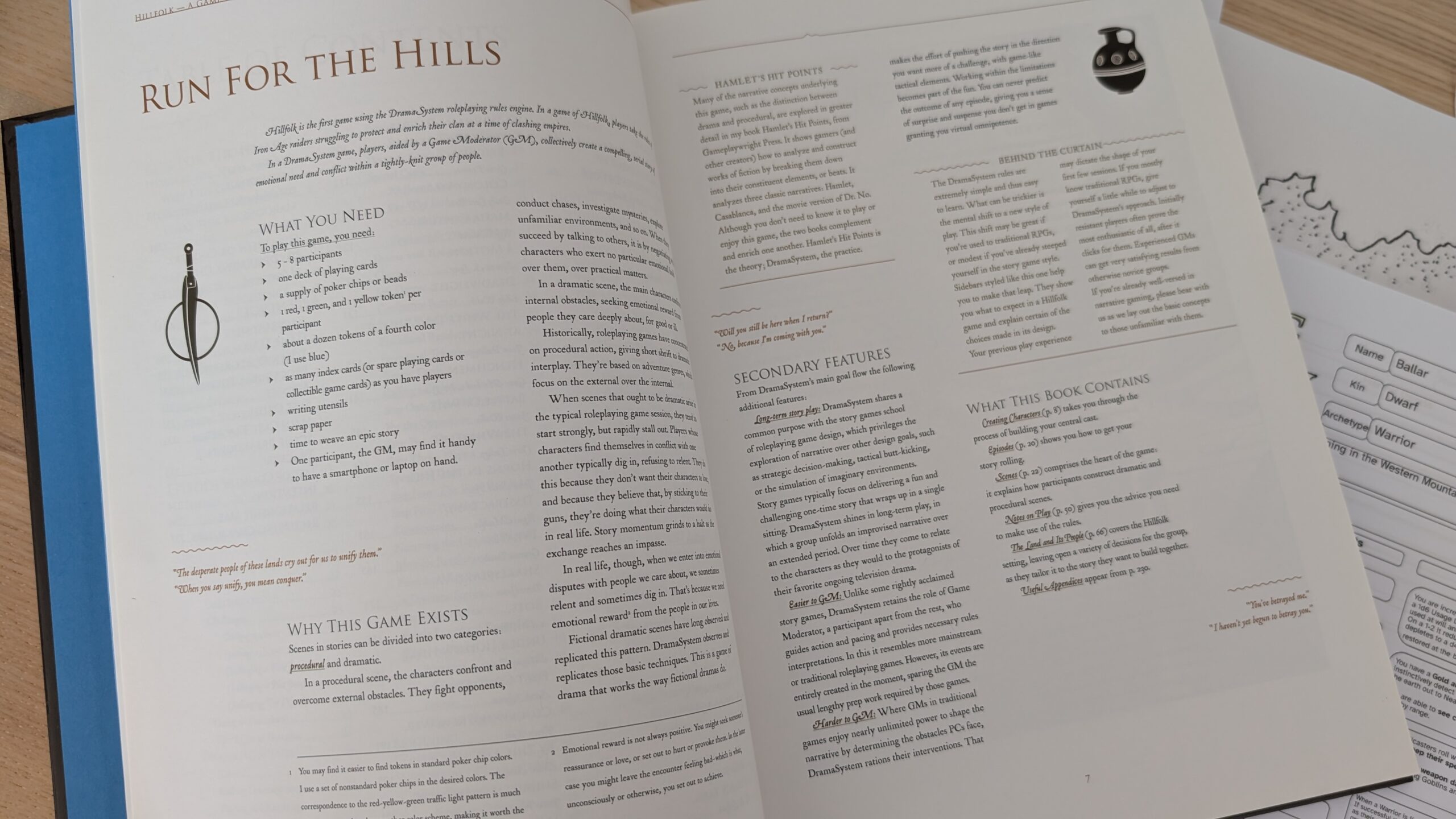
Not that there is anything wrong with a game that is more obviously designed so that a playing group can create a compelling story, sometimes within a set number of sessions, as the main artefact out of the experience. If that is what a ‘Story Game’ is, then even after all this time I have played very few. I have really enjoyed DramaSystem games ‘which privileges the exploration of narrative over other design goals..’. Even here, I have only played Hillfolk as one shots, where the game is actually designed to create an improvised narrative over longer form play.
Perhaps I am wary of the notion of a divide, because I have only played on one side of it, so that the apparent wall seems relatively inconsequential? Is the divide an ephemeral mist of loose taxonomy not actually carried through into actual play experience? Or, perhaps, even now, I need to get out more? Perhaps I need to run for the hills?