I appear to have an unhealthy attraction to ‘designed in the 2000s’ fantasy D20 games. FantasyCraft is my third after Dungeons & Dragons 4th edition and Green Ronin’s inventive True20. It’s not as though I have any meaningful history with the originating source of Dungeons & Dragons 3.0 or 3.5, as I went from University AD&D 1e shenanigans to anything but ‘Levels and Engorged Hit Points’ for more than 30 years. I may have played the 3.5 era once or twice due to test plays via Pete, my perennial D&D friend. Not much of a pedigree.
So, Crafty-Games’ FantasyCraft then. This heroic fantasy take on their super flexible Mastercraft system has so much to recommend it. My nearest touchstone is another 3.5 re-imagining via the True20 RPG, contemporarilary published by Green Ronin. Though both games take some of the core D20 system, they vary significantly in overall design, whilst both being excellent games in their own right. I say this on the basis of a FantasyCraft read through and many years of experience. I can generally and reliably tell when a game has the fun play juices within it, however this needs to be confirmed through actual play. Only then will I really know. Take this blog post as one of those excited ‘First Looks’, sixteen years after the fact.
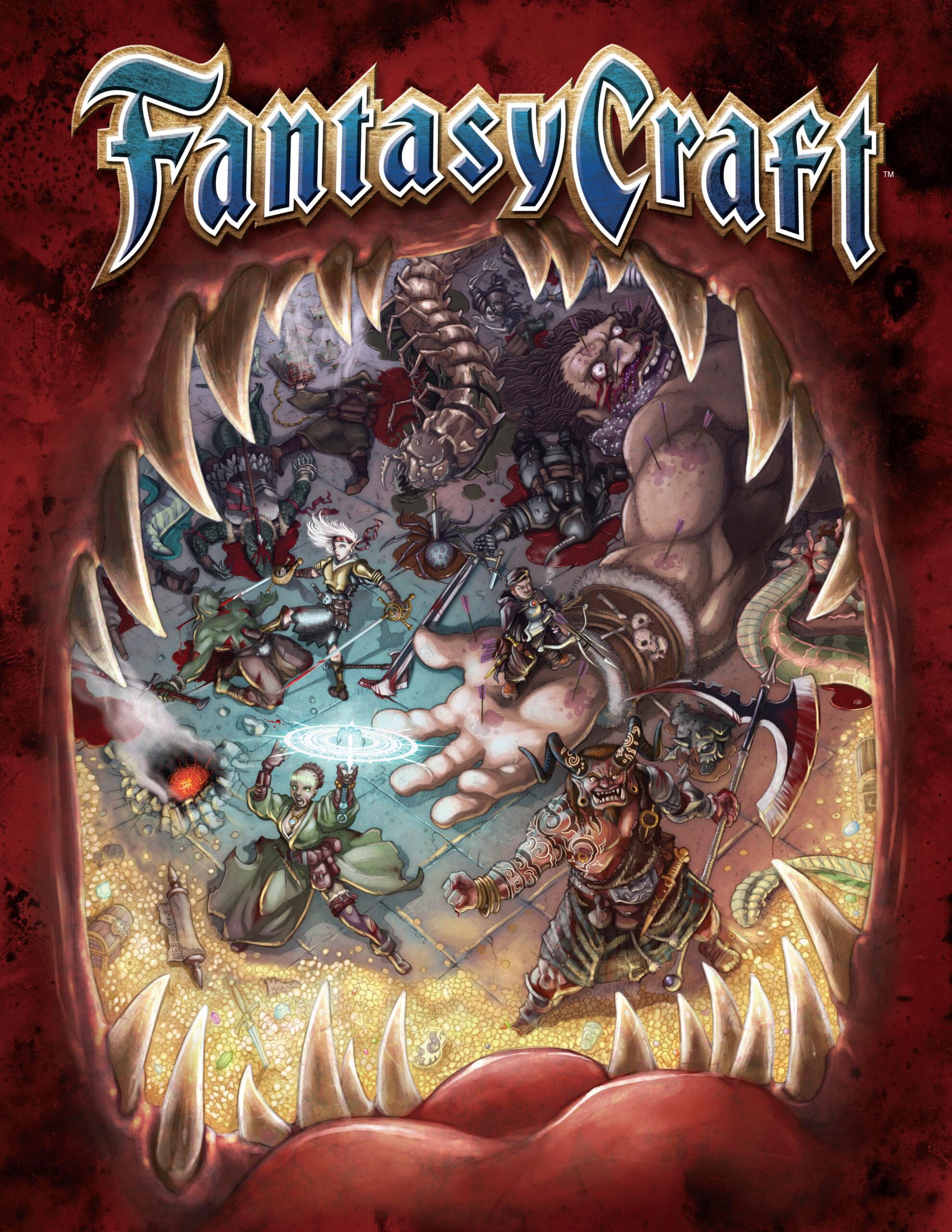
What we have here is a very full, option festooned, Fantasy D20 game, ready for your own hacking and building. There is a mostly full game here, where you pick various approaches and themes for the game that you want to present. At 395 pages you have a vast and somewhat dense game, that will need absorbing and assimilating, careful considering and detailed preparing before play. This is not a pick up and play game. The delicious variances to the D20 system need a good understanding, even though the surface game can be quickly picked up, keeping the D20 plus a bonus to hit a Difficulty Class mantra.
Starting in the middle, and why wouldn’t you, I see that this exciting system properly embraces and makes a feature out of the D20 level bubble. Hey, says every D20 player for ever, as I go up levels, all the monsters go up levels, so all the numbers are larger but my chances are about the same. You’re in that bubble of managed heroic competence, facing ever more horrendous foes as your shiny ability buffs ascend to stratospheric heights.
In FantasyCraft this is explicitely called out with the threat level system. Foes are rated on a grade of 1-10 in a number of key areas, such as Initiative, Defense, Attack, Health and Skills. Then, to work out their bonus numbers, you slide along a 1-20 ‘Threat level’ that corresponds to the average of the player character level. Quite literally, the NPCs and foes journey with the PCs on their ascension. There’s more here though, as foes have the same base, and classic six, characteristics as PCs which provide bonuses, and physical size, which affects wound totals. They also have templates, such as ‘Ancient’ , ‘Clockwork’, ‘Dire’, or ‘Lich’, which modifies the base foe in a particular direction. Add in extraordinary attack types, gear and treasure and you emerge with a massively flexible system that can build anything from a peasant to a fearsome lich drake.
FantasyCraft provides a rich set of components to build any character or foe that you may wish to create. It’s a feat heavy game, with each tightly described and voluminously listed. Player Characters are rated as ‘Special’, and protagonists can either match them or be rated as ‘Standard’. Special characters get both ‘Vitality’, a level engorging sack of hope, bravery, bruises, and inconsequential scrapes, that keeps them in the fight, and also ‘Wounds’, a largely static and small number that measures real bone crunching, life limiting endurance. Standard characters simple get a Damage Save bonus (or get knocked out). To bring this distinction to visceral life, D20 rolls have both a Threat and Error range. In simple terms this would be a 20 for a threat (critical success) and a 1 for an error (critical failure). These ranges change through a variety of factors. If a foe gets a ‘threat’ then, with the spending of an Action Die metacurrency, they can apply damage straight to your wounds and circumvent your vitality bloat. There is always danger in this game, and that’s how I like it.
Action Dice are available to both players and GM. They can be spent whole to achieve an effect, or be added to a die roll to up your numbers. They continuously explode on their maximum value, potentially giving you very high bonuses. They will also flow back to players as play progresses. It looks a really fun way to give and take edges at crucial moments in the game.
The action economy essentially allows a move and attack, or two attacks from the off. A lot of actions are rated as a ‘half action’, allowing you to do two of them. Rolled initiative, running in descending order. There’s a good range of actions to choose from, before any special actions. Armour absorbs damage and you have defence as the DC to be hit.
A character’s ‘Origin’ is a mix of species and speciality, which gives a range of individually tailored benefits, before even going into the Classes. There are 12 species in the core rulebook including the usual few stalwarts and then some new and varied alternatives. Once you’ve navigated the feats system, I expect it is fairly straightforward to make your own origins.
The Class system provides a familiar range of niche roles in the Basic classes. You can elect to stay in your base class right through the 20 levels, mix and match classes, or indeed move onto Expert (accessible from level 10) and Master tier classes ((accessible from level 15) which narrow the focus to specific archetype expectations. Other classes are available online on DrivethruRPG.
Spellcasting requires a roll against an ascending DC depending on the spell level. There are a wide range of spells and traditions and plenty of arcane powers to spice up play. As you might expect the explosive spells can be quite powerful and will soon strip away vitality, or make it very hard for ‘standard’ characters to make their damage saves.
The game has room yet for guidance on roleplay, types of fantasy and campaigns, and in Chapter 7 ‘Worlds’, a lot of thought on how to create your game and build a world setting that works for you. Similarly, there is lots of support for creating your adventures and getting the best out of FantasyCraft. I haven’t remotely covered all the strengths of this game and the depths it can take you.
I appear to have succumbed to the ‘Fixated’ condition and, slack jawed and drooling over the games’ possibilities, feel compelled to get this to the table. It appears to be another large and involved game that I can, inappropriately, bring to a face to face convention. I also note that FantasyCraft is a publisher sanctioned Foundry VTT system. Wave the white flag. I must make it happen.
Although further output for the game is now unlikely, there is plenty available in what they have published to last you a lifetime. I may not have that much time, so probably should get started.