As happens every time a Grogmeet emerges, I scurry off to bury myself in a game from ‘back in the day’.
Today, I have taken a joyful canter through the densely enumerated DragonQuest (2e), to look in some depth at a game that passed me by at the time, but continues with the enthusiasm of a cadre of dedicated players.
“Fantasy roleplaying, as a way to spend one’s leisure time, has come of age in the last five years. Since the days when a small group of devoted die-hards first uncovered an enjoyable fantasy roleplaying game, the idea has attracted an ever-growing body of people whose divergent tastes demand innovative and original new works. Thus, enter DragonQuest.
Three general themes guided the design and development of DragonQuest and make this game different, and an improvement on other roleplaying games
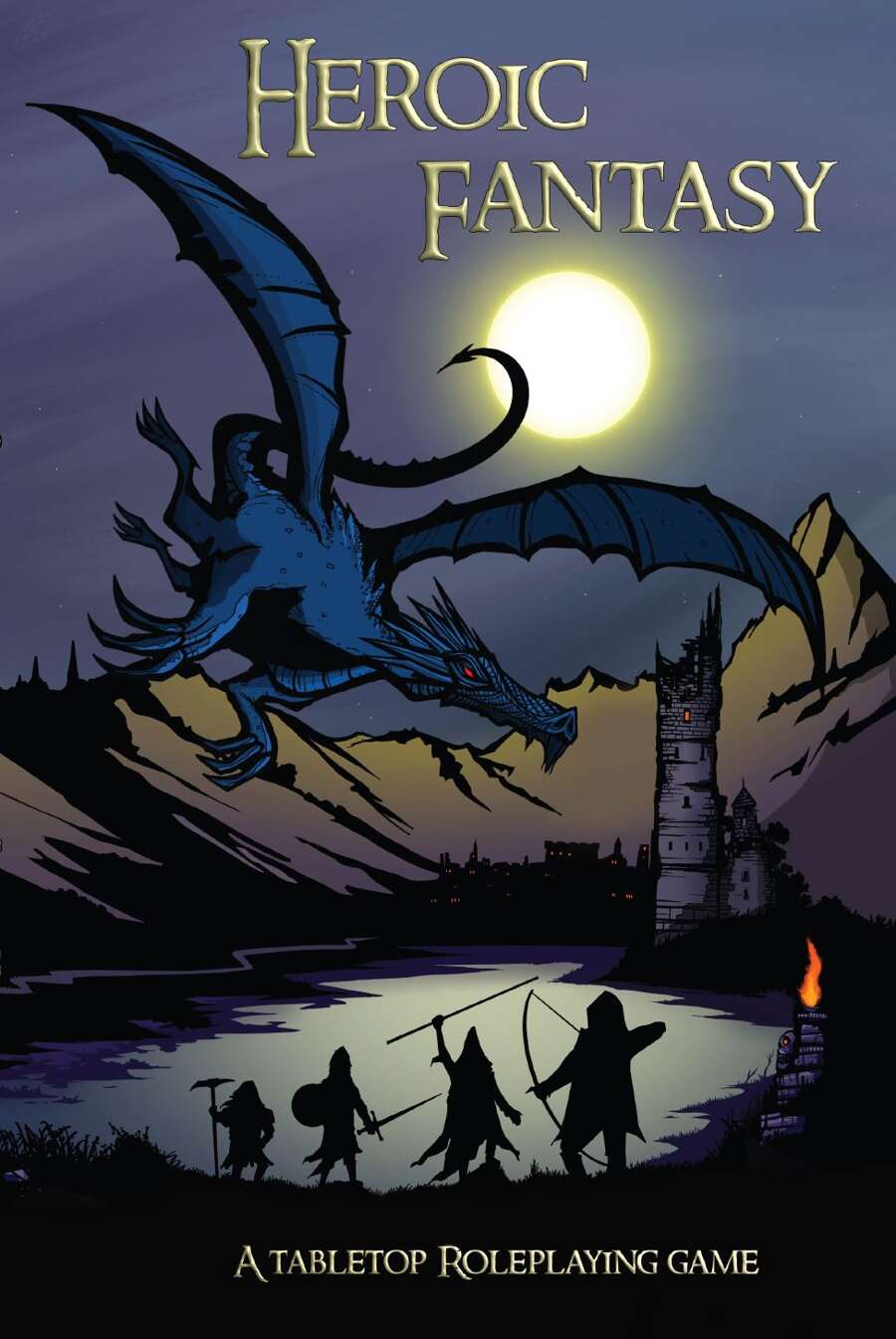
Thus, enter Dragonquest… I love to read games from back in the day, time capsules of early enthusiasm, confidence, and even heady arrogance. Who would then have thought of the voluminous divergence of today, or that this game would have such a limited published life? When you are in the midst of the text, all those future realities fall away; you are right there with the writers, in your leg warmers and flouncy shirt, as they put down the all encompassing RPG of the eternal future.
The three themes were:
- Classless – without the restrictions of a certain other game. The game leans into a more RQish openness with players able to choose pretty much everything from weapons, skills and magic, with inbuilt limitations from the implied setting
- A kind of verisimilitude by using creatures of our own legend and myth. Probably overstated, but the list is big enough from which extrapolation can build out any classic adversary.
- Flexible rules that you can add to without breaking the game. That seems right, not least because the rules are some thing of a patchwork that can be similarly patched without affecting existing similar rules. There is no ‘Charisma’ or ‘persuasion’ style ability, but a big reaction table (Rule 132), with a lot of hand wavium for modifiers to the reaction roll. I’d like to add a Characteristic for that, and the game is comfortable for me to do so.
The game is 40 years old, and it shows its age. There are many softer assumptions that wouldn’t fly today, but I’m not judging the game for being of its time. Here’s one on gender.
“[6.1] A player may always choose the gender of his character.
A character must be either male or female. Every race described in this section comprises only those two sexes. A character may only be hermaphroditic or asexual if his player receives special permission from the GM.
Each player should choose the sex of the character. It is recommended each character be the same sex as the player. Roleplaying a character whose entire gestalt is alien to the player is hard enough without a change of sex. If the player wishes a character of the opposite sex, the GM should warn him (or her) of the difficulties, and judge that player’s characterization as closely as anyone else’s.
The Physical Strength of a female character is decreased by two, but her Manual Dexterity and Fatigue are increased by one.
A character’s gender may be changed only through deep magic, or by a deity.“
There are other assumptions on play style and session length that probably don’t fit so well today, but make me want to run an all day game at home as if I were a student or retired. Wait…
There’s a very C&S ‘birthright and aspects’ section that plays into future skill checks and reactions which looks quite nice, though I’m not sure if there is much payback for remembering to apply the effects in play. You can be a shape changer, giant or an orc along with the other more usual heritages.
The game is purely a d10 based percentile resolution system for arracks, spellcasting and skill checks. Skills are a grouping of abilities that feel like ‘professions’ and only focus on ‘adventuring’, though even then with gaps that I think can be plugged with the Characteristic check rules. Healer encompasses a spiritual power as much as practical arts. Damage is a d10 with modifiers, as is a melee parry/reaction evasion. You’re encouraged to use a set of playing cards if you don’t have some d10 to hand.
Melee combat is played out tactically on a hex grid, to pick up ‘facing’ which provide chunky modifiers on to hit rolls. There are a number of small edge cases and procedures that need learning, but it looks highly playable and reasonably straightforward. Armour absorbs and damage can come off fatigue or endurance depending on the attack roll. There’s a deadly grevious wounds table as well to keep your character out of the action for weeks whilst recuperating. That’s OK though, as everyone likes to have up to six characters on the go, though you are advised to only play one at any one time, and interactions between your stable should be kept to a minimum.
Magic is well described with many arcane schools, in which you must become an adept to learn the talents, spells and rituals. This hones your choices and provides an in-game speciialisation. Magic backfire is certainly a thing, you are playing with fire.
Downtime is riven through the game. Either training for new ranks in abilities, or spells, or recuperating from injuries, all the while spending upkeep. Before long you will have blown your money and will need to get back out there, refreshed and slightly upgraded to face more terror and treasures.
Here’s the guidance on experience point rewards:
[160.1] The GM should make one set of Experience Point awards for every five hours of effective play during one session. The players are effectively playing their characters when the characters are attempting to complete a mission (i.e., discounting time spent by players in eating or arguing, or time spent by players on inconsequential activities).
The five hour measure of time is intended as a flexible guideline. If the GM runs an especially long play session, he will probably want to reward the players for their patience and sustained acting of their respective character parts. The totals listed in rule 160.2 are also intended as guides for awards given during an unfinished adventure.
Stop messing about and focus on being in character, you’re on the clock with five hour blocks.
I can’t help liking the game, as much as a curiosity of its time. There are borrowed innovations that set it apart from D&D, whilst the very few design gaps can be plugged with the encouraged additions a GM might wish to make. I’m probably beyond the point of no return to get this one to the table.
Would anyone play?